
Product analysis · Documentation-led · United States
PETLIBRO One RFID Smart Feeder solves a narrower job than a generic automatic feeder: one dedicated collar tag can unlock one feeder for one pet. That can help a household separate access, but it also creates hard requirements around dry food, tag acceptance, reader placement, power, cleaning, app use, and a human backup plan.
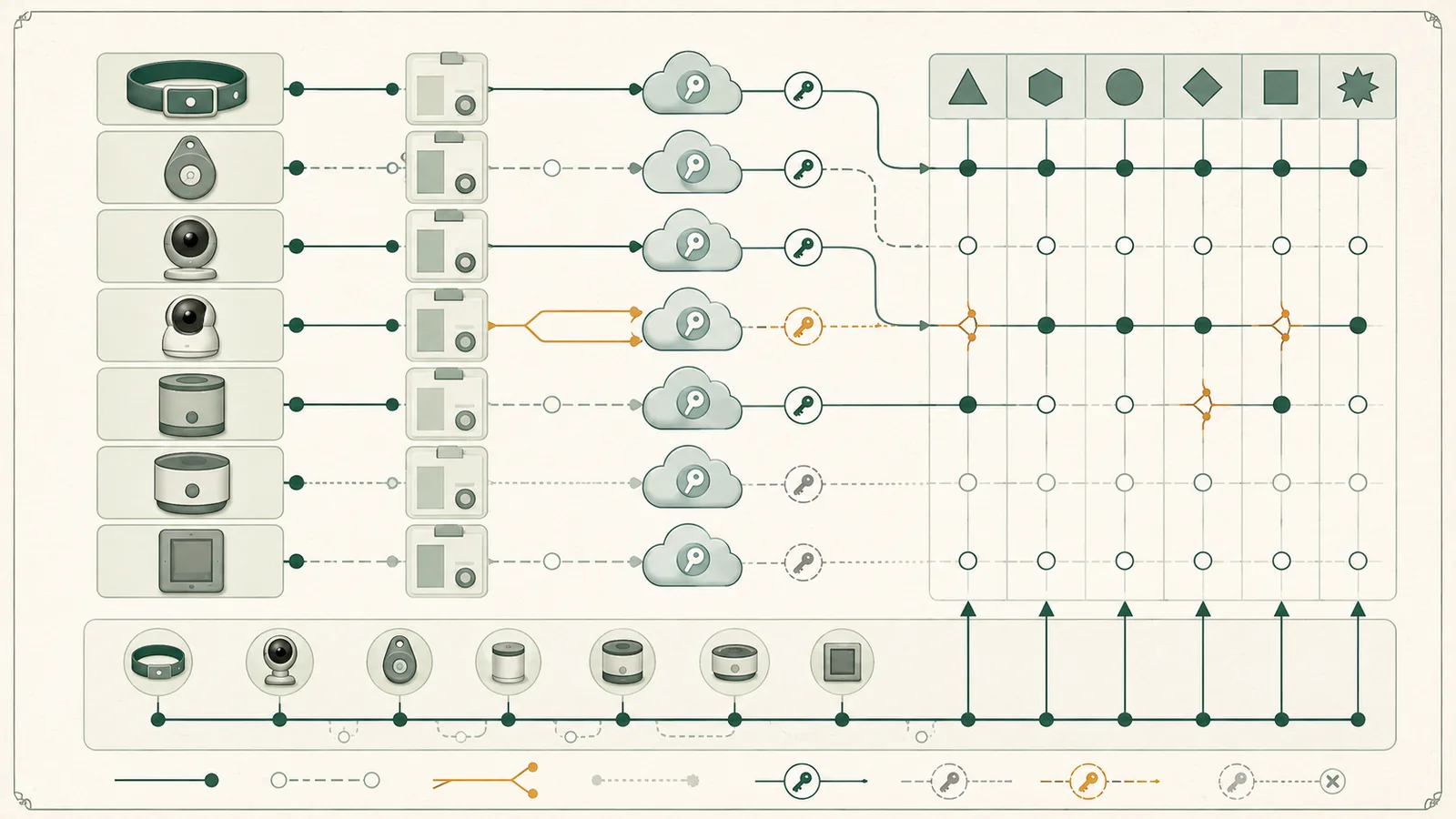
Quick answer
The PETLIBRO One RFID Smart Feeder is a plausible documentation fit for a household that needs selective access for one pet, uses dry kibble within the documented 2–15 mm range, and accepts a dedicated collar tag. It is a mismatch for implanted-microchip access, wet or refrigerated food, two pets sharing one selectively controlled station, full remote control on battery power, or outdoor use.
Its clearest documented advantage is a one-feeder/one-tag access architecture; its main limitation is that the household must still verify food flow, tag recognition, pet acceptance, stored schedules, cleaning, backup power, and an in-person fallback before relying on it.
Swipe horizontally to see all columns.
| Buyer requirement | Current documentation state | Decision implication |
|---|---|---|
| One-pet selective access | Dedicated tag and reader mat are documented | Conditional fit after exact-pet verification |
| Implanted microchip access | Not supported | Stop |
| Dry kibble, 2–15 mm | Documented range | Verify the exact food; shape and oiliness remain untested |
| Wet, refrigerated, or semi-moist food | Product is documented for dry food only | Stop |
| Stored meals during battery-only operation | Vendor says schedules continue while Wi-Fi is disabled | Conditional; run a supervised household test |
| Remote control while battery powered | Wi-Fi is documented as disabled | Stop |
| Outdoor operation | Vendor does not recommend it | Stop |
The architecture is a conditional documentation fit only when its one-tag, dry-food, indoor, supervised-verification, and backup-plan requirements all match the household.
Key facts
This page applies only to PETLIBRO One RFID Smart Feeder model PLAF301: a dry-food, one-feeder/one-dedicated-tag architecture that still requires exact-food, tag, placement, power, cleaning, app, and human-backup verification.
This analysis separates current vendor documentation from original method work. Product facts are first-party statements, not independent measurements. The original contribution is a deterministic elimination-and-cost method that keeps unknowns visible. Its synthetic tests validate logic; they do not validate the feeder.
Pet Signal Guide applies the same documentation, testing, unknown, conflict, and commercial-independence boundaries described in How We Research and Evaluate Pet Technology.
Swipe horizontally to see all columns.
| Evidence layer | Present? | What it can support | What it cannot support |
|---|---|---|---|
| Current official product and support pages | Yes | Exact identity, documented requirements, policies, and troubleshooting paths | Accuracy, reliability, pet fit, or real-world outcome |
| Authority guidance | Yes | General food handling, connected-device, and subscription diligence | Exact-product performance or safety certification |
| Reproducible decision method | Yes | Consistent elimination rules, integer-cent arithmetic, and unknown handling | A product score, winner, or recommendation |
| Hands-on feeder and app testing | No | Nothing | Dispensing, timing, tag recognition, outages, cleaning, alerts, or account behavior |
| Qualified specialist review | No | Nothing | Material feeding, nutrition, health, behavior, or safety conclusions |
Current documentation and deterministic logic can support bounded fit checks; they cannot establish product performance, pet fit, or specialist conclusions.
Exact product and box contents
This page applies only to PETLIBRO One RFID Smart Feeder model PLAF301. It does not transfer findings from PETLIBRO camera feeders, older Wi-Fi feeders, the RFID fountain, or another selective-access brand.
The current US product surface lists a 3-liter hopper, approximately 13 cups by the vendor’s description, a stainless-steel bowl and holder, a power adapter, one desiccant bag, bowl lid and shields, one collar, one RFID reader, and one tag. Three alkaline D batteries are an optional backup and are not included.
Swipe horizontally to see all columns.
| Field | Current documented state | Reader check |
|---|---|---|
| Model | PLAF301 | Confirm the delivered label and revision |
| Displayed hardware amount | USD 149.99 | Recheck stock, seller, tax, and checkout |
| Capacity | 3 L; vendor approximation of 13 cups | Confirm refill cadence with the exact kibble |
| Feeder dimensions | 442 × 196 × 320 mm | Measure station, lid clearance, and reader-mat area |
| Feeder weight | 2.80 kg | Check stability in the intended location |
| Wireless | 2.4 GHz and 5 GHz Wi-Fi | Verify the actual router and setup path |
| Mobile systems | Current US surface lists iOS 13+ and Android 7+ | Recheck current app-store compatibility |
Keep the exact PLAF301 identity, included parts, optional batteries, app requirements, and selective-access architecture separate from sibling PETLIBRO products.
Food and physical fit
The exact product documentation is for dry food only, with kibble diameter from 2 to 15 mm. That range is an elimination gate, not proof that every kibble inside it will dispense well. Shape, oil coating, crumbs, density, breakage, static, hopper loading, and food-path cleanliness can still matter.
A vendor portion-volume reference is not a feeding recommendation and does not convert cleanly into grams for every food. Meal quantity and schedule must come from the household’s existing plan or an appropriately qualified professional when the pet’s case requires one. A dispense log does not prove that the intended pet ate the food.
Swipe horizontally to see all columns.
| Check | Documentation | Why it still needs observation |
|---|---|---|
| Food form | Dry only | Wet, refrigerated, and semi-moist food are outside scope |
| Kibble diameter | 2–15 mm | Measure the exact product; shape and oiliness are not captured by diameter alone |
| Pet size and posture | Vendor says most cats and small dogs; tall pets may recognize poorly or not at all | No fit, posture, or comfort observation occurred |
| Reader-mat use | Required for recognition | Placement, connection, and pet approach must be checked in the home |
| Multiple stations | At least 10 inches apart | Household interference was not tested |
| Outdoor use | Not recommended | Environmental performance is not established |
Dry-food range and physical dimensions are eligibility gates, not proof of reliable dispensing, tag acceptance, or suitability for an individual pet.
How selective access works
The feeder does not read an implanted pet microchip. It uses the dedicated PETLIBRO collar tag and the supplied reader mat. The vendor’s pre-sale documentation describes one feeder syncing with one tag and the architecture as one feeder for one pet. A household with two pets that each need selective access therefore needs two feeder stations, not two tags paired to one station.
The included tag is documented at 4.2 g and does not require charging. The accessory page describes it as splashproof only – not submersible – and offers a snap-release collar and ring for another collar. Those are product statements, not a pet-wear, release-force, durability, chewing, comfort, or welfare test by Pet Signal Guide.
The same pre-sale record says the lid reopens briefly if another pet blocks closing and enters a failed-to-close state after repeated obstruction, with a notification after the third unsuccessful close. That workflow still requires household observation: a notification does not establish that access control worked correctly or that the intended pet ate.
Power and offline behavior
Primary power is the supplied adapter. In the vendor’s battery and offline documentation, three alkaline D batteries are emergency backup rather than the preferred sole power source. In battery-only mode, Wi-Fi and the reset button are disabled to extend runtime, while the vendor says the stored meal schedule continues normally. No battery-runtime, low-battery, timing, recovery, or reconnect test occurred here.
Swipe horizontally to see all columns.
| Condition | Documented expectation | Do not assume |
|---|---|---|
| Corded power and internet available | App-connected operation is in scope | Successful dispense, alert delivery, or eating |
| Home internet unavailable, corded power present | Stored/local behavior may continue within product design | Remote controls, app status, or notifications remain current |
| Battery-only operation | Basic schedule continues; Wi-Fi/reset disabled | Remote feed, remote monitoring, or full feature parity |
| Batteries depleted or absent | No backup power remains | A schedule can execute without power |
| Power returns | Recovery is possible | Time, schedule, account, Wi-Fi, and status are automatically correct |
Battery mode can preserve stored feeding while narrowing Wi-Fi and remote functions; household runtime and recovery still require supervised verification.
A defensible smart-feeder backup plan includes measured manual food, a bowl and measuring tool, written instructions, a named person who can enter the home, and a household-defined response window. That window is an operating threshold, not medical advice.
App, account, and sharing
The PETLIBRO app – currently distributed through the Apple App Store and Google Play – is part of remote feeding, schedule, status, and sharing workflows. Official sharing support documents inviting another registered email to device access. This package did not establish the exact current permission matrix, notification ownership, revocation effects, maximum current users, cached access, or a public exact-product MFA workflow.
Those unknowns matter. “Can invite someone” is not the same as “can restrict a sitter to one action,” “can see who changed a schedule,” or “can revoke every active session.” Before relying on shared access, a household should test a noncritical invitation, verify what the invited user can view or change, remove the user, and confirm that access actually ends.
The current privacy policy describes account information, location data among possible personal-information categories, access/export/deletion rights, an in-app deletion route, a device reset path, and a published product-support table. These are vendor policy statements, not a security audit or proof of implementation.
Cleaning and consumables
FDA guidance supports routine handwashing and bowl/utensil cleaning, plus cool, dry storage and retaining original packaging or lot information. Exact feeder instructions remain controlling for which components may be removed, rinsed, or placed in a cleaning device.
PETLIBRO’s pre-sale record says only the food bowl can be cleaned with cleaning devices. The exact cleaning support page applies parts-specific restrictions to the base, reader, and tag and requires dry reassembly. A clean-looking bowl does not establish that the rotor, outlet, lid area, reader connection, seals, or internal food path are ready.
One desiccant bag is included. PETLIBRO sells replacement bags, displays pack and recurring-purchase choices, and publishes an exact-model replacement suggestion. The selected pack quantity, home humidity, actual cadence, annual purchase count, and annual cost remain buyer-verified rather than being converted into a fixed recurring total.
Swipe horizontally to see all columns.
| Item | Current evidence | Owner verification |
|---|---|---|
| Stainless-steel bowl | Included; bowl is the part documented for cleaning devices | Follow current manual and dry before use |
| Base and electronics | Direct wetting is restricted | Keep electronics dry |
| RFID reader/mat | Required for selective access | Reconnect and verify recognition after cleaning |
| Tag | Splashproof only | Do not submerge; inspect attachment and condition |
| Rotor and outlet | Troubleshooting paths exist | Inspect for crumbs, oil, foreign matter, and blockage |
| Desiccant | One included; replacement product and vendor cadence exist | Verify pack, environment, cadence, and cost |
| Food traceability | FDA supports retaining product and lot information | Keep original bag or lot/best-by record |
Cleaning, consumables, tag care, and food traceability are recurring workflow requirements, not one-time setup details.
Failure modes to plan for
PETLIBRO publishes support paths for no dispense, rotor stuck, schedule failure, no power, firmware update failure, tag pairing, outlet blockage, red-exclamation status, and “feeding status unknown.” The existence of troubleshooting pages proves neither failure prevalence nor repair success.
Swipe horizontally to see all columns.
| Symptom | Documentation lead | Household action before reliance |
|---|---|---|
| No dispense | Power, food, outlet, rotor, cleaning, manual feed | Run observed manual and scheduled dispenses with exact food |
| Rotor stuck or outlet blocked | Rotor checks and outlet-blockage checks | Inspect only when safely powered down as instructed; reassemble dry |
| Meal not on schedule | Power, restart, interference, reset/reconnect | Verify time zone and every schedule after setup or reset |
| Tag not recognized | Pairing, mat connection, spacing, interference, tag state | Observe the exact pet’s approach; keep a manual fallback |
| Feeding status unknown | Status support path | Check bowl and pet in person; do not infer eating |
| Firmware update fails | Power, network, app, retry, support | Record current version; avoid assuming the update completed |
| Power or network loss | Battery and offline boundaries | Test recovery while supervised, then recheck time, schedule, and status |
Troubleshooting pages identify bounded checks; they do not establish failure prevalence, repair success, or reliable long-term operation.
Known cost and unknown cost
The current official display for the feeder is USD 149.99, with one tag included. A separately displayed PLTG001 tag is USD 14.99. A desiccant product page currently displays USD 25.99, but it also has pack and recurring-purchase choices, so that amount cannot become an annual consumable cost without selecting and verifying the exact option. For wider ownership-cost context, see the smart-feeder pricing and ownership-cost guide.
An unknown required cost is not zero. The useful comparison output is a known subtotal plus an explicit list of unknowns – not a false “total.”
Swipe horizontally to see all columns.
| Scenario | Known subtotal | Still unknown |
|---|---|---|
| Feeder with included tag and box contents | USD 149.99 | Tax, future change, replacement timing |
| Feeder plus one displayed spare tag | USD 164.98 | Tax, actual need, future change, replacement timing |
| Feeder plus one displayed desiccant purchase | USD 175.98 | Selected pack, annual count, tax, future change, replacement timing |
| Feeder, displayed spare tag, and displayed desiccant purchase | USD 190.97 | Selected pack, annual count, tax, future change, replacement timing |
| Two selectively controlled pet stations | USD 299.98 | Tax, station space/power, batteries, consumables, future change |
Known subtotals exclude unresolved tax, battery, consumable cadence, replacement, parts, and product-life assumptions; unknown required cost is not zero.
Current direct-site shipping documentation displays free standard shipping above USD 99 for the contiguous United States, but seller, destination, stock, taxes, and checkout must be verified. Battery price, desiccant cadence, tag replacement, parts, and product-life timing remain outside the base subtotal unless the buyer has current evidence.
Privacy, updates, and support period
A connected feeder is more than its hopper and motor. It can include firmware, app, account, cloud services, household sharing, notifications, support, reset, and deletion workflows. The current vendor policy lists PLAF301 in a security-support table through December 31, 2027. Treat that as a current vendor statement, not an independent guarantee that every update, vulnerability, app version, cloud service, or feature will remain available until that date.
Before purchase, confirm the current support entry and app compatibility. After setup, record firmware/app versions, use a unique account password, review app permissions, test sharing and removal, understand account deletion versus device reset, and save the current support route. No security, privacy, account-deletion, or firmware workflow was executed for this article.
Returns and warranty boundaries
Current direct-purchase surfaces display a 30-day return path and a 24-month warranty label. Eligibility depends on the seller, original packaging and accessories, proof, product condition, exclusions, timing, and the current return policy. Return shipping can affect the refund in non-malfunction cases. No return, refund, replacement, or warranty claim was attempted.
Keep the box, tag, collar, reader, shields, adapter, manuals, and purchase record until the household has completed fit, food, schedule, recognition, outage, cleaning, app, and pet-acceptance checks. A policy window is not a promise that a specific claim will be accepted.
Documentation-fit method
The retained method starts with elimination rather than scoring. It stops scenarios that conflict with exact product documentation and keeps unknown required costs visible. A surviving result is always conditional because no physical or account testing occurred and the roadmap’s specialist-review target is unmet.
- Verify exact model and current US sale/support state.
- Eliminate non-dry food and kibble outside 2–15 mm.
- Eliminate implanted-microchip, third-party-tag, or two-pets-one-feeder requirements.
- Check acceptance of the reader mat and dedicated tag.
- Check power, offline, remote-control, indoor-use, and cleaning requirements.
- Check app/account, sharing-permission, MFA, and support-horizon requirements.
- Add only current displayed costs explicitly selected by the buyer.
- Keep tax, consumable cadence, battery amount, future changes, and replacement timing unknown until verified.
- Return either a conditional documentation fit or a stop – never a winner or recommendation.
The synthetic validation suite covers valid scenarios, invalid-input rejection, deterministic property cases, stable hashes, integer-cent arithmetic, unknown-not-zero behavior, and non-ranking output. It does not test the product.
First-week verification plan
Do not begin with an unattended critical schedule. Use a supervised verification period with the exact food, pet, tag, station, network, and backup person.
- Inventory: confirm model, reader mat, tag, collar, bowl, shields, adapter, desiccant, manuals, and return deadline.
- Measure food: confirm dry form and kibble diameter; retain the original bag and lot/best-by information.
- Place the station: keep it dry, stable, indoors, with lid clearance and required spacing from another RFID station.
- Observe recognition: verify the exact pet can approach, open, eat, and leave without another pet gaining access.
- Verify dispense: run manual and scheduled dispenses; inspect the bowl rather than relying only on app status.
- Verify time and schedule: check time zone, every meal, and behavior after a restart.
- Test backup safely: install the exact alkaline D batteries if relied on, then observe the household’s offline/recovery workflow while present.
- Test access: invite a noncritical second account, inspect permissions and notifications, remove it, and confirm removal.
- Clean and reassemble: follow current exact-model instructions, dry fully, reconnect the reader, and repeat recognition/dispense checks.
- Prepare manual fallback: measured food, bowl, tool, written schedule, named caregiver, home access, and support information.
Who this architecture may fit
Potential documentation fit: one cat or small dog using dry kibble within the documented range; one-pet selective access is valuable; the household accepts the dedicated collar tag, reader mat, indoor station, app/account, visible unknown costs, and supervised verification.
Likely stop: implanted microchip access is required; two pets must share one selective-access station; the food is wet, refrigerated, or semi-moist; remote control must work on battery alone; outdoor operation is required; all food-path components must be documented for cleaning devices; current public exact-product MFA or a complete caregiver permission matrix is a hard requirement.
To compare this dedicated-tag design with a schedule-driven nonselective feeder, use the RFID feeder versus timed feeder comparison.
If camera monitoring is also a requirement, compare a feeder-camera combo with separate devices before treating that separate decision as a reason to select this feeder.
Needs professional planning before reliance: any case involving therapeutic food, medication timing, diabetes, growth, pregnancy, illness, recovery, weight management, appetite monitoring, or another feeding-sensitive condition. This article does not define portions, meal timing, escalation thresholds, or medical suitability.
What remains unverified
- dispensing accuracy, timing accuracy, jam rate, and long-term reliability;
- tag-recognition rate, interference tolerance, pet comfort, lid behavior, and access-control success;
- battery runtime, outage behavior, alert delivery, reconnect behavior, and schedule recovery;
- app permissions, sharing limits, revocation, notifications, MFA, deletion, and firmware updates;
- cleaning difficulty, drying time, residue, hygiene outcome, and reassembly error;
- support response, repair quality, return acceptance, and warranty outcome;
- whether the intended pet consumed the intended amount;
- any material feeding, health, behavioral, or safety conclusion requiring specialist review.
No score, rank, winner, reliability verdict, feeding-suitability verdict, safety verdict, or recommendation is supported by this package.
Sources
- Proper Storage of Pet Food & Treats – U.S. Food and Drug Administration. Checked July 27, 2026. General pet-food storage, packaging, lot-retention, and cleaning guidance; not exact-feeder performance evidence.
- Tips for Safe Handling of Pet Food and Treats – U.S. Food and Drug Administration. Checked July 27, 2026. General pet-food handling and bowl/utensil cleaning guidance; not individualized veterinary or nutrition advice.
- Profile of the IoT Core Baseline for Consumer IoT Products – NIST. Checked July 27, 2026. Consumer-IoT product-system framing; not a feeder certification, security audit, or reliability finding.
- Securing Your Internet-Connected Devices at Home – Federal Trade Commission. Checked July 27, 2026. General connected-device, router, account, and update guidance; not exact-product implementation evidence.
- Getting In and Out of Free Trials, Auto-Renewals, and Negative Option Subscriptions – Federal Trade Commission. Checked July 27, 2026. General trial, renewal, and cancellation diligence; not product-specific legal advice.
- How We Research and Evaluate Pet Technology – Pet Signal Guide. Checked July 27, 2026. Sitewide evidence and commercial-independence method.
- One RFID Smart Feeder – PETLIBRO. Checked July 27, 2026. Exact PLAF301 identity, current hardware display, capacity, dimensions, dry-food range, tag, power, connectivity, and box contents; no checkout or use test.
- Pre-sale Inquiries About One RFID Feeder – PETLIBRO. Checked July 27, 2026. Dedicated-tag, one-pet-per-feeder, lid-close, remote-feed, battery-only, pet-height, cleaning-device, and outdoor-use statements; no controlled observation.
- One RFID Smart Feeder Battery and Offline FAQ – PETLIBRO. Checked July 27, 2026. Battery-backup, Wi-Fi-disabled battery mode, schedule execution, tag, shipping, and warranty statements; no outage or runtime test.
- How Do I Disassemble and Clean the One RFID Pet Feeder? – PETLIBRO. Checked July 27, 2026. Exact PLAF301 parts-specific wetting, disassembly, drying, and reassembly guidance; no hygiene outcome test.
- What Can I Do If My One RFID Feeder Does Not Dispense Food? – PETLIBRO. Checked July 27, 2026. Power, food, outlet, rotor, cleaning, and manual-dispense troubleshooting; no incidence or repair-success rate.
- One RFID Feeder Rotor Stuck Error – PETLIBRO. Checked July 27, 2026. Rotor-stuck troubleshooting; no failure prevalence or independent repair outcome.
- One RFID Feeder Schedule Troubleshooting – PETLIBRO. Checked July 27, 2026. Power, restart, interference, reset, and reconnection workflow; no timing measurement or executed troubleshooting.
- One RFID Feeder Will Not Boot or Stops Working – PETLIBRO. Checked July 27, 2026. Power-source troubleshooting; no electrical measurement or failure rate.
- Unable to Update One RFID Feeder Firmware – PETLIBRO. Checked July 27, 2026. Firmware-update troubleshooting; no update execution or support-lifetime guarantee.
- Pair the Collar Tag With the One RFID Feeder – PETLIBRO. Checked July 27, 2026. Dedicated-tag pairing and interference checks; no pet-wear, access-control, or recognition-rate test.
- One RFID Feeder Food Outlet Blockage – PETLIBRO. Checked July 27, 2026. Food-outlet blockage checks from an official localized support record; no independent outcome.
- One RFID Feeder Red Exclamation Mark – PETLIBRO. Checked July 27, 2026. Status/notification troubleshooting; no executed app workflow.
- One RFID Feeder Feeding Status Unknown – PETLIBRO. Checked July 27, 2026. Feeding-status interpretation boundary; no proof that food was dispensed or consumed.
- Share One RFID Feeder Device Access – PETLIBRO. Checked July 27, 2026. Invitation workflow by registered email; exact permissions, revocation effects, notification ownership, and maximum current users were not executed.
- RFID Collar Tag – PETLIBRO. Checked July 27, 2026. PLTG001 identity, current USD display, PLAF301 compatibility, dimensions, weight, no charging, and splash-proof boundary; no pet-wear test.
- PETLIBRO Pet Food Desiccant Bag – PETLIBRO. Checked July 27, 2026. Displayed package amount, pack selector, recurring-purchase offer, and model compatibility; selected pack, cadence, and annual cost remain buyer-verified.
- How Often Should I Replace the Desiccant Bag for One RFID Feeder? – PETLIBRO. Checked July 29, 2026. Exact-model vendor replacement suggestion; environment, selected pack, and actual consumption were not tested.
- Privacy Policy – PETLIBRO. Checked July 27, 2026. Vendor data, rights, deletion, reset, and support-period statements; not an independent privacy/security audit or future guarantee.
- Return Policy – PETLIBRO. Checked July 27, 2026. Direct-purchase conditions, proof, exclusions, seller route, and warranty labels; no return or warranty transaction.
- Subscription Service Terms – PETLIBRO. Checked July 27, 2026. Recurring-service terms and cancellation framing; no subscription was activated and exact selected recurring purchase remains unknown.
- Shipping Policy – PETLIBRO. Checked September 21, 2026 for the shipping threshold; other package fields retain their recorded July 27, 2026 check. Current direct-site contiguous-US thresholds and timing; seller, destination, tax, stock, and checkout remain transaction-specific.
- PETLIBRO Help Center – PETLIBRO. Checked July 27, 2026. Current support route; not response-time, repair-quality, support-success, or future-availability evidence.
- Contact PETLIBRO – PETLIBRO. Checked July 27, 2026. Current vendor contact route; no support interaction or response-time observation.
- PETLIBRO App for iOS – PETLIBRO / Apple App Store. Checked July 29, 2026. Current app-distribution surface; no account, permissions, notification, remote-feed, or reliability workflow was executed.
- PETLIBRO App for Android – PETLIBRO / Google Play. Checked July 29, 2026. Current United States Android app-distribution surface; no account, permissions, notification, remote-feed, or reliability workflow was executed.
- How Much Is in One Feeding Portion? – PETLIBRO. Checked July 27, 2026. Vendor portion-volume context across models including PLAF301; no food-specific weight measurement and no individualized feeding recommendation.