
Product analysis · Documentation-led · United States
PetSafe Smart Feed Gen 2 is a large timed hopper feeder with app scheduling, optional backup batteries, and an optional equal-output two-pet splitter. Its strongest documented use case is routine dry-food scheduling in a household that accepts app, power, network, cleaning, and human-backup dependencies. It is not an identity-selective feeder, and the current exact records do not establish one consistent semi-moist-food rule.
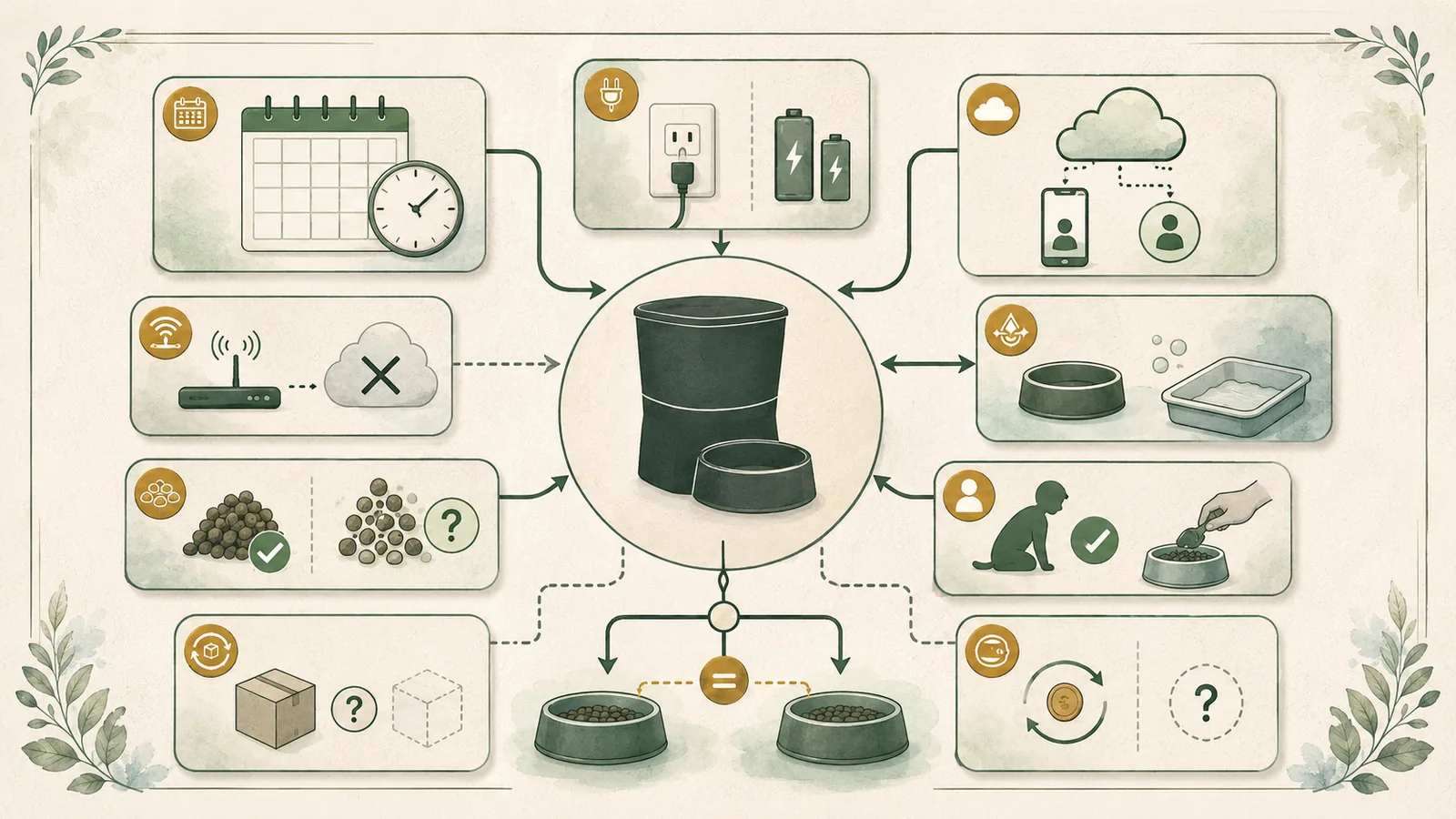
Quick answer
PetSafe Smart Feed Gen 2 is a plausible documentation fit for a household that wants a timed dry-food hopper, needs no more than twelve scheduled meals, accepts a vendor app and account, can keep the feeder on AC power, and maintains a written manual fallback; it is a direct mismatch when the buyer needs identity-selective access, independently proven portion accuracy, wet or refrigerated food, notifications or remote control during an internet outage, or long unattended battery-only operation.
The most important unresolved issue is food scope: the current product page says dry and semi-moist food, but the exact-model 2019 guide conflicts between dry-only language and a later dry-or-semi-moist instruction, so this analysis treats semi-moist use as unresolved rather than selecting the more permissive statement.
Swipe horizontally to see all columns.
| Buyer requirement | Documentation state | Decision implication |
|---|---|---|
| Dry food and timed hopper | Supported within stated settings | Plausible documentation fit; verify with actual food |
| Semi-moist food | Official records conflict internally and across surfaces | Stop until exact current reconciliation |
| Wet or refrigerated food | Outside retained scope | Direct mismatch |
| Identity-selective access | Not documented | Direct mismatch |
| Scheduled feeding while internet is down | Vendor says stored schedule continues if powered | Conditional; alerts and remote control are separate |
| Notifications while offline | Vendor says no notifications while offline | Direct mismatch |
| Long unattended battery-only use | Backup only; short, use-dependent guidance | Do not treat as independence |
Use this table to rule out hard mismatches first; a conditional fit still requires verification with the household’s exact food, power, network, and fallback plan.
Key facts
- Access
- Public documentation only
- Exact model
- PetSafe Smart Feed Automatic Dog and Cat Feeder, 2nd Generation, PFD00-16828
- Current evidence
- Reproducible documentation method, cross-source synthesis, and current official facts
- Specialist review
- Not performed
- Commercial relationship
- No monetized outbound link, sponsored placement, retailer call to action, or commission-based inclusion
The analysis follows the public Pet Signal Guide research method. Synthetic tests validate deterministic logic and integer-cent arithmetic only. They are not feeder tests.
Exact product and box contents
This page applies only to the second-generation Smart Feed identified as PFD00-16828. Support records also reference an earlier PFD00-15788 model, but this package does not transfer a model-specific claim unless the retained current documentation explicitly covers both generations.
Swipe horizontally to see all columns.
| Field | Current documented value | Qualification |
|---|---|---|
| Displayed hardware amount | $134.99 | Current US display; not completed checkout |
| Capacity | 24 cups | Vendor capacity, not independently measured usable volume |
| Schedule ceiling | Up to 12 meals daily | Setting, not observed timing accuracy |
| Portion settings | 1/8 cup to 4 cups | Selectable values, not measured output accuracy |
| Network | 2.4 GHz Wi-Fi | Remote functions also depend on phone, account, internet, app, and vendor service |
| Primary power | Included AC wall adaptor | Four D-cell alkaline batteries are optional backup and not included |
| Current app baseline | iOS 12+ and Android 9+ | Older exact guide lists lower versions; recheck before purchase |
The documented numbers describe selectable settings and included parts, not measured performance or a completed checkout.
The current PetSafe product page lists the feeder, stainless-steel bowl, bowl holder, wall adaptor, app access, and quick-start guide. Four D-cell alkaline batteries are optional and are not included. A displayed hardware amount is not proof of inventory, tax, delivery, or final checkout.
Food, schedule, and portion limits
The schedule and portion ranges help eliminate an obvious mismatch, but they do not prove dispensing accuracy with the household’s exact food. Food shape, fill level, debris, priming, conveyor alignment, and wear can affect output. PetSafe’s incorrect-amount troubleshooting record identifies low food, a feeder that was not primed, debris, and conveyor misalignment as possible contributors.
Swipe horizontally to see all columns.
| Question | Documented answer | Not established |
|---|---|---|
| Dry food? | Supported by current page and exact guide | Fit with the exact food shape and flow |
| Semi-moist food? | Current page says yes; exact guide contains contradictory dry-only/no-moist and dry-or-semi-moist statements | A single reliable exact-model rule |
| Wet or refrigerated food? | Not supported in retained scope | Food-safety or medical suitability |
| Meals per day? | Up to 12 | That the intended pet ate each meal |
| Portion setting? | 1/8 cup to 4 cups | Measured accuracy by food, fill level, wear, or environment |
| Slow Feed? | Meals over 1/8 cup spread over 15 minutes | A behavioral or health benefit for a particular pet |
Dry food is within the retained scope, but semi-moist use remains unresolved and no setting proves nutritional suitability or dispensing accuracy.
Power and offline behavior
The feeder is designed around AC power with an optional four-D-cell backup. PetSafe’s offline-feeder guidance describes the stored schedule as continuing while the feeder is offline if it still has power. Its notification guidance says an offline feeder does not send notifications. Remote changes and feed commands therefore remain dependent on the app, account, internet path, and vendor service.
Swipe horizontally to see all columns.
| Condition | Feeding schedule | App/alerts | Reader action |
|---|---|---|---|
| AC power + internet | Documented routine path | Remote functions available subject to current service | Verify schedule, time zone, notifications, and actual output |
| AC power + internet outage | Stored schedule described as continuing | No offline notifications; remote control unavailable | Use human verification rather than assuming status |
| Battery backup | Scheduled feeding described for short backup use | Connectivity behavior is limited | Treat as bridge, not long unattended power |
| No power | No documented dispensing path | No remote recovery | Use the manual fallback immediately |
| Factory reset | Programming erased | Setup required again | Re-enter and verify every schedule |
Stored schedules may continue through an internet outage when power remains, but alerts and remote control do not; battery operation is a short backup, not independence.
A separate power-support record says battery-powered operation may require battery changes every seven days or less depending on use, while setup documentation uses “up to seven days.” Those statements are vendor guidance, not a measured runtime result. Temperature, battery brand, schedule, motor load, age, and maintenance may change actual behavior.
Use the smart-feeder backup-plan checklist to separate power, network, food, caregiver, and manual-feeding fallbacks before relying on an automated schedule.
App, account, and household access
The current product page and support hub describe My PetSafe app scheduling and access from multiple smartphones. The documented household-member workflow uses a nickname and email invitation. However, bounded public research did not establish a complete exact-product permission matrix, notification ownership, revocation effects, current MFA workflow, session handling, or cached-data behavior.
Swipe horizontally to see all columns.
| Control | Documented | Unknown or untested |
|---|---|---|
| App/account | Required for remote management | Current account-recovery and MFA behavior for this exact workflow |
| Household invitation | Nickname + email invitation documented | Exact roles, edit scope, notification ownership, and revocation effects |
| Activity log | Exact 2019 guide says two weeks | Current retention, export, deletion, and account-specific access |
| Feed Now | App and device button documented | Latency, duplicate commands, or outcome under unstable connectivity |
| Notifications | Food and feeder notifications documented | Delivery latency, missed pushes, permission conflicts |
| Device deletion/reset | App deletion and factory reset paths exist | Full cloud-data deletion and ownership-transfer behavior |
Multiple-phone access does not establish fine-grained roles, notification ownership, secure recovery, or complete data deletion.
Do not share a primary password merely because multiple phones can control the feeder. Use separate invitations where the current app supports them, document who has access, and verify removal after a caregiver no longer needs it.
Cleaning and reassembly
PetSafe’s current cleaning guidance says removed components should be washed with warm soapy water, rinsed, and dried thoroughly before reassembly. The base must not get wet. The conveyor and crumb catcher are not dishwasher safe. A separate setup page labels the hopper, lid, bowl, and holder dishwasher safe while directing the conveyor to hand washing.
Swipe horizontally to see all columns.
| Part | Documented cleaning boundary | Verification after reassembly |
|---|---|---|
| Bowl | Dishwasher safe | Dry and seat correctly |
| Bowl holder | Dishwasher safe in setup guidance | Attach under feeder securely |
| Hopper and lid | Dishwasher safe in setup guidance | Dry, latch, and confirm auger position |
| Conveyor | Hand wash with warm water | Align belt lip with arrows and lock red latch |
| Crumb catcher | Not dishwasher safe | Reinstall in conveyor |
| Base/electronics | Do not get wet | Inspect power connection and perform supervised manual dispense |
| Food and lot record | Keep current food identification | Record lot/best-by for complaint or recall traceability |
Cleaning is component-specific: keep the base dry, hand-wash the conveyor, and verify reassembly with a supervised dispense.
Cleaning instructions are component-specific. “Top-rack dishwasher safe” on the product page does not mean the whole feeder can be put in a dishwasher. A cleaning record also does not prove hygiene, long-term reliability, or suitability for a particular food.
Multi-pet use and the meal splitter
The optional meal splitter divides one scheduled output between two bowls. It does not identify pets, lock either bowl, verify equal consumption, or prevent one animal from eating both portions. On July 30, 2026, the current product surface and accessory listing both displayed $21.99. That agreement supports a dated displayed amount only; it does not establish inventory, checkout, tax, shipping, output equality, or pet behavior.
A household needing selective access should not substitute an equal-output splitter for an RFID or microchip-controlled architecture. Where two pets can safely share simultaneous access under an existing household plan, supervised setup should verify bowl placement, kibble size, output division, pet behavior, and the effect of the privacy panel.
Failure modes to plan for
PetSafe’s current troubleshooting records cover an offline feeder, missing notifications, incorrect amounts, meal timing, reboot or reset behavior, and a feeder that will not power on. These records document possible symptoms and checks; they do not reveal failure prevalence, long-term reliability, or the probability that a step will fix the problem.
Swipe horizontally to see all columns.
| Symptom | Documentation-led checks | What still needs human verification |
|---|---|---|
| Feeder offline | Home internet, 2.4 GHz network, router, app reinstall, reboot/reset | Whether the stored schedule and actual bowl output continue |
| No notification | Offline state, app switches, phone notification permissions | Whether a meal actually dispensed or was consumed |
| Wrong amount | Food level, priming, debris, conveyor alignment | Measured output with current food |
| Wrong time | Time zone, router proximity, reboot | Clock and actual dispense timing over multiple cycles |
| No power | Cord, outlet, generation, battery state | Safe manual fallback and in-person feeding |
| Jam/mechanical error | Food path, cleaning, alignment, support route | Whether the feeder can be relied on again |
| After factory reset | All programming erased | Schedule, amount, time zone, notifications, and caregiver access re-entered |
Troubleshooting documentation suggests checks, but only human verification can establish whether food actually dispensed and reached the intended pet.
A dispense or activity record does not prove that the intended pet ate the food. An alert does not prove food reached the bowl. A caregiver, camera, scale, or direct observation may provide additional context, but none should be represented as a medical conclusion.
If visual monitoring is part of the fallback, compare a feeder-camera combination with separate devices before treating either architecture as proof that a meal was eaten.
Known and unknown costs
The current direct hardware display is $134.99. The retained accessory displays are $5.99 for a replacement bowl, $8.99 for a bowl holder, and $21.99 for the replacement adaptor in the accessory listing. The current splitter product surface and accessory listing both displayed $21.99 when checked on July 30, 2026. These are dated vendor displays, not proof of stock or completed checkout. An unknown required cost is not zero.
Swipe horizontally to see all columns.
| Scenario | Known subtotal | Excluded or unknown |
|---|---|---|
| Hardware only | $134.99 | Tax, transaction-specific shipping, future replacement |
| Hardware + spare bowl | $140.98 | Tax, shipping, future replacement |
| Hardware + bowl holder | $143.98 | Tax, shipping, future replacement |
| Hardware + spare adaptor | $156.98 | Tax, shipping, future replacement |
| Hardware + bowl + holder + adaptor | $171.96 | Tax, shipping, batteries, future replacement |
| Hardware + splitter | $156.98 | Tax, shipping, stock, future replacement |
| Two independent feeder stations | $269.98 | Tax, shipping, batteries, future replacement |
| Hardware + reader-declared $20 batteries | $154.99 | Battery replacement count, tax, shipping, future replacement |
Known subtotals exclude material unknowns such as tax, shipping, battery replacement, and product life; unknown does not mean zero.
No scenario includes a subscription because the retained exact product does not require one for its core app workflow. That does not make ownership cost complete: batteries, replacements, delivery, tax, internet, phone, support outcome, and product life remain outside these known subtotals.
For a broader ownership-cost framework, compare these exact-product figures with the smart-feeder pricing and total-cost guide.
Privacy, security, and support lifecycle
The PetSafe privacy policy describes data categories, business purposes, rights, security limitations, and contact routes at a company/site/app level. It does not prove the security of this feeder, the app, the home network, or a particular account. NIST and FTC materials are used only to frame verification questions around updates, accounts, routers, data, and support – not to certify the product.
Bounded public research did not establish an exact public support-end date for PFD00-16828, a current exact-product MFA workflow, a role matrix for household members, or a public vulnerability-disclosure record tied to this feeder. These remain material unknowns rather than automatic failures or passes.
Returns and warranty boundaries
PetSafe’s US direct-purchase return and warranty policy currently describes a 45-day return window subject to conditions, non-refundable shipping charges, prepaid return freight, original condition and packaging, and seller-specific handling. The same policy describes a one-year non-transferable limited warranty for qualifying purchases from authorized sellers. A retailer purchase, used item, unauthorized seller, individual claim, or future policy may differ.
Record the seller, receipt, delivery date, exact model, serial or order information, and packaging before a problem occurs. This page does not predict the result of a return, support case, replacement, or warranty claim.
Documentation-fit method
The retained method asks the buyer to declare food type, schedule, portion setting, access requirements, outage expectations, battery plan, cleaning requirement, account tolerance, household permission needs, selected accessories, unknown-cost tolerance, and a known-cost ceiling. It returns only conditional or stop.
A conditional result means the documentation does not show an immediate hard mismatch after preserving every unknown. It is not a recommendation, reliability result, safety conclusion, privacy verdict, feeding plan, or specialist opinion.
First-week verification plan
- Confirm exact model and current app compatibility.
- Use dry food while the semi-moist documentation conflict remains unresolved.
- Clean, fully dry, and reassemble exact parts according to current instructions.
- Prime the conveyor after filling or when food gets low.
- Compare several actual outputs against the intended setting without treating a small sample as a reliability study.
- Verify time zone, schedule, Feed Now, notifications, and low-food behavior.
- Simulate loss of internet only when a human is present and a manual meal is immediately available.
- Test battery backup under supervision; do not infer future runtime from one test.
- Confirm each household member’s practical permissions and remove a test invitation.
- Keep measured backup food, a bowl, instructions, and a reachable caregiver outside the automated path.
Who this architecture may fit
It may fit a household that wants a high-capacity timed dry-food hopper, accepts the My PetSafe app and account, uses 2.4 GHz Wi-Fi for remote features, can provide continuous AC power, treats batteries as short backup, performs parts-specific cleaning, and keeps a human fallback.
It is not a documentation fit when identity-selective access is required, the household rejects an app/account, the exact food is wet or refrigerated, semi-moist use cannot wait for manufacturer reconciliation, exact portion accuracy is a hard condition, the entire food path must be dishwasher safe, offline notifications are mandatory, or long battery independence is required.
To compare this schedule-driven nonselective design with a dedicated-tag feeder, use the RFID feeder versus timed feeder comparison.
What remains unverified
- Current exact-model resolution of the semi-moist-food conflict.
- Measured portion and timing accuracy with real foods and changing hopper levels.
- Jam rate, motor life, product life, and long-term reliability.
- Actual battery runtime and connectivity behavior under outages.
- Notification latency, cloud uptime, app permissions, MFA, roles, revocation, and deletion behavior.
- Splitter output equality and pet behavior.
- Cleaning outcome, odor, residue, wear, and correct reassembly over time.
- Pet acceptance, access, consumption, comfort, health, and feeding suitability.
- Support, return, warranty, and replacement outcomes.
- Tax, checkout, battery, product-life, and future replacement cost.
No product access, controlled test, or specialist review occurred. A future evidence upgrade must retain exact model, food, environment, account, firmware, observation timestamps, protocol, failures, and negative results.
Sources
- U.S. Food and Drug Administration – Proper Storage of Pet Food & Treats. General food storage and lot-traceability guidance; not feeder performance evidence.
- U.S. Food and Drug Administration – Tips for Safe Handling of Pet Food and Treats. General handling and bowl/utensil cleaning guidance; not individualized nutrition or veterinary advice.
- NIST – Profile of the IoT Core Baseline for Consumer IoT Products. Consumer-IoT product-system framing; not a feeder certification or security audit.
- Federal Trade Commission – Securing Your Internet-Connected Devices at Home. General account/router/update guidance; not exact-product implementation evidence.
- Federal Trade Commission – Getting In and Out of Free Trials, Auto-Renewals, and Negative Option Subscriptions. General US trial and renewal diligence; not product-specific legal advice.
- Pet Signal Guide – How We Research and Evaluate Pet Technology. Sitewide evidence and commercial-independence method.
- PetSafe – Smart Feed Automatic Dog and Cat Feeder, 2nd Generation. Exact model, displayed price, current feature and box-content claims; no checkout or use test.
- PetSafe – Smart Feed Automatic Dog and Cat Feeder, 2nd Generation Support Hub. Support index and product framing; marketing superiority language is excluded.
- PetSafe – Smart Feed PFD00-16828 Quick Start Guide. Exact-model PDF; internally inconsistent food language and older app requirements; no current implementation test.
- PetSafe – Set up the Smart Feed Automatic Dog and Cat Feeder, 1st and 2nd Generation. Setup, cleaning, battery and schedule guidance; some steps cover both generations.
- PetSafe – My PetSafe Smart Feed Automatic Pet Feeder is Offline. Vendor-described offline schedule behavior; no outage test or uptime evidence.
- PetSafe – Smart Feed Not Sending Notifications. Notification troubleshooting and offline limitation; no delivery-latency test.
- PetSafe – Disassemble and Clean the Smart Feed Automatic Pet Feeder. Parts-specific washing/drying restrictions; no hygiene or reliability outcome test.
- PetSafe – Smart Feed Is Not Dispensing the Correct Amount of Food. Possible causes and checks; no incidence or measured accuracy data.
- PetSafe – Smart Feed Is Not Dispensing Meals on Time. Time-zone and connection checks; no timing-accuracy measurement.
- PetSafe – Reboot or Reset the Smart Feed Automatic Pet Feeder. Reboot versus factory-reset behavior; no recovery-success rate.
- PetSafe – Smart Feed Automatic Pet Feeder Will Not Power On. Power checks and battery replacement warning; no runtime test.
- PetSafe – What Is Slow Feed and How Do I Use It. Vendor-described 15-minute setting; no behavioral or health benefit established.
- PetSafe – Assemble the Smart Feed Automatic Pet Feeder. Assembly and alignment steps; no post-assembly performance evidence.
- PetSafe – Install the 2-Pet Meal Splitter. Equal-output splitter installation; no identity-selective access or consumption control.
- PetSafe – Add Another Household Member to the My PetSafe App. Invitation flow; exact Smart Feed permissions, revocation effects and notification ownership remain untested.
- PetSafe – Privacy Policy. Company/site/app privacy notice; not a security audit or exact Smart Feed data-flow test.
- PetSafe – Return & Warranty Information. Direct-purchase return and limited-warranty terms; retailer and claim outcomes can differ.
- PetSafe – Shipping Policy. US seller-specific shipping thresholds and timing; checkout remains authoritative.
- PetSafe – Stainless-Steel Bowl. Displayed accessory amount and compatibility; not checkout or necessity evidence.
- PetSafe – Smart Feed Replacement Bowl Holder. Displayed accessory amount and compatibility; not checkout or necessity evidence.
- PetSafe – Fountain and Feeder Filters & Accessories. Current accessory listing includes adapter and splitter displays; selection and availability can change.
- PetSafe – 2-Pet Meal Splitter with Bowl. Current surface displayed USD 21.99 on July 30, 2026; availability and checkout remain volatile.
- PetSafe – Terms & Conditions of Sale. General commerce terms; not exact-product performance evidence.
- PetSafe – PetSafe Support Center. Current support route; not response-time or resolution-quality evidence.
- PetSafe – PetSafe App Downloads. Exact-model app distribution route; not exact current permission, MFA or account-behavior evidence.
- PetSafe – Legacy Smart Feed Product Route. Canonical identity route only; not independent corroboration.