
Documentation-led comparison
RFID and timed feeders are not two versions of the same tool. One can restrict access through a dedicated collar tag; the other releases food by schedule without identifying the animal at the bowl. This guide compares those architectures without pretending that documentation is a feeding test.
Quick answer
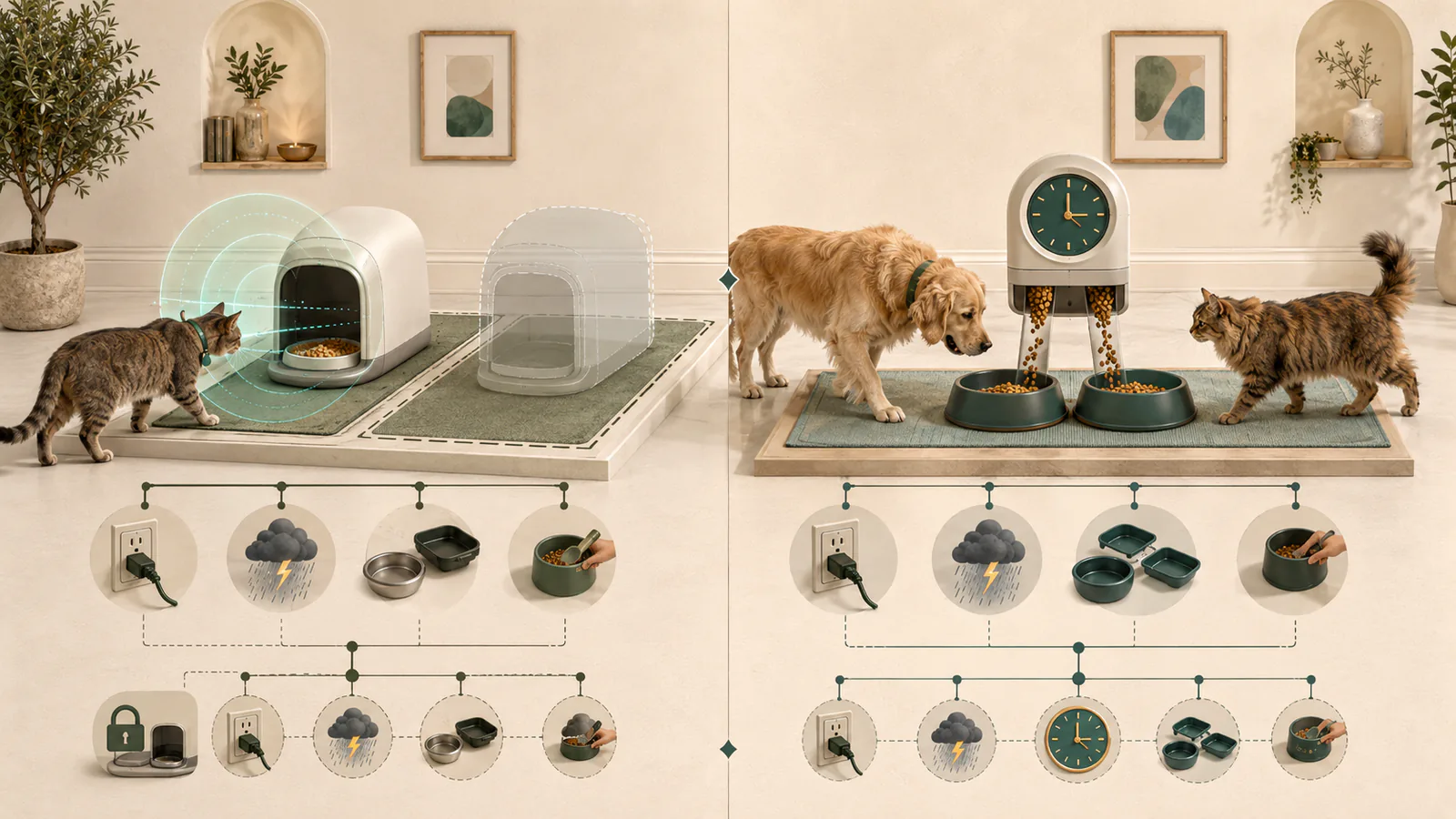
Choose by the access problem before comparing price: the PETLIBRO One RFID Smart Feeder uses a dedicated collar tag and reader mat, with one feeder bound to one tag for one pet, while the PetSafe Smart Feed Gen 2 is a timed, nonselective hopper whose optional splitter divides output without identifying pets or preventing one pet from eating the other portion.
Neither architecture is a universal winner: the RFID path is the only retained option here with documented pet-specific access but adds a tag, reader, placement requirements, and potentially one device per pet, while the timed path is simpler when household separation is unnecessary but cannot verify identity or consumption and retains a semi-moist-food documentation conflict.
Swipe horizontally to see all columns.
| Decision field | PETLIBRO One RFID | PetSafe Smart Feed Gen 2 |
|---|---|---|
| Access architecture | Dedicated collar tag and reader mat | Timed nonselective hopper |
| Exact model | PLAF301 | PFD00-16828 |
| Regular displayed hardware | $149.99 | $134.99 |
| Multi-pet separation | One feeder and one tag per pet | Optional splitter divides output; no identity |
| Implanted microchip | No | No selective-access function |
| Specialist-reviewed evidence target | Not achieved | Not achieved |
Choose the access architecture first: a lower displayed price cannot make a nonselective timed feeder equivalent to pet-specific access.
Key facts
- Exact products
- PETLIBRO One RFID Smart Feeder PLAF301 and PetSafe Smart Feed Gen 2 PFD00-16828.
- Access architecture
- PLAF301 uses one dedicated collar tag for one feeder and one pet; PetSafe is a timed, nonselective hopper.
- Food boundary
- PLAF301 is retained as a dry-kibble path; PetSafe dry food is the conflict-free path, while its semi-moist documentation remains unresolved.
- Evidence boundary
- No feeder, app, pet, meal, outage, cleaning process, or long-term behavior was tested, and no specialist reviewed the comparison.
Start with the job, not the feature list
A multi-pet household can be solving several different problems: releasing food at set times, preventing food theft, feeding pets separately, keeping a schedule through an internet outage, reducing caregiver workload, or recording that a feeder attempted to dispense. Those jobs should not be collapsed into a single “smart feeder” label.
Selective access is an architecture requirement. Scheduling is a timing function. A two-bowl splitter is an output accessory. An activity log is a software record. None of those, by itself, proves that the intended pet ate the intended amount.
Exact products compared
The RFID candidate is the PETLIBRO One RFID Smart Feeder, model PLAF301. The timed candidate is the PetSafe Smart Feed Automatic Dog and Cat Feeder, 2nd Generation, model PFD00-16828. Sibling models, future revisions, retailer bundles, and implanted-microchip feeders are outside this comparison.
The retained regular hardware displays are $149.99 for PLAF301 and $134.99 for the PetSafe feeder. These are dated website amounts, not completed checkout totals. Taxes, destination shipping, batteries, consumables, accessories, and replacement timing remain separate.
Food compatibility is a hard gate
PLAF301 is frozen as a dry-kibble path with a documented 2–15 mm range. Semi-moist, wet, canned, refrigerated, and therapeutic-food decisions are outside the approved comparison.
For PetSafe, dry food is the conflict-free path. Current product/support wording permits dry or semi-moist food, while the exact guide contains a dry-only warning and a separate reference to dry or semi-moist food. That material conflict is not repaired by choosing the more permissive sentence. A buyer requiring semi-moist food should obtain current exact-model written clarification before relying on the product.
Swipe horizontally to see all columns.
| Food question | PLAF301 | PetSafe Gen 2 | Buyer treatment |
|---|---|---|---|
| Dry food | Documented; 2–15 mm kibble | Documented | Current comparison path |
| Semi-moist | Outside frozen path | Official records conflict | Stop until exact clarification |
| Wet or refrigerated | Outside path | Outside frozen path | Use neither frozen path |
| Portion or frequency | Not evaluated | Not evaluated | Use an existing owner/professional plan |
Dry food is the retained comparison path for both products; PetSafe semi-moist use remains unresolved and neither device supplies an individualized feeding plan.
Multi-pet access: one tag per feeder is not the same as a splitter
PETLIBRO’s retained architecture binds one dedicated tag to one feeder for one pet. It does not read an implanted microchip and does not turn an extra tag into simultaneous two-pet access on one station. Independent selective access for two pets therefore means two feeder stations, two reader mats, suitable spacing, and two power/maintenance paths.
PetSafe’s splitter is different. It is an optional accessory intended to divide output between two bowls. It does not identify the animal, create a permission boundary, stop food theft, or confirm equal consumption. In a household where one pet must not reach the other’s food, “two bowls” is not equivalent to “two controlled eaters.”
Swipe horizontally to see all columns.
| Household need | PLAF301 | PetSafe Gen 2 |
|---|---|---|
| One pet | One feeder/tag path | One timed hopper path |
| Two pets, separate access | Two feeder stations required | Not identity selective |
| Two pets, one device | Conflicts with one-tag/one-pet design | Optional nonselective splitter |
| Prevent food theft | Not proven in a home | Not provided by splitter |
| Prove which pet ate | Not established | Not established |
One dedicated tag and feeder per pet is a different architecture from dividing one nonselective output between two bowls.
Scheduling, app control, and the limits of a log
PetSafe documents up to 12 scheduled meals per day. The maximum daily schedule count for PLAF301 was not established in the retained exact-product record, so a strict schedule-count requirement remains unresolved rather than being guessed.
Both products use app/account workflows for connected features. App availability, permissions, notification ownership, MFA, account recovery, and sharing behavior were not executed. A schedule entry, activity log, access event, or “status unknown” screen is not evidence that the right food reached the bowl or that the intended pet consumed it.
Swipe horizontally to see all columns.
| Control | PLAF301 | PetSafe Gen 2 |
|---|---|---|
| Daily schedule maximum | Not established in retained exact record | Up to 12 meals |
| Remote app control | Documented while connected | Documented while connected |
| Internet unavailable | Basic stored schedule described as continuing | Stored schedule described as continuing if powered |
| Notifications offline | Not available when Wi-Fi is unavailable | Not available offline |
| Consumption confirmation | No | No |
A schedule or app record can describe a device event, but neither feeder alone establishes which pet ate or how much it consumed.
Power, internet, and backup behavior
Both products document battery-backup options using D cells that are not included. PLAF301 uses three; PetSafe uses four. The documentation supports a narrower conclusion than “works during an outage”: stored schedules may continue under documented conditions while remote control, Wi-Fi, cloud behavior, or notifications become limited or unavailable.
No battery runtime, schedule accuracy, reconnect time, alert delivery, or recovery sequence was measured. A household relying on automation needs measured backup food, a bowl and measuring tool, a person who can reach the home, and a written plan that does not depend on the same app or network that may have failed.
Swipe horizontally to see all columns.
| Outage question | PLAF301 | PetSafe Gen 2 |
|---|---|---|
| Primary power | Included adapter | Included AC adapter |
| Backup cells | Three alkaline D; not included | Four alkaline D; not included |
| Battery runtime | Not measured | Not measured |
| Remote control on battery/offline | Not available or limited | Not established/available offline |
| What must be verified | Schedule, batteries, manual fallback | Schedule, batteries, manual fallback |
Stored schedules may continue under documented outage conditions, but remote functions and alerts can fail, so both paths require a human fallback.
Cleaning and maintenance are device-specific
FDA pet-food handling guidance supports handwashing, cleaning bowls and utensils, retaining original packaging or lot information, and keeping dry food cool and dry. It does not replace the device manual.
PLAF301 has wetting restrictions for the electronic base, tag, and reader components. PetSafe similarly limits washing to removable parts and requires thorough drying before reassembly; the base must not be wet. “Dishwasher-safe bowl” should never be expanded into “the complete food path is dishwasher safe.” No hygiene outcome, residue buildup, or maintenance interval was tested.
What feeder logs can and cannot prove
A feeder record can document an attempted action or a device-reported event. A dispense or access record does not prove that the intended pet ate the food. It cannot by itself prove successful dispensing, correct mass, absence of a jam, the identity of the eater, or actual consumption. A camera can add visual context, but a clip still does not prove a pet consumed the intended amount.
For multi-pet homes, actual-consumption verification is a separate workflow. The comparison method stops both architectures when the buyer requires the device alone to prove consumption.
Known hardware cost and incomplete ownership cost
The one-unit hardware difference is $15.00, with PLAF301 higher. That arithmetic is not a value judgment. A two-pet selective PLAF301 scenario uses two stations and has a known hardware subtotal of $299.98. Two PetSafe units total $269.98, but two nonselective feeders do not automatically establish identity control unless the physical household setup itself creates separation.
On July 30, 2026, the current PetSafe splitter product surface and accessory listing both displayed $21.99. That produces a dated hardware-plus-splitter subtotal of $156.98, but it does not establish stock, completed checkout, tax, shipping, output equality, or pet behavior. Required batteries also remain unknown until a buyer verifies a current amount. An unknown required cost is not zero; it makes the complete required total unavailable.
Swipe horizontally to see all columns.
| Scenario | Known subtotal | What remains unknown |
|---|---|---|
| One PLAF301 | $149.99 | Tax, shipping, batteries, desiccant cadence, replacement |
| Two PLAF301 stations | $299.98 | Same unknowns for two stations |
| One PetSafe Gen 2 | $134.99 | Tax, shipping, batteries, replacement |
| Two PetSafe units | $269.98 | Same unknowns; still not identity selective |
| PetSafe plus splitter | $156.98 | Dated hardware-plus-splitter display only; stock, checkout, tax, shipping, batteries, replacement timing, output equality, and pet behavior remain unverified |
| One-unit hardware difference | $15.00 | Not a value or savings verdict |
Known hardware subtotals do not include every required ownership cost, and the two-station totals do not make the access architectures equivalent.
Failure modes to plan for
Manufacturer support pages document possible symptoms such as no dispense, blocked outlet, rotor or timing issues, power failure, offline state, notification failure, and incorrect amount. Their existence does not establish how often a problem occurs or whether a troubleshooting sequence succeeds.
Swipe horizontally to see all columns.
| Failure family | Why it matters | Verification |
|---|---|---|
| Power | Schedules can stop without sufficient backup | Check cells and manual fallback |
| Internet/cloud | Remote control and alerts can stop | Test current app behavior |
| Food path | Blockage, rotor, wrong amount, stale food | Inspect and manual-dispense |
| Tag/reader | Pairing or recognition can fail | Verify exact tag and placement |
| Splitter/competition | Output division is not pet identity | Observe access; do not infer |
| Cleaning/reassembly | Wet electronics or incomplete drying can cause problems | Follow exact current manual |
Support documentation identifies checks, not failure prevalence or repair success; verify recovery and keep a manual feeding path available.
How the two architectures route common scenarios
The table below summarizes documentation dispositions, not recommendations. “Conditional” means the retained documentation does not show a hard conflict but still leaves untested behavior, unknown cost, or an unresolved household verification step.
Swipe horizontally to see all columns.
| Scenario | PLAF301 | PetSafe Gen 2 |
|---|---|---|
| One pet, dry food | Conditional | Conditional |
| Two pets need selective access | Conditional with two stations | Stop |
| Two pets must share one device | Stop for selective use | Conditional with nonselective splitter |
| Implanted microchip required | Stop | Stop |
| Semi-moist food | Stop | Stop or conditional conflict |
| More than 12 meals daily | Unknown maximum | Stop |
| Notifications during internet outage | Stop | Stop |
A conditional result means no immediate documented hard mismatch was found; it is not a recommendation or proof of real-world performance.
Continue with cost, product detail, and backup planning
- Map the incomplete ownership total with the smart feeder pricing and cost guide.
- Review the documented selective-access path in the PETLIBRO One RFID product analysis.
- Review the documented timed-feeding path in the PetSafe Smart Feed Gen 2 product analysis.
- Build a human fallback with the smart feeder backup-plan guide.
These pages provide narrower cost, product, and failure-planning context. They do not turn this documentation comparison into a product test, ranking, or purchase recommendation.
How the comparison method works
The retained method validates a declared scenario, evaluates each exact product in a stable order, uses integer cents, and returns only conditional or stop for each architecture. It preserves food conflicts, unknown schedule limits, unknown required costs, and the one-tag/one-feeder versus nonselective-splitter distinction.
It has no score, winner, rating, reliability verdict, safety verdict, medical verdict, or purchase recommendation. Synthetic fixtures test logic, not products. The broader evidence approach is described on How We Research and Evaluate Pet Technology.
Pre-purchase verification checklist
- Confirm exact model, current price, seller, return policy, warranty, and included parts.
- Confirm the current food type and physical kibble range against the exact manual.
- Decide whether the household needs timing, identity-selective access, or both.
- For PLAF301, accept one dedicated tag and one feeder station per independently controlled pet.
- For PetSafe, treat the splitter as nonselective and recheck its exact checkout amount.
- Verify outlet placement, reader or bowl placement, cleaning access, and dry reassembly.
- Verify stored schedules, time zone, backup cells, manual dispense, and notification settings.
- Prepare a human fallback that works without the app, internet, or feeder.
- Use an existing professional plan for feeding-sensitive cases; do not derive medical thresholds from this article.
Evidence limits and what remains blocked
Pet Signal Guide had no physical product, app account, checkout, pet, food trial, splitter trial, outage test, cleaning trial, support case, return, warranty claim, or long-term observation. No qualified specialist reviewed material feeding, behavior, welfare, or health conclusions. The specialist-reviewed evidence target is therefore not achieved.
Blocked conclusions include “best,” “safer,” “more reliable,” “prevents food theft,” “proves the pet ate,” “accurate portions,” “works through outages,” and any individualized feeding recommendation. Product availability, prices, support records, policies, app behavior, and conflicts require rechecking immediately before any CMS execution.
Sources
-
U.S. Food and Drug Administration – Proper Storage of Pet Food & Treats
Checked July 27, 2026. General food storage and lot-traceability guidance; not feeder performance evidence. -
U.S. Food and Drug Administration – Tips for Safe Handling of Pet Food and Treats
Checked July 27, 2026. General handling and bowl/utensil cleaning guidance; not individualized nutrition or veterinary advice. -
NIST – Profile of the IoT Core Baseline for Consumer IoT Products
Checked July 27, 2026. Consumer-IoT product-system framing; not a feeder certification or security audit. -
Federal Trade Commission – Securing Your Internet-Connected Devices at Home
Checked July 27, 2026. General account/router/update guidance; not exact-product implementation evidence. -
Federal Trade Commission – Getting In and Out of Free Trials, Auto-Renewals, and Negative Option Subscriptions
Checked July 27, 2026. General US trial and renewal diligence; not product-specific legal advice. -
Pet Signal Guide – How We Research and Evaluate Pet Technology
Checked July 27, 2026. Sitewide evidence and commercial-independence method. -
PETLIBRO – One RFID Smart Feeder
Checked July 27, 2026. Exact PLAF301 identity, current hardware display, capacity, dimensions, dry-food range, tag, power, connectivity, and box contents; no checkout or use test. -
PETLIBRO – Pre-sale Inquiries About One RFID Feeder
Checked July 27, 2026. Dedicated-tag, one-pet-per-feeder, lid-close, remote-feed, battery-only, pet-height, cleaning-device, and outdoor-use statements; no controlled observation. -
PETLIBRO – One RFID Smart Feeder Battery and Offline FAQ
Checked July 27, 2026. Battery-backup, Wi-Fi-disabled battery mode, schedule execution, tag, shipping, and warranty statements; no outage or runtime test. -
PETLIBRO – How Do I Disassemble and Clean the One RFID Pet Feeder?
Checked July 27, 2026. Exact PLAF301 parts-specific wetting, disassembly, drying, and reassembly guidance; no hygiene outcome test. -
PETLIBRO – What Can I Do If My One RFID Feeder Does Not Dispense Food?
Checked July 27, 2026. Power, food, outlet, rotor, cleaning, and manual-dispense troubleshooting; no incidence or repair-success rate. -
PETLIBRO – One RFID Feeder Rotor Stuck Error
Checked July 27, 2026. Rotor-stuck troubleshooting; no failure prevalence or independent repair outcome. -
PETLIBRO – One RFID Feeder Schedule Troubleshooting
Checked July 27, 2026. Power, restart, interference, reset, and reconnection workflow; no timing measurement or executed troubleshooting. -
PETLIBRO – One RFID Feeder Will Not Boot or Stops Working
Checked July 27, 2026. Power-source troubleshooting; no electrical measurement or failure rate. -
PETLIBRO – Unable to Update One RFID Feeder Firmware
Checked July 27, 2026. Firmware-update troubleshooting; no update execution or support-lifetime guarantee. -
PETLIBRO – Pair the Collar Tag With the One RFID Feeder
Checked July 27, 2026. Dedicated-tag pairing and interference checks; no pet-wear, access-control, or recognition-rate test. -
PETLIBRO – One RFID Feeder Food Outlet Blockage
Checked July 27, 2026. Food-outlet blockage checks from an official localized support record; no independent outcome. -
PETLIBRO – One RFID Feeder Feeding Status Unknown
Checked July 27, 2026. Feeding-status interpretation boundary; no proof that food was dispensed or consumed. -
PETLIBRO – Share One RFID Feeder Device Access
Checked July 27, 2026. Invitation workflow by registered email; exact permissions, revocation effects, notification ownership, and maximum current users were not executed. -
PETLIBRO – RFID Collar Tag
Checked July 27, 2026. PLTG001 identity, current USD display, PLAF301 compatibility, dimensions, weight, no charging, and splash-proof boundary; no pet-wear test. -
PETLIBRO – PETLIBRO Pet Food Desiccant Bag
Checked July 27, 2026. Displayed package amount, pack selector, recurring-purchase offer, and model compatibility; selected pack, cadence, and annual cost remain buyer-verified. -
PETLIBRO – Privacy Policy
Checked July 27, 2026. Vendor data, rights, deletion, reset, and support-period statements; not an independent privacy/security audit or future guarantee. -
PETLIBRO – Return Policy
Checked July 27, 2026. Direct-purchase conditions, proof, exclusions, seller route, and warranty labels; no return or warranty transaction. -
PETLIBRO – Shipping Policy
Checked July 27, 2026. Current direct-site contiguous-US thresholds and timing; seller, destination, tax, stock, and checkout remain transaction-specific. -
PETLIBRO – PETLIBRO Help Center
Checked July 27, 2026. Current support route; not response-time, repair-quality, support-success, or future-availability evidence. -
PetSafe – Smart Feed Automatic Dog and Cat Feeder, 2nd Generation
Checked July 27, 2026. Exact model, displayed price, current feature and box-content claims; no checkout or use test. -
PetSafe – Smart Feed Automatic Dog and Cat Feeder, 2nd Generation Support Hub
Checked July 27, 2026. Support index and product framing; marketing superiority language is excluded. -
PetSafe – Smart Feed PFD00-16828 Quick Start Guide
Checked July 27, 2026. Exact-model PDF; internally inconsistent food language and older app requirements; no current implementation test. -
PetSafe – Set up the Smart Feed Automatic Dog and Cat Feeder, 1st and 2nd Generation
Checked July 27, 2026. Setup, cleaning, battery and schedule guidance; some steps cover both generations. -
PetSafe – My PetSafe Smart Feed Automatic Pet Feeder is Offline
Checked July 27, 2026. Vendor-described offline schedule behavior; no outage test or uptime evidence. -
PetSafe – Smart Feed Not Sending Notifications
Checked July 27, 2026. Notification troubleshooting and offline limitation; no delivery-latency test. -
PetSafe – Disassemble and Clean the Smart Feed Automatic Pet Feeder
Checked July 27, 2026. Parts-specific washing/drying restrictions; no hygiene or reliability outcome test. -
PetSafe – Smart Feed Is Not Dispensing the Correct Amount of Food
Checked July 27, 2026. Possible causes and checks; no incidence or measured accuracy data. -
PetSafe – Smart Feed Is Not Dispensing Meals on Time
Checked July 27, 2026. Time-zone and connection checks; no timing-accuracy measurement. -
PetSafe – Reboot or Reset the Smart Feed Automatic Pet Feeder
Checked July 27, 2026. Reboot versus factory-reset behavior; no recovery-success rate. -
PetSafe – Smart Feed Automatic Pet Feeder Will Not Power On
Checked July 27, 2026. Power checks and battery replacement warning; no runtime test. -
PetSafe – What Is Slow Feed and How Do I Use It
Checked July 27, 2026. Vendor-described 15-minute setting; no behavioral or health benefit established. -
PetSafe – Assemble the Smart Feed Automatic Pet Feeder
Checked July 27, 2026. Assembly and alignment steps; no post-assembly performance evidence. -
PetSafe – Install the 2-Pet Meal Splitter
Checked July 27, 2026. Equal-output splitter installation; no identity-selective access or consumption control. -
PetSafe – Add Another Household Member to the My PetSafe App
Checked July 27, 2026. Invitation flow; exact Smart Feed permissions, revocation effects and notification ownership remain untested. -
PetSafe – Privacy Policy
Checked July 27, 2026. Company/site/app privacy notice; not a security audit or exact Smart Feed data-flow test. -
PetSafe – Return & Warranty Information
Checked July 27, 2026. Direct-purchase return and limited-warranty terms; retailer and claim outcomes can differ. -
PetSafe – Shipping Policy
Checked July 27, 2026. US seller-specific shipping thresholds and timing; checkout remains authoritative. -
PetSafe – Fountain and Feeder Filters & Accessories
Checked July 27, 2026. Current accessory listing includes adapter and splitter displays; selection and availability can change. -
PetSafe – 2-Pet Meal Splitter with Bowl
Checked July 30, 2026. This current surface and the accessory listing both displayed $21.99; stock, checkout, tax, shipping, output equality, and pet behavior remain unverified.