
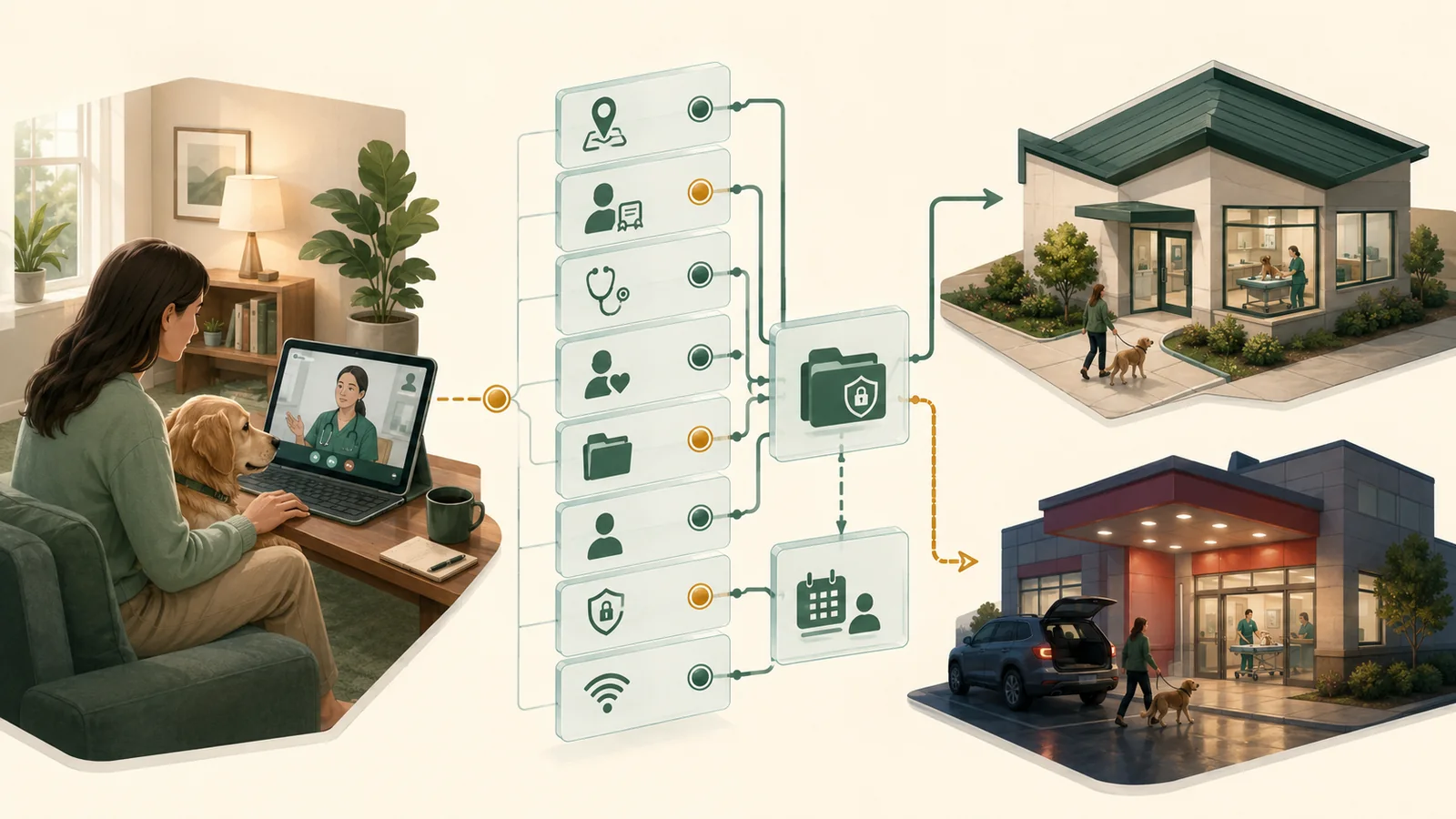
Documentation-led tele-vet service guide
Tele-vet services differ by the animal’s physical location, the professional’s license, the service type, the veterinarian-client-patient relationship, current rules, records, and the provider’s own terms. This guide separates those dependencies from platform availability, membership language, and price snapshots.
Quick answer
A tele-vet service is not one uniform product. What it may provide depends on the animal’s physical location, the veterinarian’s active license, the service type, the applicable veterinarian-client-patient relationship, current federal and state rules, records, and professional judgment.
The useful comparison is therefore a set of access and verification questions, not a promise that a platform can diagnose, prescribe, replace an examination, or provide the same service in every state.
This guide uses current documentation and a bounded six-jurisdiction sample. It is not veterinary or legal advice, and it does not replace immediate in-person emergency care.
Key facts
Swipe horizontally to see all columns.
| Field | Bounded answer |
|---|---|
| Topic | How to compare tele-vet service types, legal and professional dependencies, costs, records, privacy, continuity, and escalation questions. |
| Geography | United States documentation with a six-jurisdiction contrast sample; not a 50-state survey. |
| Evidence basis | Federal and state authority records, provider pages and terms, current price records, and four bounded independent studies. No live service use. |
| Current service examples | Existing-practice telemedicine, Vetster, Dutch, Pawp, and Chewy architectures. The sample is not a ranking or recommendation. |
| Price snapshot | Retained records range from USD 35 prescription visits and USD 49.99 video visits to USD 102 appointments and USD 120 or USD 132 annual plans. Medication, testing, in-person care, tax, and pharmacy costs are separate or unknown. |
| What was not done | No account, booking, animal visit, prescription request, records transfer, privacy test, cancellation, provider contact, or emergency workflow. |
| Main limitation | Veterinary and authority review are not complete, and provider pages can conflict or change. |
Treat each service claim as conditional until location, license, service type, relationship, current authority, records, and escalation path are checked together.
What tele-vet services mean
Provider labels often use telehealth, visit, consult, care, or chat for different professional acts. The label alone does not establish whether a service can diagnose, prescribe, or create a continuing clinical relationship.
Swipe horizontally to see all columns.
| Term | Documentation meaning | Boundary to keep visible |
|---|---|---|
| Telehealth | An umbrella for electronic information, education, consultation, monitoring, and related veterinary services. | It does not by itself say that diagnosis, treatment, or prescribing is allowed. |
| Teleadvice | General information or education that is not specific enough to become a diagnosis or treatment plan. | General information must not be rewritten as individualized care. |
| Teletriage | Remote assessment intended to direct the urgency or type of further care. | It cannot perform a hands-on examination or guarantee that deterioration will not occur. |
| Telemedicine | Veterinary practice delivered remotely within the required professional relationship, license, jurisdiction, and standard of care. | The allowed act, record duties, drug scope, and follow-up depend on current law and professional judgment. |
| Teleconsulting | Professional-to-professional consultation, often with the treating veterinarian remaining responsible. | It is not the same as a direct-to-consumer visit. |
| Telemonitoring | Collection and transmission of patient information or device data for veterinary review. | Data availability does not create a diagnosis or continuous emergency monitoring. |
| VCPR | The veterinarian-client-patient relationship defined by applicable law and professional duties. | How it is established, maintained, extended, and used for prescribing varies by jurisdiction and federal purpose. |
Normalize the actual professional act and legal scope before comparing a provider’s marketing label.
Location, license, and relationship
The animal’s physical location during the service is a material jurisdiction fact. A billing address, provider headquarters, app availability, or "available in all states" message does not prove that a particular veterinarian may perform the proposed act there. The AAVSB license lookup resource is a starting point, while the relevant board record and current rule control.
Swipe horizontally to see all columns.
| Question | Why it matters | What documentation cannot prove alone |
|---|---|---|
| Where is the animal physically located? | Jurisdiction and professional-practice rules attach to the service location. | A home, billing, or provider address does not establish the service jurisdiction. |
| Is the professional licensed there? | Licensure is a separate check from platform access or profile text. | A badge, provider headquarters, or marketplace listing is not a board record. |
| What service type is booked? | Advice, triage, telemedicine, follow-up, consulting, and monitoring have different boundaries. | A video button does not establish the clinical act or its legal scope. |
| What relationship and records exist? | VCPR, history, consent, records, and follow-up can determine what a veterinarian may do. | A membership or first chat does not guarantee a valid relationship or prescription. |
| What is the in-person fallback? | Continuity and emergency routing are operating dependencies, not optional copy. | A "24/7" label does not establish local coverage, response time, or emergency care. |
Verify the animal’s location, the professional’s license, the booked service, the relationship, and the local fallback as one chain.
A six-jurisdiction contrast
The following sample demonstrates variation rather than national coverage. California and Florida records describe paths for synchronous audiovisual evaluation under detailed conditions. Colorado, Washington, and North Carolina retain in-person-established relationship requirements. Texas has codified restrictions alongside a materially unsettled practical landscape, so its current board and legal position needs a fresh check.
Swipe horizontally to see all columns.
| Jurisdiction | Bounded record | Reader-facing implication |
|---|---|---|
| California | Current board FAQ describes synchronous audio-video conditions for a virtual relationship, with history, records, nearby medical resources, and jurisdiction-specific restrictions. | Open the current statute and board material before relying on a service path. |
| Florida | Current statute describes a synchronous audiovisual path and excludes audio-only, text, questionnaires, and chatbots from establishing the relationship. | Identity, local resources, follow-up, technology failure, and drug restrictions still need exact review. |
| Colorado | Enacted law requires an in-person physical examination to establish the relationship, then permits telehealth under specified conditions. | Do not treat virtual availability as a way to create the initial relationship. |
| Washington | The cited rule does not allow the relationship to be established solely by telehealth; teleadvice and teletriage have separate boundaries. | Separate advice or triage from telemedicine and confirm follow-up coverage. |
| North Carolina | Board material requires an established relationship and states it cannot be established electronically; record and standard-of-care duties remain. | A platform’s registration flow cannot substitute for the board’s current rule. |
| Texas | The cited codified rule says an existing relationship is required and cannot be established solely electronically, while later legislative material makes the practical landscape unsettled. | Obtain direct current board and legal review. Do not publish a static permission answer. |
A contrast sample is useful for showing variation, not for clearing a service in an unreviewed state.
Service architectures
Different architectures solve different access and continuity problems. The table describes structures, not provider recommendations or clinical outcomes.
Swipe horizontally to see all columns.
| Architecture | What the service may document | Hard limit to verify |
|---|---|---|
| Existing-practice telemedicine | Follow-up, recheck, education, monitoring, or remote care through a practice with records and an existing relationship. | The veterinarian may still require examination, testing, procedure, local referral, or an emergency route. |
| Advice-only service | General education and product-independent questions. | No diagnosis, prescription, refill, or individualized treatment should be inferred. |
| Teletriage | Remote direction about urgency or type of further care where permitted. | It cannot examine the animal by hand or guarantee that deterioration will not occur. |
| Direct-to-consumer telemedicine | Diagnosis, treatment, or prescribing only where the relationship, law, modality, records, and professional judgment allow it. | State, license, drug class, follow-up, procedure, and in-person limits remain material. |
| Marketplace appointment | Access to a chosen professional through a platform. | Marketplace availability does not prove scope, continuity, license, or emergency coverage. |
| Membership telehealth | Recurring access to some combination of advice, visits, or follow-up. | The membership fee does not necessarily include medication, testing, procedures, or emergency care. |
| Professional teleconsulting | Specialist input to a treating veterinarian using locally acquired records or images. | It is not equivalent to a direct-to-consumer visit or a remote hands-on examination. |
| Telemonitoring | Data or media sent for review under a veterinary plan. | Data collection does not create continuous supervision or emergency response. |
Compare the professional relationship and failure path, not just whether the service offers a chat or video button.
What current provider documents describe
The examples below were retained because they show different architectures and documentation conflicts. They are not a shortlist or endorsement.
Swipe horizontally to see all columns.
| Provider path | Current documentation snapshot | Boundary or conflict |
|---|---|---|
| Existing veterinary practice | Practice-specific follow-up, recheck, education, monitoring, or telemedicine through an existing relationship and records. | Cost, hours, availability, local escalation, and remote suitability are practice-specific and were not tested. |
| Vetster | Provider records describe single appointments and a USD 120/year Plus path with four appointments; a retained price record lists a USD 102 appointment. | A May 2026 help record says diagnosis and prescriptions are unavailable, while other current surfaces describe them where regulated. The conflict blocks a clean scope conclusion. |
| Dutch | Current membership material lists USD 132/year for video calls and messaging for up to five pets; medication is separate. | Prescription and care scope depends on state, provider availability, relationship, and judgment. Membership is not a prescription guarantee. |
| Pawp | Base membership, scheduled Prescription Visits, and optional Emergency Protection are separate paths; a retained prescription record starts at USD 35. | The veterinarian decides whether a prescription is appropriate. Financial protection is separate from medical care and has its own conditions. |
| Chewy | Free licensed-vet-tech chat is distinct from a paid veterinarian video visit listed at USD 49.99 in seven states. | The free chat is not the paid visit; products, medication, in-person care, and late or missed-visit terms are separate. |
Provider pages control provider claims and terms only. They do not replace state authority, a license check, or a clinical review.
Costs, renewal, and cancellation
Amounts below are documentation snapshots checked July 28, 2026, in USD. They are not quotes, total-care costs, savings estimates, reimbursement promises, or recommendations. Medication, testing, in-person care, tax, pharmacy, compounding, late, missed, cancellation, and renewal terms can change.
Swipe horizontally to see all columns.
| Provider path | Recorded amount | Material exclusions |
|---|---|---|
| Existing veterinary practice | Unknown; obtain the exact written practice fee. | Exam, testing, procedure, prescription, after-hours, emergency, tax, and follow-up terms. |
| Vetster single appointment | USD 102.00 in the retained price record. | Tax, medication, pharmacy or compounding fees, follow-up, and outcome. |
| Vetster Plus annual | USD 120.00 per year in the retained record. | Auto-renewal, medication, additional appointments, pharmacy or compounding fees, and tax. |
| Dutch annual membership | USD 132.00 per year in the retained plan record. | Medication, testing, in-person care, outside-pharmacy transfer, and tax. |
| Pawp scheduled Prescription Visit | Starts at USD 35.00 in the retained price record. | Base membership, medication, in-person care, financial protection, and no prescription guarantee. |
| Chewy paid video visit | USD 49.99 in the retained seven-state service record. | Medication, products, in-person care, tax, and late or missed appointment terms. |
A low entry price can still leave the clinically or operationally important parts of care outside the service fee.
Records, privacy, and continuity
Tele-vet workflows may involve owner identity, payment, pet history, medication and veterinary records, photos, video, audio, chat, transcripts, recordings, location, pharmacy data, and financial-product documents. A policy page describes terms; it is not a completed account, privacy, export, deletion, or security test.
Swipe horizontally to see all columns.
| Dependency | Question to verify | Why it matters | What this research did not establish | Fallback question | Residual unknown |
|---|---|---|---|---|---|
| Consent and recording | Is the visit recorded, transcribed, or shared, and for how long? | Consent, access, and retention can affect the owner and the pet’s records. | No live recording or consent flow was executed. | Ask how to withdraw consent and obtain the record. | Exact retention and deletion behavior. |
| Records and export | Who can download, correct, and send the record to a local clinic? | Continuity depends on usable records, not only a chat history. | No record export or correction request was performed. | Ask for the format, route, timing, and owner access. | Provider-specific portability. |
| Account and privacy | What data are collected, shared, advertised, retained, or deleted? | Membership cancellation may not equal data deletion. | No permissions, deletion, security, or household-sharing test was performed. | Read the current privacy policy and account controls. | Actual implementation may differ from policy text. |
| Continuity | Who follows up if the assigned professional is unavailable? | Remote contact can fail without a local clinic or emergency route. | No provider continuity or adverse-reaction workflow was tested. | Record the local clinic and emergency facility before booking. | Availability and response time. |
| Technology failure | What happens after a dropped call, poor image, missing record, or payment failure? | A technical failure can change what information is visible. | No failure, refund, credit, or cancellation workflow was executed. | Ask for the rebooking, refund, and in-person escalation path. | Exact provider terms and timing. |
Privacy and continuity questions belong in the service decision because the remote interaction is also a records and account workflow.
In-person and emergency boundaries
Remote services cannot directly perform a hands-on examination, specimen collection, imaging, vaccination, surgery, dentistry, hospitalization, or another physical procedure. A veterinarian may decide that an in-person visit or testing is needed even when a platform accepts a booking.
Do not delay travel to an in-person emergency facility for chat, video, registration, membership, document upload, prescription request, payment, or reimbursement steps. A disconnected, incomplete, unavailable, or apparently reassuring remote interaction is not an emergency clearance.
Swipe horizontally to see all columns.
| Situation | Documentation-safe boundary | Question to ask before relying on the service |
|---|---|---|
| Hands-on need | Remote care cannot directly examine, test, image, vaccinate, operate on, or hospitalize an animal. | Which local facility can perform the physical step and how are records transferred? |
| Urgency or triage | A remote assessment depends on what is visible and reported and cannot guarantee that deterioration will not occur. | What is the immediate in-person route if the service cannot complete the assessment? |
| Technology failure | A dropped call, no response, or missing data is not proof that no problem exists. | Who is responsible for follow-up and what is the backup communication route? |
| Medication or prescription | A visit or membership does not guarantee a prescription, refill, pharmacy fulfillment, or a legally permitted drug path. | Which professional, relationship, jurisdiction, drug category, and follow-up rules apply? |
| Financial product | Emergency protection or reimbursement terms are separate from medical care and do not guarantee payment. | Would contacting the platform delay immediate care, and what are the separate claim conditions? |
Keep a local clinic and emergency route independent of platform access, membership status, and payment state.
What this page does not establish
- A complete or current 50-state tele-vet, VCPR, licensing, or prescribing answer.
- That a named provider is available, licensed, clinically suitable, safest, or recommended for a particular dog.
- That a chat, video visit, membership, triage message, or prescription request will produce diagnosis, treatment, medication, refill, or an outcome.
- That a remote interaction clears an emergency or makes it safe to wait.
- That a price snapshot is a quote, total-care cost, saving, reimbursement, or value calculation.
- That provider privacy, security, export, deletion, continuity, cancellation, or refund behavior was tested.
- That published research transfers to every platform, professional, animal, jurisdiction, or clinical setting.
- That Pet Signal Guide contacted a provider, booked a visit, observed an animal, or obtained a clinical result.
If a material fact is not established here, treat it as an open verification task rather than a positive or negative conclusion.
Method
This guide groups claims by professional act and service architecture, then checks federal and state authority records, provider product and support pages, price and cancellation records, privacy and terms pages, and bounded independent studies. The comparison preserves geography, checked date, service type, relationship, provider conflict, price exclusions, records boundary, emergency boundary, and unknowns.
The retained studies include a provider-affiliated retrospective teletriage dataset of 1,575 dogs, a 106-cat caregiver video-education study, tele-ultrasound based on clinic-acquired images, and fifteen case reports. These designs are context-specific and do not create a consumer symptom protocol, diagnosis claim, safety guarantee, or outcome equivalence.
No provider account, animal, appointment, prescription, records transfer, privacy action, checkout, cancellation, security test, vendor contact, or emergency workflow was performed. The result is a bounded documentation summary, not a scorecard, ranking, certification, recommendation, or legal opinion.
Sources
- FDA: Veterinarian-Client-Patient Relationships, Prescribing, Dispensing Animal Drugs and Telemedicine U.S. Food and Drug Administration; checked July 28, 2026. Federal relationship and drug-scope context.
- FDA: State or federal VCPR for a lawful VFD U.S. Food and Drug Administration; checked July 28, 2026. VFD-limited state and federal comparison; not a general current telemedicine survey.
- AAVSB Veterinary License Look-Up American Association of Veterinary State Boards; checked July 28, 2026. License verification starting point.
- California Veterinary Medical Board AB 1399 FAQ California Veterinary Medical Board; checked July 28, 2026. Current board guidance with statute and jurisdiction limits.
- Florida Statutes section 474.2021 Florida Legislature; checked July 28, 2026. Synchronous audiovisual and operational conditions.
- Colorado HB24-1048 Colorado General Assembly; checked July 28, 2026. In-person relationship establishment and telehealth conditions.
- Washington WAC 246-933-200 Washington rule; checked July 28, 2026. Relationship and teleadvice/teletriage boundaries.
- North Carolina Veterinary Medical Board laws North Carolina Veterinary Medical Board; checked July 28, 2026. Relationship and record requirements.
- Texas Administrative Code section 573.68 Codified Texas rule text via Cornell; checked July 28, 2026. Existing relationship and electronic-establishment boundary.
- Texas SB 1442 committee substitute analysis Texas Legislature; checked July 28, 2026. Materially unsettled policy context requiring current recheck.
- Vetster United States service surface Vetster; checked July 28, 2026. Provider service description only.
- Vetster pricing Vetster Help Center; checked July 28, 2026. USD 102 appointment and USD 120/year Plus snapshot.
- Vetster Plus service record Vetster Help Center; checked July 28, 2026. Annual-plan description used only for the documented service comparison.
- Vetster diagnosis or prescription help record Vetster Help Center; checked July 28, 2026. Retained conflict record; no clean scope conclusion.
- Dutch membership plans Dutch; checked July 28, 2026. USD 132/year membership snapshot.
- Dutch prescription conditions Dutch Help Center; checked July 28, 2026. State-dependent service and provider scope.
- Pawp prescription pricing Pawp Help Center; checked July 28, 2026. Starting USD 35 prescription-visit snapshot.
- Pawp service overview Pawp Help Center; checked July 28, 2026. Membership and service-path description only.
- Pawp Emergency Protection Pawp Help Center; checked July 28, 2026. Separate financial-product terms and delay boundary.
- Chewy Online Vet Virtual Visit Chewy; checked July 28, 2026. Seven-state USD 49.99 paid-visit record.
- Chewy free Connect with a Vet chat Chewy; checked July 28, 2026. Technician-chat boundary separate from paid veterinarian video.
- Retrospective teletriage and teleadvice analysis of 1,575 dogs Open Veterinary Journal / PubMed; checked July 28, 2026. Provider-affiliated retrospective associations, not a consumer protocol.
- Video telehealth for chronic mobility problems in cats Frontiers in Veterinary Science / PubMed; checked July 28, 2026. Caregiver education and perceived helpfulness, not diagnosis equivalence.
- Tele-ultrasonography for gastrointestinal obstruction Journal of Small Animal Practice / PubMed; checked July 28, 2026. Clinic-acquired images and specialist interpretation, not direct-to-consumer tele-vet.
- Fifteen novel-species teletriage case studies Frontiers in Veterinary Science / PubMed; checked July 28, 2026. Case reports, not efficacy or prevalence evidence.