
Quick answer
The Fi Series 3+ is a plausible documentation-level match for a United States dog owner who accepts an integrated Fi-compatible collar, has usable AT&T service on the relevant routes, can support the Fi Base and app workflow, and accepts a prepaid membership. It is a poor match when the dog falls outside the documented 9.5–31 inch collar range, an ordinary existing collar must be retained, cellular service is unsuitable, or a recurring plan is unacceptable. The strongest advertised advantage is long battery life under low-use conditions; the most important limitation is that fit, route coverage, alert timing, battery life, comfort, and durability were not independently tested.
Key facts
Swipe horizontally to see all columns.
| Field | Current documented value | What remains unverified |
|---|---|---|
| Exact product | Fi Series 3+ | Delivered hardware, firmware, app version, and checkout configuration |
| Tracker size and weight | Fi lists 81.5 × 30 × 11.5 mm and 47 g for the tracker | Independent measurement and complete collar weight |
| Collar fit | Five sizes covering documented neck ranges from 9.5 to 31 inches | Comfort, rubbing, pressure, bounce, retention, and safe fit for an individual dog |
| Cellular network | AT&T for current Series trackers with an active membership | Indoor, route-level, terrain, handoff, signal, alert, and location performance |
| Charging | Fi Base required; Fi says charging typically takes around three hours from zero to full | Measured charging time and battery aging |
| Battery | Fi estimates up to three months for low use, four to six weeks for moderate use, up to two weeks for high use, and about two days in Lost Mode | Real runtime for the buyer’s routes, signal conditions, temperature, and household setup |
| Standard prepaid cost | USD 99 / 189 / 339 for 6 / 12 / 24 months, plus USD 20 activation | Tax, any standard-purchase shipping, accessories, replacement, and future renewal |
| Evidence boundary | Product Analysis based on documents | No hands-on Review, performance score, ranking, or recovery conclusion |
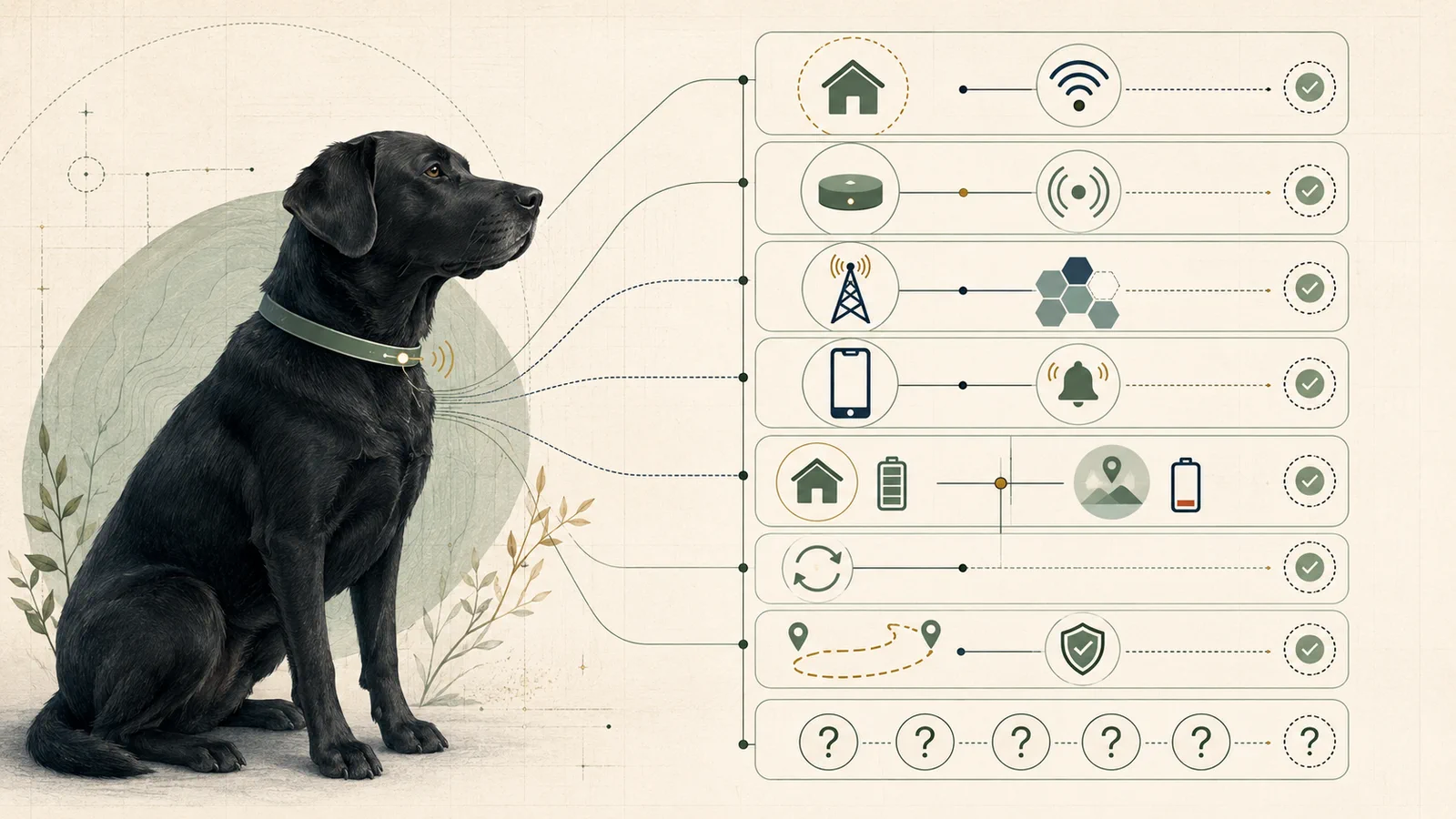
Series 3+ should survive fit, network, setup, commitment, and budget gates before its feature list matters.
This analysis may fit your decision if
- You are choosing a tracker for a dog in the United States.
- You can use a Fi-compatible integrated collar band.
- AT&T coverage is plausible around the home and routes that matter.
- You accept a prepaid membership and the Fi Base charging workflow.
- You will verify real fit, coverage, alerts, and battery behavior after delivery.
Use a different research path if
- You need remote tracking where usable cellular service is absent.
- You must attach the tracker to an ordinary existing collar.
- The dog’s measured neck falls outside every documented size range.
- You do not want a membership or at least a six-month commitment.
- You need independently measured accuracy, latency, battery, comfort, retention, or durability.
Confirm the exact model
Fi’s current product-comparison page lists three distinct tracker families: Fi Mini, Fi Series 3+, and Fi Ultra. This page analyzes only the Fi Series 3+. It does not transfer Mini or Ultra specifications, network behavior, battery estimates, attachment rules, or offer terms into the Series 3+ record.
Fi currently lists the Series 3+ tracker at 81.5 × 30 × 11.5 mm and 47 grams. The 47-gram number is the tracker weight; it should not be read as the complete collar-and-buckle weight. We did not measure the tracker or a finished collar.
Use the dog GPS tracker buyer’s guide to define the required job and hard gates before evaluating this individual product.
Check collar fit and attachment before features
The Series 3+ is an integrated-collar system. Fi says its Series trackers use special connectors and cannot attach directly to an ordinary existing collar. A Fi Band or a compatible band built for the Fi connector is required. A second collar or harness may still be needed for a particular walking setup, but this analysis did not evaluate dual-collar use or third-party bands.
Measure the dog’s neck where the collar actually sits. Fi’s current instructions recommend a two-finger fit check and provide these Series 3+/Series 3 ranges:
Swipe horizontally to see all columns.
| Size | Documented neck range | Band width | Evidence-safe use |
|---|---|---|---|
| Extra Small | 9.5–11 in | 0.75 in | Documentation screen only; verify the delivered fit |
| Small | 10.5–13 in | 0.75 in | Documentation screen only; verify the delivered fit |
| Medium | 12.5–16.5 in | 1 in | Documentation screen only; verify the delivered fit |
| Large | 15.5–22 in | 1 in | Documentation screen only; verify the delivered fit |
| Extra Large | 20–31 in | 1 in | Documentation screen only; verify the delivered fit |
A measurement inside a listed range prevents one obvious mismatch; it does not prove comfort, retention, pressure, rubbing, or safe use.
Fi says Series collars are designed for dogs and are not optimized for cats, horses, or other pets. This is a dog-only analysis and not a veterinary fit recommendation.
Account for the required setup
Fi’s current package record says a Series 3+ purchase includes the tracker, Fi Base, collar band, USB charging cable, and a one-year product warranty. It also says the buyer needs a smartphone, Wi-Fi, and a five-watt or higher USB adapter; those items are required but not included.
The Series 3+ uses the Fi Base for charging. Fi says the Base is the only charging method for Series 2, Series 3, and Series 3+, and a compatible Series 3 Base works with Series 3+. The household therefore needs a practical place to keep the Base powered and connected.
An active Fi Membership is required for current Series 3+ remote tracking and Lost Mode. A buyer who wants a no-subscription remote GPS tracker should treat that as a hard mismatch rather than hoping the collar will retain the same functions after membership ends.
Treat coverage maps as a first-pass filter
Fi says current Series trackers use AT&T’s cellular network with an active membership. The buyer’s phone may use another carrier, but that does not change the Series 3+ network dependency.
Fi also warns that carrier maps show general coverage and do not show signal strength. The FCC explains that its mobile coverage is propagation-modeled for outdoor or in-vehicle use, does not show indoor availability, and can differ from real experience because of the device, network capacity, terrain, and other conditions.
- Before purchase: check AT&T and FCC map context for the home, regular walks, vehicle routes, sitter or boarding locations, and higher-risk corridors.
- Do not call a map a pass: indoor, basement, dense-building, terrain, handoff, and tracker-specific behavior remain unknown.
- After delivery: test the real routes and Lost Mode without deliberately creating an escape.
- Use the return window: record unusable locations and decide before the applicable deadline.
Separate escape alerts from Lost Mode
Fi documents Lost Mode and live tracking for Series 3+ when an active membership is present. Current instructions say that Series 3+ begins GPS and cellular live tracking in Lost Mode. They also say the collar light is not switched on automatically when Lost Mode begins; the user must turn it on in the app.
That workflow contains several distinct stages: boundary or location detection, service processing, push notification, caregiver attention, Lost Mode activation, location reporting, map display, and human response. This package did not measure any of them. Fi’s “real time” wording should not be converted into a guaranteed seconds value, accuracy claim, missed-alert rate, reliability percentage, or recovery promise.
Fi recommends learning and testing Lost Mode before an emergency. A bounded test should keep the dog secured; a person or vehicle can carry the tracker while the household records app updates, notification delivery, battery change, and route gaps.
Compare battery conditions, not one headline
Fi’s current device-battery record does not give one universal Series 3+ runtime. It provides different vendor estimates based on how much time the tracker spends away from home and whether Lost Mode is active:
Swipe horizontally to see all columns.
| Vendor-described condition | Fi estimate | How to interpret it |
|---|---|---|
| Low use | Up to 3 months | Mostly at home or short walks; maximum vendor estimate |
| Moderate use | 4–6 weeks | Regular yard time and frequent indoor/outdoor movement |
| High use | Up to 2 weeks | Outdoors most of the day with extended time away |
| Lost Mode | About 2 days on a full battery | Battery-intensive live tracking; approximate vendor estimate |
The three-month headline is relevant only to the low-use condition. A dog that is frequently away from the Base or using Lost Mode belongs to a different battery scenario.
Fi says the tracker typically takes around three hours to charge from zero to full. We did not measure charging time, battery aging, temperature effects, weak-signal use, firmware effects, or the impact of household app and Wi-Fi behavior.
Keep behavior features in their evidence lane
Fi currently lists activity, rest, AI-assisted behavior fields, and Apple Watch integration for Series 3+. Its membership page names steps, sleep, barking, licking, scratching, eating, and drinking patterns.
These are vendor-listed software features, not medical findings. We did not establish detection accuracy, false alerts, app-version parity, clinical validity, behavioral meaning, or whether a change requires veterinary care. Do not use a wearable signal to diagnose, rule out, or treat a health or behavior concern.
Fi also documents the Series 3+ as IP68 and IP66K under specified test conditions. Its current waterproof record describes submersion to 1.5 meters for up to 30 minutes and a separate water-jet test. Those are vendor test conditions, not proof of performance after impact, wear, seal damage, aging, or repeated real-world exposure.
Compare the prepaid commitment, not a monthly equivalent
Fi’s United States billing page, checked July 23, 2026, lists a USD 20 activation fee and three prepaid Series 3+ membership terms. The table does not add a separate Series 3+ hardware amount. That should not be interpreted as a promise that every offer, retailer, replacement, upgrade, or future checkout includes hardware on the same basis.
Swipe horizontally to see all columns.
| Term | Prepaid membership | Activation | Known subtotal | Still unknown |
|---|---|---|---|---|
| 6 months | USD 99 upfront | USD 20 | USD 119 | Tax and any standard shipping |
| 1 year | USD 189 upfront | USD 20 | USD 209 | Tax and any standard shipping |
| 2 years | USD 339 upfront | USD 20 | USD 359 | Tax and any standard shipping |
The known subtotal is reproducible arithmetic over the current documented terms. It is not the complete checkout or total ownership cost.
For a dated cross-product price structure, see the pet GPS tracker pricing guide; recheck the exact Fi offer before purchase.
Fi says current plans have a minimum six-month commitment and auto-renew. Its billing record says a cancellation request within 30 days of an auto-renewal charge can qualify for a full refund of that renewal; after 30 days, renewal charges are not refundable or prorated. Verify the current account terms before renewal rather than relying on an old screenshot or a monthly-equivalent advertisement.
For multiple pets, Fi says each remotely tracked pet generally needs its own tracker and membership, with a narrow same-pet paired-Ultra exception. No multi-pet discount or household checkout was verified.
Understand the free-trial path before entering payment details
Fi’s current United States new-member trial is a separate offer from the standard prepaid purchase. It is available once per eligible new-member account and currently uses a certified pre-owned Series 3+ package.
- Initial known charge: USD 12 shipping plus applicable tax.
- Trial period: 30 days under Fi’s stated activation timeline.
- Automatic continuation: USD 189 one-year prepaid membership plus tax if not canceled.
- United States return-label fee: USD 9 when the prepaid label is generated.
- Return deadline: the full package must be returned within 14 days after the trial ends under the current terms.
A continuation scenario therefore has USD 201 in known shipping and membership charges before tax. A timely cancel-and-return scenario has USD 21 in known shipping and label fees before tax. These are scenario subtotals, not maximum costs or guaranteed outcomes.
The Federal Trade Commission advises consumers to read trial length, fees, automatic conversion, renewal, and cancellation terms before signing up. This general guidance is not a legal conclusion about Fi.
Check returns, warranty, and account exit separately
Standard direct purchase
Fi’s current satisfaction policy says qualifying products purchased directly from its website require an RMA request within 30 days of purchase. The package must meet the stated condition and completeness requirements, and return shipping is arranged and paid by the customer. Retailer purchases do not automatically inherit that policy.
Warranty
Fi says current purchases include a one-year product warranty beginning on the purchase date. Exact coverage, exclusions, proof, shipping, remedy, and claim outcome depend on the applicable policy and purchase date. This analysis does not promise replacement.
Cancellation and deletion
Membership cancellation, product return, and account deletion are different actions. Fi describes account deletion as irreversible and says the user loses app access and historical pet data. It also says account deletion does not create a prorated mid-membership refund. This package did not audit whether every data copy is deleted, how long deletion takes, or the full privacy and security program.
Decision rules by scenario
Swipe horizontally to see all columns.
| Declared scenario | Documentation-level disposition | Reason | What still has to happen |
|---|---|---|---|
| Dog fits a documented range, household accepts Fi band and membership, and the AT&T precheck is plausible | Conditional | No hard documentation conflict | Verify delivered fit, actual routes, alerts, battery, checkout, and return timing |
| Dog’s measured neck is below 9.5 inches or above 31 inches | Ineligible under this documented size set | No listed Series 3+/3 collar range contains the measurement | Research a different current product or architecture |
| Household must use an ordinary existing collar | Ineligible | Series 3+ uses Fi-specific band connectors | Research an attachable tracker without assuming equal performance |
| AT&T precheck fails on the routes that matter | Ineligible for the declared remote route need | Series 3+ depends on AT&T cellular service | Research another network or non-cellular architecture |
| Remote tracking is required where usable cellular service is absent | Ineligible | The current Fi product comparison does not present Series 3+ as the satellite-fallback model | Research the exact remote-area architecture separately |
| No subscription or minimum commitment is acceptable | Ineligible | Active membership is required and current plans have a six-month minimum | Research a lower-complexity or non-subscription layer |
| Buyer needs independently measured accuracy, latency, comfort, retention, or runtime | Defer | This package contains documentation only | Obtain a controlled model-specific test packet |
A “conditional” result means only that the current documents do not show a hard mismatch. It is not a recommendation or performance verdict.
What we could not verify
- real-world location accuracy, indoor performance, carrier handoff, route coverage, or outage behavior;
- escape-alert latency, missed notifications, app delivery, map refresh, or household-response reliability;
- actual battery life or charging time in the buyer’s signal, temperature, travel, boarding, and Lost Mode conditions;
- complete collar weight, comfort, pressure, rubbing, bounce, attachment retention, buckle durability, or safe fit;
- water resistance after impact, wear, seal damage, repeated swimming, cleaning, or aging;
- behavior-feature accuracy, medical significance, false alerts, or veterinary usefulness;
- support response, return acceptance, refund timing, warranty remedy, or future product support;
- destination tax, any standard shipping, accessories, replacement, future renewal, or complete ownership cost;
- a market-wide ranking, universal best product, recovery outcome, or safety improvement.
When Series 3+ is the wrong architecture
Do not force Series 3+ through a failed hard gate. A different Fi sibling or another product category may solve a different constraint, but each needs its own current evidence:
- Ordinary-collar or very low-weight requirement: research a current attachable tracker rather than assuming Series 3+ can be adapted.
- Remote areas without usable cellular service: research a satellite-fallback or dedicated radio-and-handheld system; do not infer that it will match Series 3+ battery, size, cost, or app behavior.
- No recurring service: separate permanent identification, nearby finding, physical containment, radio tracking, and live cellular tracking because they do different jobs.
- Need for measured performance: wait for a model-specific controlled test rather than treating vendor specifications as observations.
Method
This Product Analysis used current official Fi support, billing, feature, policy, and product records; FCC coverage-map guidance; FTC trial and auto-renewal guidance; and one dated independent launch record for context. Product and policy links were rechecked on July 24, 2026; pricing was checked on July 23, 2026.
Pet Signal Guide’s original contribution is a versioned documentation-compatibility method. It applies hard gates for model scope, neck range, integrated-band acceptance, phone, Wi-Fi, USB adapter, membership, AT&T precheck, non-cellular requirements, offer eligibility, and known budget. It keeps route tests, fit checks, battery, tax, shipping, comfort, alert latency, and durability visible as conditions or unknowns. It does not score or rank products.
The retained method suite passed 15 regression fixtures, rejected 15 invalid-input cases, passed 300 seeded deterministic property cases, reproduced outputs, validated its JSON Schema, generated input hashes, and independently recomputed the current known subtotals. These are method tests, not product tests.
No affiliate link, referral code, retailer link, commercial call to action, analytics tag, form, product sample, sponsorship, reviewer, specialist, or veterinary claim is present. See how Pet Signal Guide researches and controls claims for the site-wide editorial framework.
Sources
- Fi: Choose the Best Fi Product For You
- Fi: Find Your Fi Series Collar Size
- Fi: Fi Series Collar Compatibility
- Fi: What’s Included With Your Fi Purchase
- Fi: Fi Membership Billing
- Fi: Free Trial Program
- Fi: Fi Tracker Cellular Coverage
- Federal Communications Commission: What’s on the National Broadband Map
- Federal Communications Commission: How to Use the Mobile Speed Test App
- Fi: Enable Lost Mode
- Fi: Lost Mode Features & Differences
- Fi: Fi Device Battery Life
- Fi: Charge Your Fi Tracker
- Fi: Fi Membership Features
- Fi: Fi Tracker Waterproof Rating
- Fi: Fi 30 Day Satisfaction Guarantee Return Policy
- Fi: Fi Warranty Policies
- Fi: Delete a Fi account
- Fi: Multiple devices and memberships
- Federal Trade Commission: Getting In and Out of Free Trials, Auto-Renewals, and Negative Option Subscriptions
- The Verge: Fi Series 3+ launch coverage, June 3, 2025
- Pet Signal Guide: How We Research and Evaluate Pet Technology