
Pricing framework
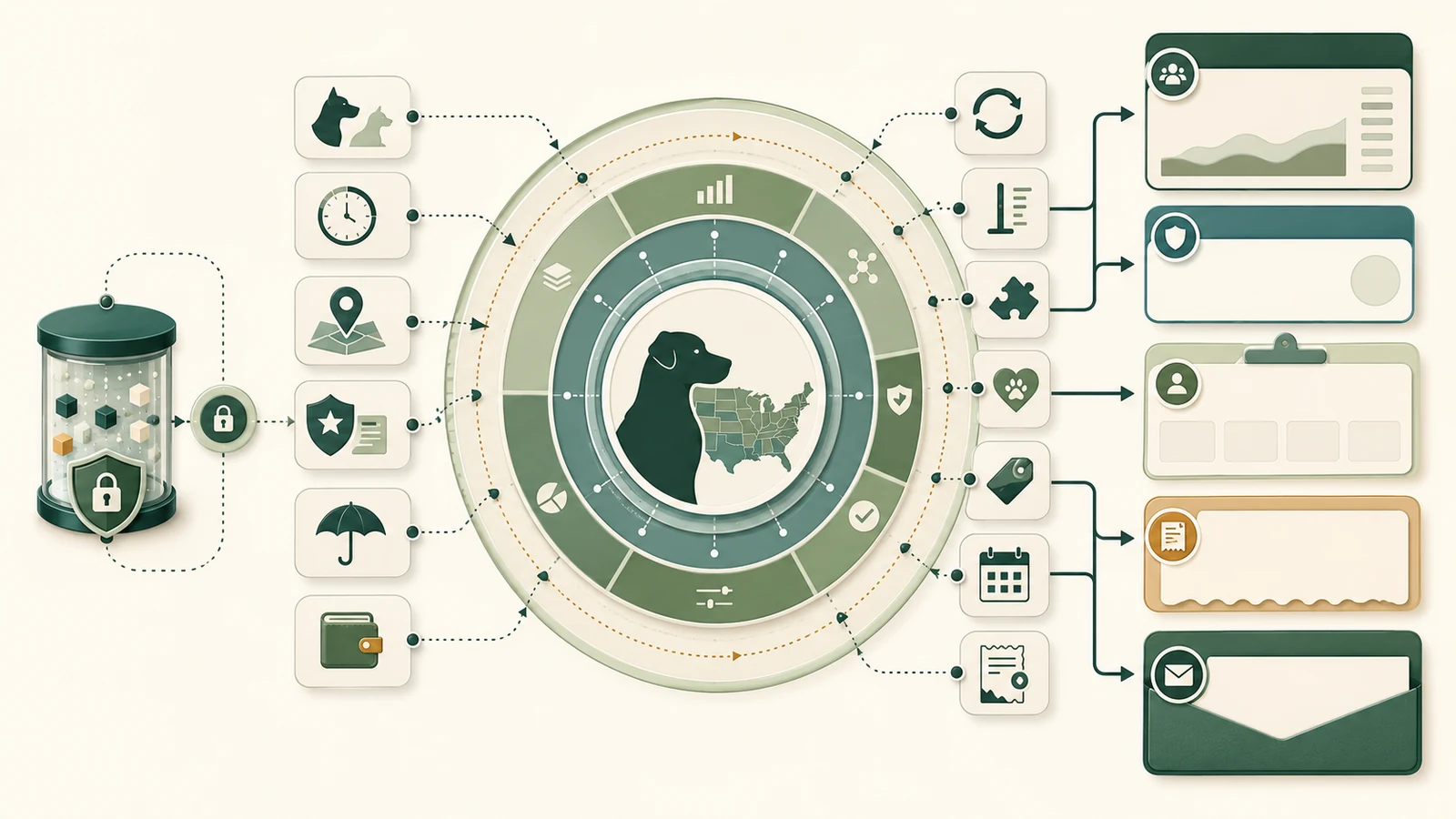
A documentation-first way to read pet insurance pricing evidence without turning an average, provider example, or fee line into an invented quote.
Evidence summary: This page cross-checks regulator material, industry methodology, and public provider documents. It records the input fields and limitations that make a price record comparable; it did not request a quote, submit personal data, or buy a policy.
Quick answer
Pet insurance pricing is a record of a particular pet, location, product or policy form, coverage configuration, fees, discounts, and time. A national average, a provider portfolio average, or a dated marketing example can describe its own population, but none is a current household quote. The safe comparison is to preserve the missing fields and compare only records with the same state, product identity, coverage choices, fee treatment, and time window.
Key facts
Swipe horizontally to see all columns.
| Field | Bounded answer | What remains unknown |
|---|---|---|
| Price record | A dated observation tied to a named population, product, coverage selection, or transaction. | Whether it applies to another pet, state, form, or date. |
| Currency and geography | This research packet uses United States records and USD labels where a source provides them. | A complete public geography or a universal state rate is not established. |
| Project quotes | Pet Signal Guide generated zero quotes and entered no quote inputs. | Any household premium must come from an exact provider or policy record. |
| Comparability | Match pet, location, underwriter, product, coverage, fees, discounts, billing and time. | Unknown fields stay unknown; they are not treated as zero. |
| Decision boundary | This page explains what to document before comparing records. | It does not rank providers, recommend a plan, or forecast renewal value. |
Takeaway: A number is useful only when its record type, scope, currency, period, source, and missing inputs travel with it.
Separate the record types
Start by naming what the number actually represents. The NAPHIA methodology explains how aggregate industry data is compiled, while provider pages describe their own examples or portfolios. Those sources do not turn a population statistic into a quote for an individual household.
Swipe horizontally to see all columns.
| Record type | It can show | It cannot establish |
|---|---|---|
| Factor statement | A source says a field may be considered, such as age, breed, location, deductible, or limit. | The factor’s weight, direction, or effect on a particular premium. |
| Industry aggregate | A historical population average with a stated period and method. | A current quote, a specific coverage design, or value for one pet. |
| Provider portfolio average | A provider-selected population or state summary with its own mix of plans. | A standardized comparison with another provider. |
| Advertised example or range | The inputs and conditions shown on a dated provider page. | A live offer when state, ZIP, timestamp, underwriter, or other inputs are missing. |
| Observed quote, bill, or renewal | A real record for a named product, time, and transaction or policy. | A forecast for a different date, pet, location, or coverage selection. |
Takeaway: Label the record before comparing the amount; otherwise unlike evidence is silently combined.
Start with identity and geography
The NAIC Pet Insurance Model Act is a framework, not automatically the law in every state. The NAIC state department directory and named state sources help locate the controlling regulator. California, Washington, Maine, Delaware, Louisiana, and New Hampshire examples in the research packet illustrate why disclosures can mention claim history, age, geography, limits, deductibles, coinsurance, or the underwriter without supplying a universal rate.
Swipe horizontally to see all columns.
| Identity field | Capture | Why a missing value matters |
|---|---|---|
| State and ZIP or risk location | The location used for the record and its effective date. | Availability, disclosures, taxes, fees, and rate treatment can vary by place and time. |
| Brand and underwriter | The consumer-facing brand and the legal risk-bearing entity named in the source or policy. | Two brands may use different entities, forms, or rating rules. |
| Product and form | Accident-only, accident-and-illness, rider or wellness program, form number and edition. | A similar label can hide different covered items, exclusions, or fee treatment. |
| Timestamp | Quote, example, bill, renewal, or publication date, with the source checked date. | A dated example is not a current offer after the product or rate changes. |
Takeaway: Preserve state, underwriter, form, and date before copying any amount into a comparison sheet.
Map pet and product inputs
Provider documents expose different input sets. Spot describes age, species or breed, location, coverage, deductible, reimbursement, and limit context. Embrace describes pet and ZIP inputs plus coverage choices, while Trupanion describes age, breed, location, policy type, and deductible context. These are provider statements, not a shared actuarial formula.
Swipe horizontally to see all columns.
| Input group | Record examples | Comparison boundary |
|---|---|---|
| Pet identity | Species, breed or mix, age, size, sex, spay or neuter, and other fields a provider exposes. | A collected field does not prove its pricing weight or direction. |
| Location | State, ZIP, address or local cost context, plus the date used. | Do not transplant a state-specific statement to another location. |
| Coverage design | Accident-only or accident-and-illness, deductible structure, reimbursement basis, annual limit, and riders. | A lower amount with narrower coverage is not evidence of better value. |
| Optional programs | Wellness, routine-care, membership, or discount features recorded separately. | A noninsurance charge must not be merged into an insurance premium. |
| Billing context | Monthly or annual frequency, installment or transaction fee, promotion, and tax status. | Unknown tax or required fees remain unknown. |
Takeaway: Compare like-for-like inputs first; do not infer a price effect from a field that a provider merely collects.
Keep fees, discounts, and wellness separate
Fee treatment can change cash outlay without changing the stated insurance benefit. The Embrace quote-help page states a one-time USD 25 activation fee in its documented flow. The public Pets Best enrollment example shows a USD 2 transaction fee alongside a sample plan amount. Those records are not interchangeable, and a separate wellness program is not automatically insurance.
- Keep recurring premium, one-time activation, transaction, installment, tax, and wellness charges in separate columns.
- Record the discount name, eligible state or group, base amount, duration, stacking rule, and expiration when the source supplies them.
- Preserve annual and monthly views only when the source states the billing basis; do not annualize an unknown or one-time amount as recurring.
- Write “unknown” when a source does not disclose tax, required fees, or the underwriter-specific treatment.
Takeaway: A clean comparison distinguishes insurance risk transfer from optional benefits and from the mechanics of collecting payment.
Do not merge an initial quote with renewal
An initial quote is a time-stamped offer or estimate for selected inputs. A renewal offer is a later record that may reflect the policy form, attained age, location, base-rate change, veterinary-cost environment, discount review, or product-population information. Embrace describes several renewal factors; Trupanion describes its own pricing architecture. These explanations do not support a forecast for another policyholder.
Record two separate lines: “what this dated policy or renewal notice says” and “what remains unknown for a future term.” Do not turn a provider explanation into a predicted renewal amount.
After a move, plan change, rider change, deductible change, or renewal, capture the new declarations, effective date, form or endorsement, discount treatment, and fee schedule. If the source does not identify the change, mark it unknown rather than treating the difference as a single factor.
Read examples and benchmarks in context
The table below keeps exact amounts attached to their record type, currency, geography, period, source, and missing inputs. Each amount was checked against the cited public source on August 15, 2026. None is a quote generated by Pet Signal Guide, and none is a recommendation or a forecast.
Swipe horizontally to see all columns.
| Record and amount | Exact context | Why it is not a quote |
|---|---|---|
| NAPHIA U.S. dog accident-and-illness aggregate: USD 749.29/year, or USD 62.44/month conversion | United States; dog; 2024 calendar-year aggregate reported in 2025; industry population, not a selected plan; no promotion; checked 2026-08-15. | It is historical aggregate data with mixed policies and no household pet, ZIP, form, deductible, limit, or quote timestamp. |
| Pets Best public Annie example: USD 99.23/month plan plus USD 2.00 transaction fee, USD 101.23/month shown total | Provider example; the page identifies an example pet and selected plan fields; state, ZIP, underwriter, and timestamp for the displayed amount are not all supplied; checked 2026-08-15. | Missing identity and timing fields make it a noncomparable example, not a live household offer. |
| ASPCA Rhode Island example: provider-stated starting ranges | Named Rhode Island examples with stated pet and coverage inputs and a dated provider page; currency is USD where displayed; checked 2026-08-15. | A starting range is provider marketing evidence for its stated inputs, not a current quote or market average. |
| Spot state averages: provider portfolio summaries | State summaries with mixed policy configurations and policyholder populations; no standardized deductible, limit, reimbursement, form, or time window across states; checked 2026-08-15. | A mixed portfolio average cannot be used as a like-for-like price comparison. |
Takeaway: Carry the source’s caveats beside the amount; removing them changes the meaning of the record.
Use a privacy-safe comparison record
Quote flows may ask for a ZIP or address, contact details, pet information, veterinarian, device or account information, and payment details. The Spot privacy policy, Embrace privacy policy, and Pets Best privacy agreement describe their own collection and sharing boundaries. Pet Signal Guide did not open a quote flow, enter a name, ZIP, pet or medical record, submit a form, create an account, or retain a screenshot.
Use the evidence process: Before any future comparison, write the purpose, approved geography, exact fields, redaction rule, retention period, and deletion confirmation. See how Pet Signal Guide researches documentation; this page does not collect quote data.
Swipe horizontally to see all columns.
| Field group | Minimum record | Privacy boundary |
|---|---|---|
| Purpose and scope | Question, approved state or geography, record type, and date window. | Do not collect extra fields simply because a quote form displays them. |
| Pet and owner data | Use a non-identifying description only when the task explicitly authorizes it. | No real name, address, contact, account, medical or payment data in this research workflow. |
| Evidence capture | Source URL, timestamp, visible inputs, currency, fees, and missing fields. | Redact identifiers and do not retain screenshots that expose them. |
| Retention | Record what was kept, where, why, and when it was deleted. | No affiliate identifier, lead attribution, or purchase action. |
Takeaway: Data minimization is part of price evidence; a comparison is not safer just because the form is public.
Build a bounded decision record
A useful worksheet does not need a winner column. It needs enough identity and scope to show whether two records can be compared and enough unknowns to stop an overconfident conclusion.
Swipe horizontally to see all columns.
| Checkpoint | Write down | Stop condition |
|---|---|---|
| Identity | State, ZIP or risk location, brand, underwriter, product, form, and effective date. | Any identity field is missing or two sources name different entities. |
| Configuration | Pet inputs, coverage, deductible, reimbursement, limits, riders, wellness, discounts, billing, fees, and tax status. | Coverage or fee treatment is not equivalent. |
| Record type | Aggregate, portfolio average, example, quote, bill, or renewal offer. | One record type is being presented as another. |
| Time window | Observed date, source checked date, promotion period, and renewal term. | Dates are outside the agreed comparison window or unknown. |
| Conclusion | Only the bounded difference that the records support, plus unresolved fields. | A conclusion would require a recommendation, forecast, claim prediction, or legal interpretation. |
Takeaway: A stop condition is a valid result; it prevents missing inputs from becoming invented certainty.
What this page does not establish
- A current premium, quote, application result, billed amount, renewal amount, or policy offer for any household.
- Which insurer, underwriter, product, deductible, reimbursement, limit, rider, wellness program, or payment frequency is best, cheapest, or suitable.
- A universal rating factor, actuarial coefficient, state-wide rate, complete state-law survey, or legal conclusion.
- Future renewal movement, savings, return on investment, claim payment, denial, appeal, or veterinary cost.
- That a provider example, industry average, privacy statement, or public form applies to another state, pet, product, or date.
The California consumer questions illustrate questions a buyer can ask in one named jurisdiction. They do not replace the policy, declarations, state regulator, or qualified professional for a different situation.
Method
We separated source-owner statements from cross-source synthesis, named every price record type, preserved currency and period, and left missing fields unknown. We checked regulator and industry routes plus the cited Spot, Embrace, Trupanion, Pets Best, and ASPCA records against the research packet, then refreshed the reader-facing source set on August 15, 2026. No quote flow, policy account, purchase, claim, renewal, affiliate identifier, or personal or medical data was used.
Sources
- National Association of Insurance Commissioners, Pet Insurance Model Act Model framework and scope boundary; checked August 15, 2026.
- National Association of Insurance Commissioners, State Insurance Departments Regulator directory; checked August 15, 2026.
- NAPHIA, State of the Industry Report 2026 Industry context; checked August 15, 2026.
- NAPHIA, About This Data Aggregate methodology and limitations; checked August 15, 2026.
- NAPHIA, 2025 State of the Industry highlights 2024 U.S. aggregate example; checked August 15, 2026.
- California Department of Insurance, Pet Insurance Questions Named state consumer questions; checked August 15, 2026.
- Spot, How Much Does Pet Insurance Cost? Provider factor statements; checked August 15, 2026.
- Spot, How Much Is Pet Insurance? Provider portfolio summaries; checked August 15, 2026.
- Spot, Privacy Policy Quote-data collection boundary; checked August 15, 2026.
- Embrace, Quote or Purchase Help Input and activation-fee statements; checked August 15, 2026.
- Embrace, Why Did My Premium Change? Provider renewal explanation; checked August 15, 2026.
- Embrace, Wellness Rewards Terms Separate noninsurance program boundary; checked August 15, 2026.
- Embrace, Privacy Policy Privacy boundary; checked August 15, 2026.
- Trupanion, How Pet Insurance Works Provider factor statements; checked August 15, 2026.
- Trupanion, Pricing Promise Provider pricing architecture; checked August 15, 2026.
- Pets Best, Enrollment Confirmation Example Dated public example and fee context; checked August 15, 2026.
- Pets Best, Privacy Agreement Application and data boundary; checked August 15, 2026.
- ASPCA Pet Health Insurance, Rhode Island Example Named-state provider example; checked August 15, 2026.