
Quick answer
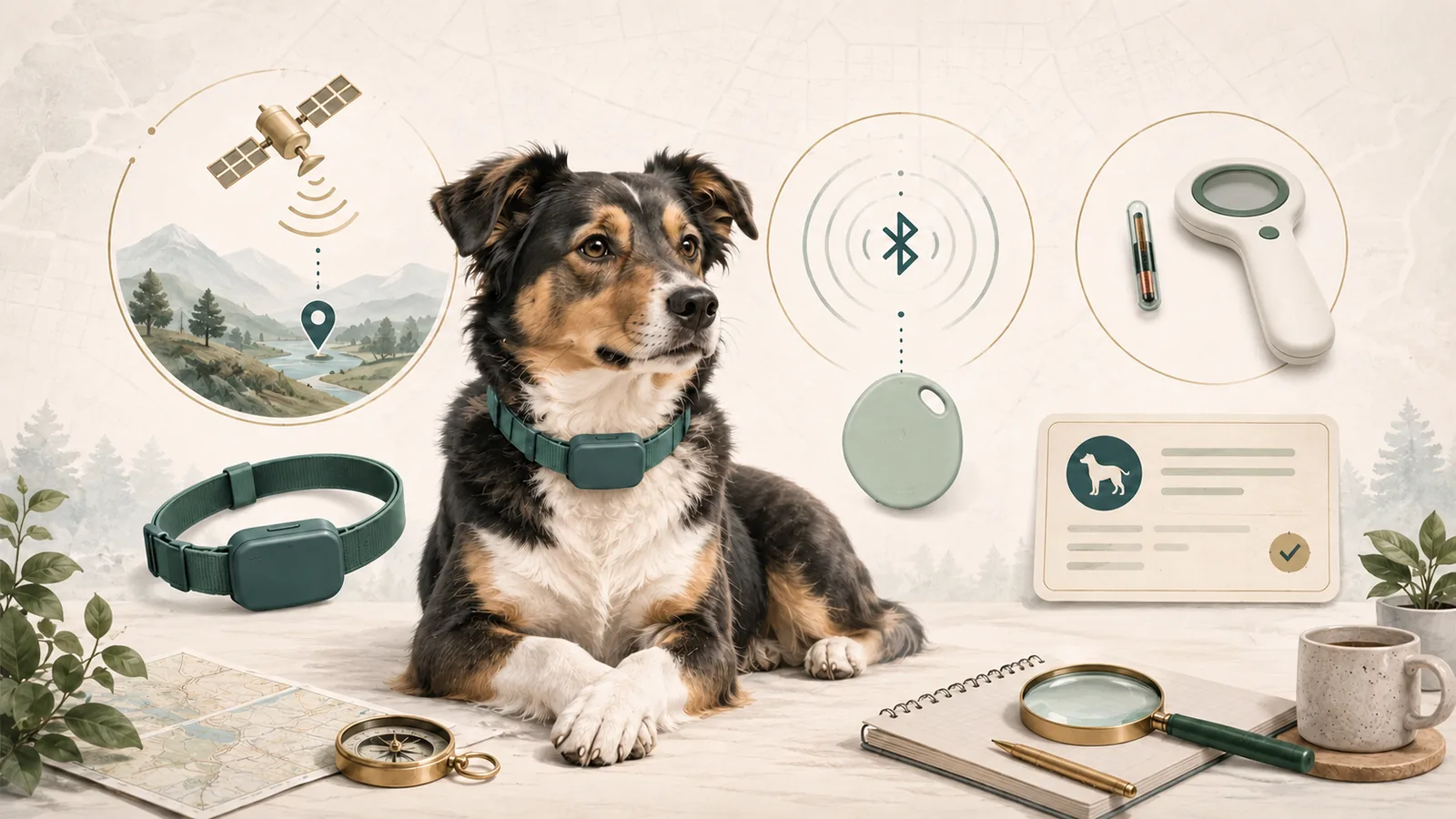
Choose the job before the device category. A complete GPS or GNSS tracker is the relevant category when you need remote or periodically updated location before someone physically finds the dog. A Bluetooth tag is a narrower tool for nearby finding or opportunistic crowd-assisted updates. A passive microchip supports identification only after the dog is found, scanned, and matched to a current registry record. None is a universal winner, and the three may be complementary because they cover different stages of a loss-and-recovery workflow.
Key facts
Swipe horizontally to see all columns.
| Option | Primary buyer job |
|---|---|
| GPS or GNSS tracker | Remote or periodically updated location through the product’s documented reporting path. |
| Bluetooth tag | Nearby finding or opportunistic crowd-assisted updates within the supported platform. |
| Passive microchip | Identification after the dog is found, scanned, and matched to a current registry record. |
| Decision boundary | None is a universal winner; the layers can complement one another because they address different stages. |
| Evidence limit | No device, service, range, battery, fit, safety, privacy, reliability, or price was directly tested. |
Choose the recovery job first, then evaluate the exact product or workflow that performs it.
For the underlying mechanics – GNSS, reporting paths, Bluetooth, crowd networks, Wi-Fi roles, and scanning workflows – start with How Pet Location Technologies Work. This page applies those foundations to a three-way decision.
GPS tracker vs Bluetooth tag vs microchip at a glance
Swipe horizontally to see all columns.
| Category | Primary job | Can provide remote updates? | Can help nearby? | Can identify the owner after a scan? | Main dependencies | Main limit |
|---|---|---|---|---|---|---|
| Complete GPS/GNSS tracker system | Remote or periodically updated location | Yes, when the reporting path, power, and service work | Sometimes, if the exact system adds nearby features | No | Satellite signals, reporting path, battery, app or handheld, account or service where applicable | Positioning and reporting can fail separately; performance varies by product and environment |
| Bluetooth tag | Nearby finding and optional crowd-assisted updates | Not independently continuous | Yes, within the exact implementation and supported features | No | Bluetooth, compatible phone or ecosystem, permissions, account or data connection where required, participating finder devices for crowd updates | No universal range or update timing; behavior is platform-specific |
| Passive microchip | Identification after physical recovery | No | No | Yes, through scan, registry lookup, and current contact information | Compatible scanner, registry participation, accessible record, current contact details | Does not report location; the recovery workflow is not fail-safe |
Takeaway: these categories are not interchangeable products. The relevant option depends on whether the job is finding, relaying a location, or identifying a dog after recovery.
Start with the job, not the label
The word tracker can hide several separate system functions. GPS provides positioning and timing, but a remote tracker also needs a communication path and an owner-facing app or handheld. A Bluetooth tag broadcasts a short-range signal and may participate in a crowd network. A microchip returns an identifier only when a compatible scanner reads it.
That is why “Which one is best?” is usually the wrong first question. A better question is: What must happen before the dog is physically found, and what must happen after recovery?
GPS tracker: the category for remote location
A complete remote tracker combines positioning with a reporting path. Tractive documents a GPS-plus-cellular architecture, and Fi documents cellular and membership dependencies for its current trackers. Cellular is not universal, however: Garmin documents a VHF radio link for the Alpha T 20 and a compatible handheld.
Use this category when the required job is to receive location updates before another person physically recovers the dog. The exact device still needs working power, a usable position fix, and its documented reporting path.
Coverage is not a guarantee
The Federal Communications Commission explains that mobile coverage maps are modeled representations. They do not guarantee indoor coverage, signal strength, or one user’s experience. A coverage map is a screening input, not proof that a specific tracker will update reliably in a specific place.
A GPS label also does not establish product accuracy. GPS.gov explains that user accuracy depends on satellite geometry, blockage, atmosphere, and receiver design. This article therefore does not compare product accuracy, update latency, battery life, or reliability.
Bluetooth tag: nearby and crowd-assisted finding
A Bluetooth tag is a narrower category. The Bluetooth SIG says effective range depends on the implementation and environment, including radio design, transmit power, receiver sensitivity, antennas, obstacles, and path loss. There is no evidence-safe universal range for pet tags.
Nearby, an exact implementation may ring, connect, estimate closeness, or provide direction-related help. Outside direct range, some tags can receive crowd-assisted updates when another participating device detects them.
Tile documents that the Tile itself has no GPS or real-time location monitoring. It can ring in range, show a prior connection location, and use the Tile Network when another participant comes within range. Tile’s pet-use support page describes attaching a Tile to a pet collar while retaining the limitation that it does not provide real-time location tracking. Tile also warns that a network notification may not be immediate and that the item may have moved after the last update.
Apple’s platform has its own rules. Apple Find My can show an approximate item location and nearby-finding features for AirTag, while Apple also states that AirTag is designed exclusively for objects, not people or pets. That statement is Apple-specific, but it illustrates why intended use must be checked for the exact tag.
Use the Bluetooth-tag category when the required job is nearby finding or opportunistic crowd-assisted updates – and when its platform limits are acceptable. Do not treat it as continuous remote tracking.
Microchip: identification after recovery
A passive microchip does not tell you where a dog is. The American Animal Hospital Association states that microchips are identification devices, not GPS trackers. A useful recovery workflow begins only after someone physically finds the dog and a compatible scanner retrieves the identifier.
The identifier must then connect to a registry or lookup workflow. The AAHA Microchip Registry Lookup helps identify candidate registries; it does not reveal owner information itself. FDA guidance also emphasizes registration and current contact information.
The workflow is not fail-safe. AAHA notes that different microchip frequencies exist and scanners are not 100 percent effective at detecting every chip. WSAVA guidance also treats the reader as an integral part of the identification system.
Use the microchip category when the required job is owner identification after recovery. It does not substitute for remote or nearby finding.
Decision path by buyer job
1. Do you need location before someone physically finds the dog?
If yes, a microchip cannot perform that job. Continue to the next question.
2. Do you need remote or periodically updated location at a distance?
If yes, the relevant category is a complete GPS or GNSS tracker with a working reporting path. Verify the exact architecture, service, coverage, power, app or handheld, and attachment requirements.
3. Is nearby finding or an opportunistic crowd update enough?
If yes, a compatible Bluetooth tag may fit that narrower job. Verify the platform, nearby features, crowd-network behavior, permissions, intended use, and the fact that updates may be delayed or absent.
4. Do you need identification if a clinic, shelter, or another finder recovers the dog?
If yes, a registered microchip and current registry record address that job. The chip still requires a successful scan and lookup.
When layers may complement one another
Because the jobs differ, more than one layer may be useful in some scenarios. That does not mean every owner needs all three, and it does not prove one universal setup is superior.
Swipe horizontally to see all columns.
| Stage | Layer that may contribute | What it helps with | What remains separate |
|---|---|---|---|
| Dog is away and not yet recovered | Complete remote tracker | Remote or periodic location updates through the documented system | Owner identification if the wearable is missing or the dog is found later |
| Attached device is nearby or encountered by a network participant | Bluetooth tag | Nearby finding or an opportunistic platform-mediated update | Continuous independent remote reporting and owner identification |
| Dog is physically found and scanned | Microchip and registry workflow | Connect a scanned identifier to current contact information | Showing where the dog was before recovery |
Takeaway: a microchip and a location aid are not redundant. One addresses post-recovery identity; the other may help before recovery.
What to verify before choosing an exact option
For a remote tracker
- Positioning and reporting architecture.
- Cellular, VHF, satellite, or other service dependency.
- Coverage evidence for the places that matter.
- Account, membership, app, or handheld requirements.
- Battery and charging workflow.
- Exact attachment and fit documentation.
For a Bluetooth tag
- Supported phone and platform ecosystem.
- Nearby-finding features, such as ringing, distance, or direction.
- Crowd-network participation and notification behavior.
- Account, permission, and data-connection requirements.
- Manufacturer’s intended use.
- Exact attachment documentation.
For a microchip workflow
- Registry accessibility and reliability.
- Current owner contact information.
- Scanner compatibility and traceability.
- Whether the chip number resolves through the relevant lookup process.
- A record of the microchip number and registry.
This checklist does not certify an exact product, attachment, implant procedure, fit, or safety outcome. Those questions require the current product and appropriate professional or authority evidence.
What this comparison does not establish
This page does not establish a product winner, the safest attachment, the longest battery life, the most accurate tracker, the most reliable network, the lowest total cost, product-specific privacy or data-handling differences, or the best option for every dog. Those conclusions require an eligible product set, evidence parity, current prices, current privacy documentation, and in some cases controlled testing or specialist review.
What we could not verify
- One universal reliable Bluetooth range for pet tags.
- A rule that every GPS pet tracker requires cellular service or a subscription.
- Guaranteed continuous location updates, accuracy, or coverage for GPS trackers.
- A predictable update interval or universal urban-versus-rural success rate for crowd networks.
- A microchip reunification statistic suitable for deciding that identification is superior to location technology.
- Product-specific winners for battery, fit, attachment safety, durability, price, accuracy, or reliability.
These are evidence controls, not proof of the opposite conclusion.
Method
This comparison uses research cross-checked across public sources, last checked on 2026-07-22. Sources include United States government GPS and communications guidance, Bluetooth SIG technical guidance, veterinary-association and FDA microchip records, and current platform-owner documentation for exact Apple, Tile, Tractive, Fi, and Garmin examples.
No tracker, tag, scanner, account, membership, app, or handheld was purchased, operated, or tested. No current prices were compared, no affiliate relationship is present, and no specialist reviewed the article. The comparison rubric uses buyer job, infrastructure, power or service dependency, failure boundary, and what each category cannot establish by itself.
Read more about how Pet Signal Guide researches and evaluates pet technology.
Sources
- GPS.gov – GPS
- GPS.gov – GPS Accuracy
- Federal Communications Commission – What’s on the National Broadband Map
- Bluetooth SIG – Understanding Bluetooth Range
- Life360 / Tile – Find My Tile
- Life360 / Tile – Use Tile with My Pets
- Apple Support – Use Find My to Locate Your Lost Apple Device or AirTag
- Apple – New AirTag Update
- AAHA – Frequently Asked Questions About Pet Microchipping
- AAHA – Microchip Registry Lookup
- AAHA – Animal Identification and Microchipping
- FDA – Take Care of Your Pets Before Disaster Strikes
- WSAVA – Microchip Identification Guidelines
- Tractive – Do I Need Wi-Fi for My Tracker?
- Fi – Tracker Cellular Coverage
- Garmin – Alpha T 20 Dog Collar Device Specifications