
Smart feeder maintenance
A smart feeder is not one washable object. The bowl, hopper, rotor or conveyor, electronic base, power connector, RFID reader or tag, camera housing, desiccant, app, schedule and food record can each have different maintenance rules. Confirm the exact model first, keep a manual feeding fallback available, and treat fully dry reassembly as a hard gate before automation resumes.
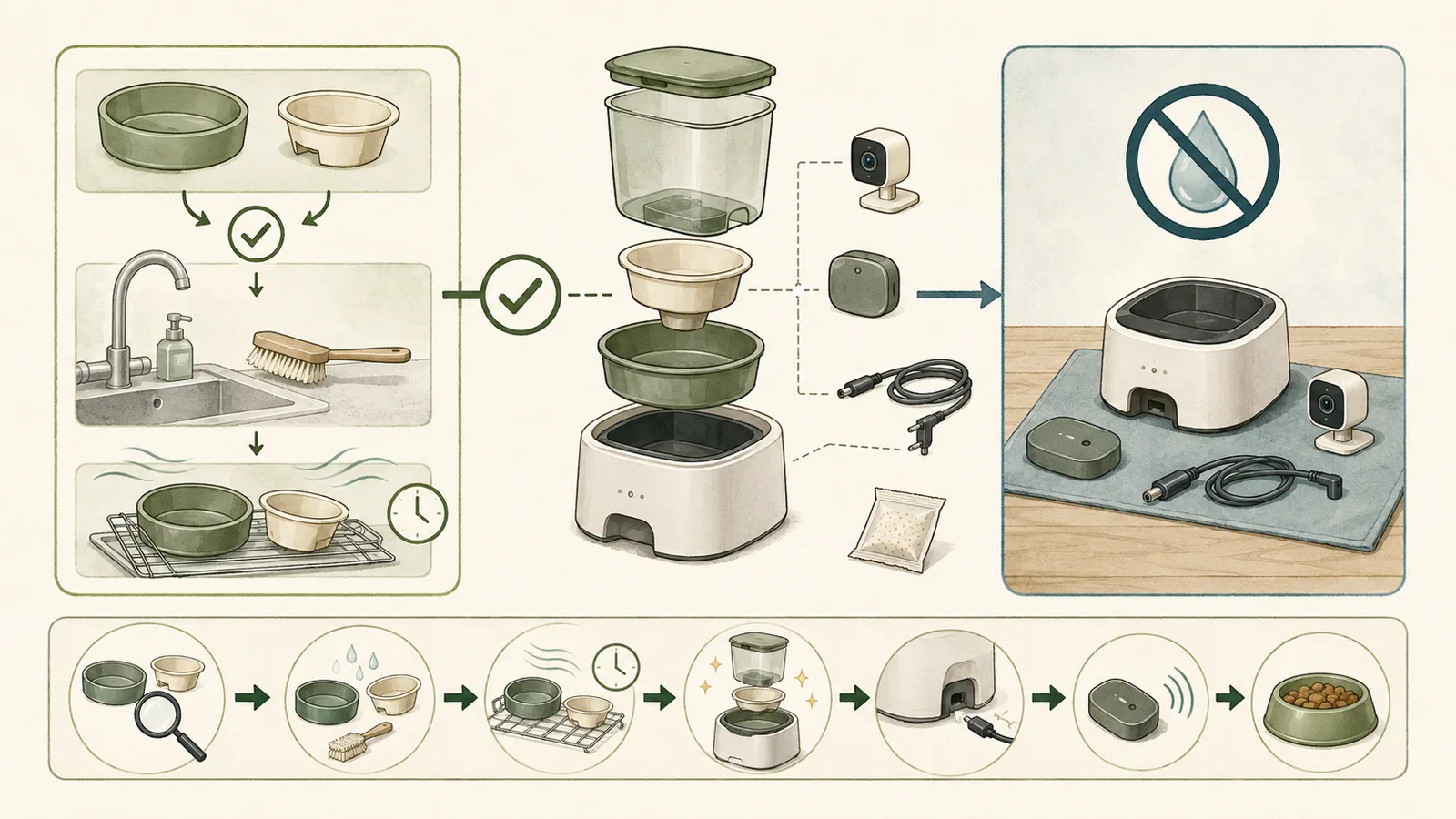
Quick answer
Use a four-boundary rule – exact model, exact part, exact wetting permission, exact post-clean check – without treating removability as dishwasher permission or an app feed event as proof that the intended pet ate.
Before opening the feeder, disconnect power, remove food, preserve the food product and lot information, and make sure the household can feed manually while parts are wet or drying.
On smaller screens, scroll the table horizontally.
| Question | Proceed only when | Stop or condition |
|---|---|---|
| Exact model? | Manufacturer, product and model match the current instruction | A sibling product or generic feeder page is the only evidence |
| Power and fallback? | Power is disconnected and manual feeding is available | The partly disassembled feeder is the only feeding path |
| Washable part? | The exact instruction permits washing that component | Material or appearance is being used to infer permission |
| Dishwasher? | The exact part is explicitly permitted | Permission is absent or another component is excluded |
| Dry enough? | Every washed part is fully dry before refill and power | Any part, seal, connector or cavity remains uncertain |
| Ready to resume? | Assembly, schedule, small manual feed and app state are checked | An abnormal result remains or a destructive reset would erase evidence |
Proceed only when the exact model, part-level wetting permission, full drying, reassembly, fallback, and post-clean check are all accounted for.
Key facts
- Model boundary
- Use the exact current instruction for the exact feeder and component; sibling or generic pages cannot grant cleaning permission.
- Wetting boundary
- Wash, wipe, rinse, soak, or dishwash a component only when its exact instruction permits that treatment.
- Return-to-service gate
- Every washed part must be fully dry, correctly reassembled, and checked with the existing household food and plan before automation resumes.
- Evidence boundary
- A maintenance step or one observed dispense does not establish hygiene, long-term reliability, portion accuracy, or consumption.
Map the parts before cleaning
The safest documentation workflow begins with a part map. Food-contact parts may include the bowl, bowl holder, hopper, lid, rotor, conveyor, crumb catcher and outlet. Non-food-contact but maintenance-relevant parts can include the base, adapter, connector, RFID reader mat, collar tag, camera housing, microphone and speaker openings. Each exact manual controls whether a part can be rinsed, wiped, soaked or placed in a dishwasher.
On smaller screens, scroll the table horizontally.
| Architecture | Likely removable food-path parts | Keep dry or separately controlled | Main unresolved field |
|---|---|---|---|
| PETLIBRO One RFID / PLAF301 | Bowl, holder, hopper, lid and permitted rotor/outlet parts | Base, connector, RFID reader mat and collar tag | No universal interval or whole-path dishwasher permission |
| PetSafe Smart Feed Gen 2 / PFD00-16828 | Bowl, holder, hopper, lid and specified removable conveyor parts | Electronic base and power connection | Semi-moist maintenance path conflicts in exact records |
| PETLIBRO Granary Camera Feeder / PLAF203 | Bowl, holder, hopper, lid and permitted removable food-path parts | Electronic base, camera housing, microphone/speaker openings and connector | Exact current US camera-housing procedure remains limited |
A parts map helps identify the correct question, but only the exact-model instruction grants permission to wash, wet, or dishwash a component.
A generic cleaning article can help identify questions, but it cannot replace the exact model instruction. Even within one brand, a reader, camera or conveyor can change the wetting boundary.
Before disassembly
- Confirm the manufacturer, product and exact model.
- Move the pet to the household’s normal manual feeding path; do not experiment with missed meals.
- Disconnect power and remove backup batteries when the exact instructions require it.
- Remove food and preserve its product name, lot number and best-by date.
- Photograph or privately record the correct part positions, schedule and time zone without capturing passwords or tokens.
- Prepare the exact permitted tools and cleaning materials. Do not improvise disinfectant, concentration, soak time or water temperature.
FDA guidance supports keeping original food packaging or lot information and using routine food-handling hygiene. It does not establish a feeder-specific cleaning chemistry or interval.
PETLIBRO One RFID / PLAF301
This feeder adds a reader mat and collar tag to the food path. Exact documentation separates washable/removable parts from the base, reader, tag and power connection. Keep the electronics and RFID components within their documented wetting limits. A splashproof tag is not a submersible part, and a reader mat is not a bowl.
On smaller screens, scroll the table horizontally.
| Stage | Documentation-led check | Do not infer |
|---|---|---|
| Disassembly | Remove food; disconnect power; identify bowl, hopper, lid, rotor/outlet, base, reader and tag | That every removable part can be soaked or dishwashed |
| Cleaning | Follow exact wetting and drying instructions for each component | That a wet cloth is permitted on the reader/base because it looks sealed |
| Desiccant | Check exact current product instructions and selected pack | A universal two-week rule for every feeder or climate |
| Reassembly | Seat food path, outlet and reader components exactly | That app status proves mechanical alignment |
| Verification | Restore schedule; run a small owner-approved manual feed; check tag path without using the pet as a test subject | Recognition rate, dispense accuracy or consumption |
For PLAF301, keep the base, power connection, reader, and tag within their documented wetting limits and verify reassembly without treating one check as a performance result.
Rotor or outlet residue may be relevant to a no-dispense symptom, but a support page does not tell us how often the problem occurs or whether cleaning will resolve it in this household.
PetSafe Smart Feed Gen 2 / PFD00-16828
PetSafe documents warm soapy water, rinsing and full drying for specified removable components while the electronic base stays dry. The exact cleaning record also distinguishes dishwasher-permitted parts from the conveyor and crumb catcher, which are not dishwasher-safe. Reassembly needs the conveyor, crumb catcher, hopper, bowl holder, bowl and lid seated correctly.
On smaller screens, scroll the table horizontally.
| Component or state | Retained documentation boundary | Verification after reassembly |
|---|---|---|
| Bowl and holder | Clean only under the exact removable-part instruction | Seat correctly and confirm clear outlet path |
| Hopper and lid | Clean/rinse/dry where permitted | Confirm alignment and secure fit |
| Conveyor and crumb catcher | Not dishwasher-safe in the retained exact cleaning record | Inspect for debris and seat exactly |
| Electronic base | Keep dry | Restore power only after all washed parts are dry |
| Schedule/time zone | Can be affected by reconnect/reset workflows | Recheck before relying on automatic meals |
| Manual feed | Useful as a small operational check | Does not establish portion accuracy or pet consumption |
PetSafe cleaning rules are component-specific: the base stays dry, and the conveyor and crumb catcher are not dishwasher-safe.
Current exact-model support documentation lists both dry and semi-moist food, but it does not establish a separate cleaning interval or a hygiene outcome for either food type. Use the same part-level cleaning limits and recheck the current product instructions before changing food or maintenance practice.
PETLIBRO Granary Camera Feeder / PLAF203
A camera feeder adds another keep-dry boundary. The electronic base, camera housing, microphone/speaker openings and power connection should not be treated like the bowl or hopper. Current feeder-family cleaning documentation can support questions about removable food-path parts, but it does not establish that every PLAF203 camera-housing surface, seam or opening can be cleaned the same way.
On smaller screens, scroll the table horizontally.
| Layer | Maintenance question | Evidence limit |
|---|---|---|
| Food path | Which exact bowl, holder, hopper, lid, rotor and outlet parts are removable and washable? | No controlled cleaning or jam test |
| Camera/electronics | How should the housing, lens area and openings be kept dry and wiped? | Exact current US text remains limited |
| Desiccant | What exact pack and cadence apply to this model and market? | Localized roughly-15-day wording is not universal |
| Network/app | Does the device reconnect and show expected status after reassembly? | No reconnect-time or uptime measurement |
| Recording | Does local/cloud recording appear in the documented state? | A clip is not proof that feeding or consumption occurred |
A camera feeder adds keep-dry electronics and recording dependencies that cannot be inferred from bowl, hopper, or sibling-model cleaning instructions.
Washing and wetting limits
Use only the cleaning agents, water exposure and tools permitted by the exact current instruction. “Food-contact” does not automatically mean “soakable,” and “wipeable” does not automatically mean “rinseable.” Avoid directing water toward motors, bases, connectors, readers, tags, cameras, microphones, speakers or seams unless the exact instruction explicitly permits it.
This package does not prescribe disinfectants, bleach concentration, vinegar, alcohol, steam, brush stiffness, soak time or water temperature beyond what the cited authority or manufacturer says. Those details can affect materials, coatings, seals and electronics and cannot be safely invented.
Dishwasher claims need part-level proof
Dishwasher permission belongs to an exact part, not to the whole feeder. PetSafe’s retained documentation expressly excludes the conveyor and crumb catcher even though other removable parts may have a different status. For PETLIBRO products, the package does not infer whole-path dishwasher safety from a stainless-steel bowl or removable hopper.
When exact permission is absent, hand-clean only within the documented boundary or stop and ask the manufacturer. A high-temperature cycle, detergent chemistry and drying cycle can affect materials differently; no long-term dishwasher or seal-durability test was performed.
Drying is a hard gate
Do not refill, reconnect power or resume automatic use while any washed component, cavity, seal, rotor, conveyor or connector area remains uncertain. Full drying is a prerequisite to reassembly – not an optional finishing step. The exact manuals may say “dry thoroughly,” but this package did not measure moisture or establish a universal dry time.
Desiccant and cleaning intervals
Desiccant is model-specific. PETLIBRO documents it for the sampled feeders, but pack size, current price and replacement wording can change, and localized records may not match the current US product path. PetSafe’s exact sampled feeder did not establish a required desiccant consumable in this package.
On smaller screens, scroll the table horizontally.
| Trigger | Reasonable documentation action | What is not established |
|---|---|---|
| Exact manual or support interval | Record the model, source and checked date | That the interval applies to every climate, food or feeder |
| Visible residue, spill or blocked outlet | Stop automation; clean only permitted parts; inspect reassembly | Microbial safety or repair success |
| Food change | Confirm compatibility and preserve the new lot | That cleaning resolves a food/documentation conflict |
| Long storage | Inspect food, parts, power path, seals and schedule before use | A universal storage-to-service protocol |
| Before travel or caregiver handoff | Complete maintenance early enough to dry and verify; retain manual fallback | That a last-minute check guarantees operation |
| Desiccant due under exact instructions | Use the exact compatible pack and document the action | That desiccant substitutes for proper storage or cleaning |
Cleaning and desiccant intervals remain exact-model and condition dependent; no generic cadence substitutes for the current instruction and observed trigger.
Reassemble the food path exactly
Use the documented order and alignment for the bowl holder, bowl, hopper, lid, rotor or conveyor, crumb catcher, outlet, reader or camera components. A component that appears seated can still be misaligned. Preserve schedules and evidence before any reset; reset is not a cleaning step and can erase configuration.
Do not refill with a full hopper as the first test. After all parts are dry and assembled, restore only the household’s existing food and plan, then run a small owner-approved manual dispense into an empty bowl while observing the food path. If the result is abnormal, stop automatic use and follow the exact troubleshooting/support route.
Post-maintenance verification
On smaller screens, scroll the table horizontally.
| Check | What it can establish | What it cannot establish |
|---|---|---|
| Visual part seating | Obvious missing or misaligned components | Dispense accuracy or long-term reliability |
| Schedule and time zone | The intended configuration is present | That a future meal will occur on time |
| Small manual dispense | The feeder can perform one observed action | Normal portion accuracy, jam rate or pet consumption |
| App/device status | Current reported connection or setting state | Cloud uptime, notification latency or mechanical state |
| RFID access check | A controlled tag/device interaction without a pet | Comfort, real-world recognition rate or correct pet consumption |
| Camera view/recording check | A current visible/recorded state if documented | That food reached the bowl or the pet ate |
| Manual fallback ready | A human feeding path exists if automation is uncertain | A medical feeding plan or emergency threshold |
Post-maintenance checks establish only the observed configuration and action; they do not prove future dispensing, hygiene, reliability, or pet consumption.
Separate food concerns from device maintenance
If food looks or smells abnormal, has moisture, insects or foreign material, or is associated with a recall or complaint concern, do not assume cleaning the feeder resolves the issue. Preserve the product name, lot number, best-by date, packaging, timestamps and relevant non-sensitive observations. Follow the food manufacturer, FDA complaint/recall and veterinary routes as applicable.
If the pet shows concerning signs, generic device maintenance stops. Contact a veterinarian or emergency animal hospital. This page does not diagnose contamination, decide whether the food caused a symptom or define how urgently an individual pet needs care.
When maintenance does not fix the problem
Use the least-destructive exact-model path: recheck power, food compatibility, food level, outlet, rotor/conveyor, alignment, schedule/time zone and connection state. Keep the manual fallback active. Preserve settings and non-sensitive evidence before reset. Repeated reset without understanding the symptom can erase schedule or incident information while leaving the mechanical cause unchanged.
If the immediate question is whether a scheduled meal occurred, follow the separate smart feeder missed-meal troubleshooting and backup workflow before continuing device work.
Manufacturer support pages establish available checks, not failure frequency, repair success or product reliability. Record the exact model, food, lot, symptom, maintenance action and result so support can distinguish a food-path, assembly, power, account or network problem.
Keep a maintenance log
On smaller screens, scroll the table horizontally.
| Field | Why retain it |
|---|---|
| Date, exact product/model and maintenance reason | Separates device versions and recurring patterns |
| Food product, lot and best-by | Supports traceability and recall/complaint handling |
| Parts washed and parts kept dry | Documents the wetting boundary used |
| Cleaning agent, water exposure and dishwasher parts | Makes the actual process reviewable |
| Drying method and completion | Records the hard gate before reassembly |
| Desiccant action | Separates model-specific consumable maintenance |
| Reassembly, schedule and manual-feed result | Documents the return-to-service checks |
| Manual fallback and support case | Shows how uncertain automation was handled |
A concise maintenance log preserves model, food, wetting, drying, reassembly, and fallback facts without exposing credentials or claiming a clean or reliable outcome.
Do not place passwords, door codes, account tokens or detailed medical records in a public or broadly shared copy.
What remains untested
No sampled feeder was opened, washed, dried, reassembled or operated. There is no microbial count, residue measurement, moisture reading, corrosion test, seal assessment, dishwasher durability result, dispensing-accuracy measurement, jam prevalence, battery runtime, reconnect time, notification latency, support-quality result or pet outcome. No qualified specialist reviewed the package, so the specialist-reviewed evidence target is not achieved.
The workflow can help a household avoid common documentation mistakes – wrong model, wet electronics, inferred dishwasher safety, incomplete drying, lost schedule or no manual fallback. It cannot certify that a feeder is clean, safe, reliable or suitable for a specific pet.
Sources
- U.S. Food and Drug Administration – Proper Storage of Pet Food & Treats. Original packaging, lot information, cool/dry storage and bowl/utensil cleaning context; not feeder-performance evidence.
- U.S. Food and Drug Administration – Tips for Safe Handling of Pet Food and Treats. General handwashing, bowl and utensil cleaning and unused-food handling; not individualized veterinary advice.
- U.S. Food and Drug Administration – How to Report a Pet Food Complaint. Complaint evidence fields and routing; not proof that a feeder caused a problem.
- U.S. Food and Drug Administration – Save Your Pet Food Lot Number!. Lot-number retention and traceability; not feeder-specific evidence.
- U.S. Food and Drug Administration – Recalls, Market Withdrawals, and Safety Alerts. Recall monitoring route; not a current recall conclusion for any food in the household.
- U.S. Food and Drug Administration – Who Do You Call If You Have a Pet Emergency?. Veterinarian and emergency-animal-hospital routing; not diagnosis or treatment.
- NIST – Profile of the IoT Core Baseline for Consumer IoT Products. Consumer-IoT product-system framing; not a feeder certification, reliability finding or security audit.
- Federal Trade Commission – Securing Your Internet-Connected Devices at Home. General router, update and account guidance; not exact-product implementation evidence.
- PETLIBRO – One RFID Smart Feeder. Exact PLAF301 identity, food range, power, tag and box contents; no use test.
- PETLIBRO – One RFID Smart Feeder Pre-Sale Inquiries. Product-use, bowl and positioning boundaries; no pet-fit observation.
- PETLIBRO – How Do I Disassemble and Clean the One RFID Pet Feeder?. Parts-specific wetting and drying limits; no hygiene outcome test.
- PETLIBRO – What Can I Do If the One RFID Feeder Does Not Dispense Food?. Power, food, rotor, cleaning and manual-feed checks; no incidence or repair-success rate.
- PETLIBRO – What Should I Do If My One RFID Feeder Shows a Rotor Stuck Error?. Rotor-stuck workflow; no prevalence or independent recovery result.
- PETLIBRO – One RFID Feeder Food Outlet Blocked. Outlet inspection and cleaning workflow; localized and untested.
- PETLIBRO – One RFID Feeder Will Not Boot or Stops Working. Adapter, cord, outlet and battery checks; no electrical measurement.
- PETLIBRO – RFID Collar Tag. Tag identity and wetting boundary; no wear, recognition or durability test.
- PETLIBRO – Pet Food Desiccant Bags. Displayed pack and replacement framing; exact quantity, cadence and price can change.
- PETLIBRO – Share One RFID Feeder Device Access. Separate-account invitation workflow; permissions and notification ownership untested.
- PETLIBRO – Privacy Policy. Public privacy and support table; not a security audit.
- PETLIBRO – Return, Refund and Warranty Policy. Vendor policy terms; outcome of a claim is untested.
- PETLIBRO – Return and Refund Policy. Direct-purchase return terms; seller and transaction can differ.
- PETLIBRO – Contact PETLIBRO Support. Current support route; not response-time or resolution-quality evidence.
- PETLIBRO – Granary Smart Camera Feeder. Exact PLAF203 architecture; no checkout or use test.
- PETLIBRO – Granary Smart Camera Feeder Specifications. PLAF203 dry-food, power, Wi-Fi and camera fields; localized and not US checkout evidence.
- PETLIBRO – How the Granary Camera Feeder Works. Setup, feed, blockage and camera workflow; no execution.
- PETLIBRO – How Do I Disassemble and Clean the Granary Smart Feeder?. Sibling-model AF103/PLAF103 removable-part cleaning context; not exact PLAF203 camera-housing instructions.
- PETLIBRO – Does the Camera Feeder Need to Be Online to Record?. Recording/network boundary; no outage test.
- PETLIBRO – PETLIBRO Feeder FAQ. Localized feeder cleaning, desiccant and outage snippets; not exact universal instructions.
- PetSafe – Smart Feed Automatic Dog and Cat Feeder, 2nd Generation. Exact PFD00-16828 product, power, schedule and food fields; no use test.
- PetSafe – Smart Feed Automatic Dog and Cat Feeder, 2nd Generation Support. Current exact-model support hub with food, removable-part and dishwasher fields; no use test.
- PetSafe – Disassemble and Clean the Smart Feed Automatic Pet Feeder. Warm-soapy-water, rinse, dry and base-wetting limits; no hygiene outcome test.
- PetSafe – Assemble the Smart Feed Automatic Pet Feeder. Assembly and conveyor alignment; no post-assembly performance evidence.
- PetSafe – Smart Feed Is Not Dispensing the Correct Amount of Food. Low food, priming, debris and alignment checks; no accuracy measurement.
- PetSafe – Smart Feed Is Not Dispensing Meals on Time. Time-zone, router and reboot checks; no timing measurement.
- PetSafe – Smart Feed Automatic Pet Feeder Is Offline. Offline schedule and remote-function boundary; no outage test.
- PetSafe – Reboot or Reset the Smart Feed Automatic Pet Feeder. Reboot/reset distinction and settings-loss risk; no executed recovery.
- PetSafe – Smart Feed Automatic Pet Feeder Will Not Power On. Power checks and battery replacement warning; no runtime test.
- PetSafe – Smart Feed Replacement Bowl. Replacement bowl identity and current display; no checkout or necessity evidence.
- PetSafe – Smart Feed Replacement Bowl Holder. Replacement holder identity and display; no checkout or necessity evidence.
- PetSafe – Return & Warranty Information. Direct-purchase terms; retailer and claim outcomes can differ.
- PetSafe – Privacy Policy. Company/site/app privacy notice; not exact Smart Feed data-flow evidence.
- PetSafe – PetSafe Support Center. Current support route; not response-time or resolution-quality evidence.