
Route-specific authority research workflow
International pet-travel requirements are a route, timing and document-sequence problem – not a reusable packing checklist. This guide shows a United States dog owner how to build a source-controlled research packet without treating an official page as permission to travel.
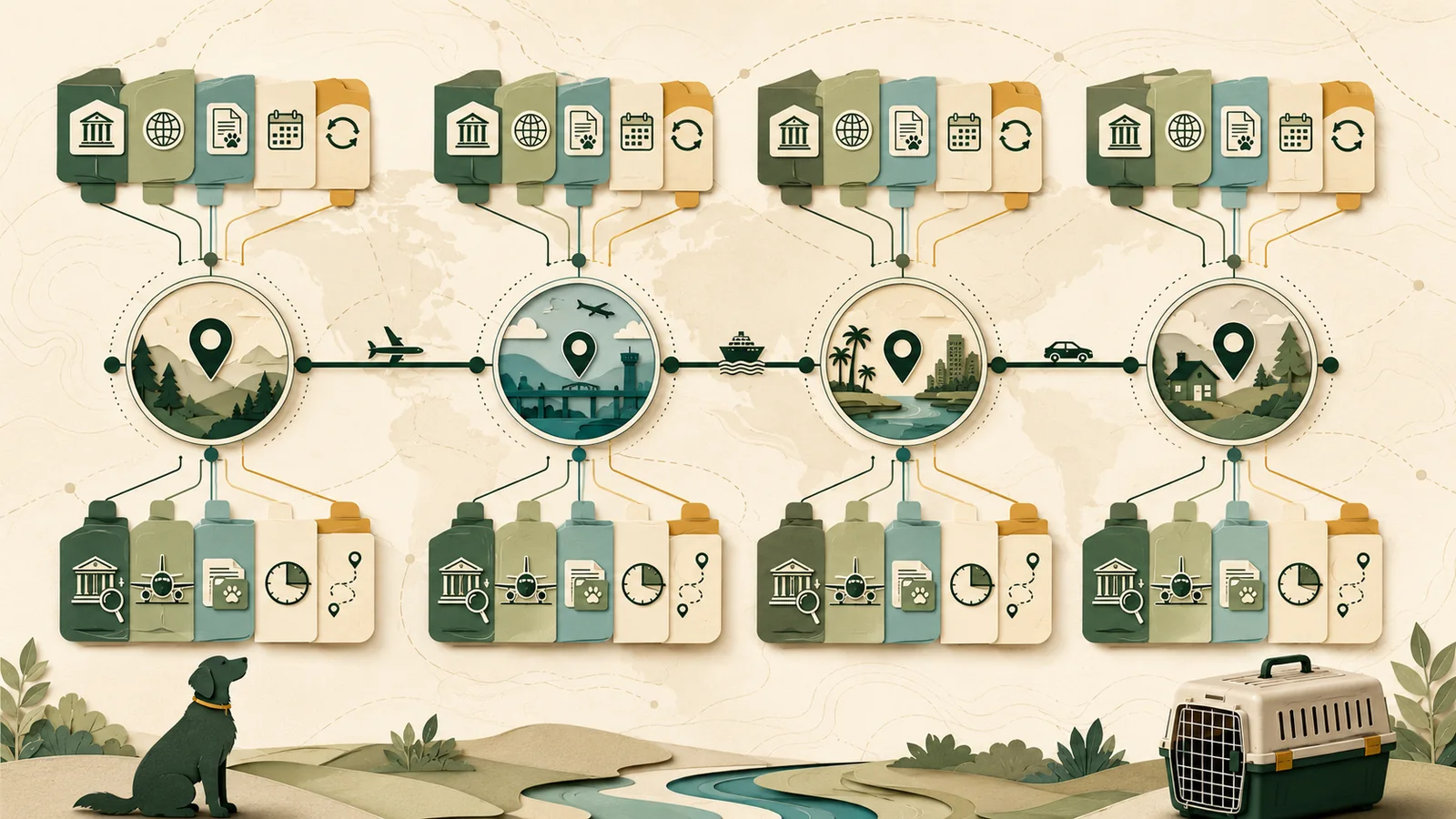
Quick answer
Start with the exact route, not a country-name checklist: record the United States origin, destination, every transit country and airport or port, return route, dates, transport mode, ticketing and operating carriers, entry point, animal count, ownership purpose and owner-travel timing.
Then research each node from its responsible authority, involve the appropriate accredited veterinarian, put identity, vaccination, tests, waiting periods, treatments, permits, certificates and endorsements in the required order, and recheck the entire packet after any itinerary change.
Government export approval, destination permission, transit permission, airline acceptance and return-to-U.S. eligibility are separate gates; completing this workflow does not guarantee boarding, entry, quarantine release or return.
On smaller screens, scroll the table horizontally.
| Situation | Research disposition | Do not assume |
|---|---|---|
| Route or transit is undefined | Stop and complete the route graph | A direct-flight checklist applies |
| Sale, transfer, more than five animals or owner timing differs | Screen the controlling extra or commercial rules | Private-pet rules still apply |
| Official destination requirement is unavailable | Contact the destination animal-health authority | No published rule means no requirement |
| Itinerary changed after research | Rebuild every affected route node | Old documents remain valid |
| Material unknown remains | Keep the packet blocked | Unknown means not required or zero cost |
The output of a good workflow is a reviewable route packet with visible unknowns – not a universal “ready to fly” badge.
Key facts
On smaller screens, scroll the table horizontally.
| Fact | What the evidence supports |
|---|---|
| Controlling source | The authority responsible for the exact origin, destination, transit, return, airport/port or carrier decision. |
| Route unit | One complete itinerary, including every transit and operating carrier – not just the final country. |
| Time unit | Absolute dates tied to sequence and validity windows, not remembered “typical” lead times. |
| Professional role | The appropriate accredited or destination-authorized veterinarian verifies the route-specific veterinary process; this article does not. |
| Unknown rule | Unknown never means not required, zero cost, safe, accepted or approved. |
These facts define the research boundary; they do not approve a route or prove that a dog can travel.
Who this workflow is for
This workflow is useful for a United States dog owner who has a proposed international itinerary and needs to organize official sources before appointments, bookings and submissions. It is especially useful when the route includes transit, a return to the United States, a country with permits or quarantine, or date-sensitive certificate windows.
It can also help an accredited veterinarian, transport coordinator or caregiver see which route facts the owner has documented and which remain unresolved. It is not a substitute for their review.
When a generic workflow is not enough
Stop and obtain route-specific professional or authority help when the movement involves sale or transfer, more than the ordinary private-pet allowance, owner travel outside the controlling timing rule, pregnancy, illness, medication, sedation, breed or age restrictions, cargo handling, unaccompanied movement, quarantine, customs representation, a complex transit, or a legal dispute.
Do not use a previous trip, another traveler’s checklist, an airline booking screen or a destination summary as proof that the current dog and itinerary satisfy the current rule.
Define the complete route
USDA APHIS asks travelers to identify the destination, travel dates, mode and relevant transit details because those facts control the export research path. The route packet should be specific enough that a reviewer can reproduce every node.
On smaller screens, scroll the table horizontally.
| Route field | Record | Why it matters |
|---|---|---|
| Origin | Country, airport/port and export authority | Defines the U.S. certification route |
| Transit | Every country, airport/port, airside/customs and handling state | A connection can create its own regulated movement |
| Destination | Country, entry point and animal-health authority | Controls entry documents and arrival process |
| Return | Return country, countries visited and arrival route | Outbound approval does not establish return eligibility |
| Transport | Air, sea, land or mixed; ticketing and operating carriers | Carrier and government gates are separate |
| Movement facts | Species, count, ownership purpose and owner timing | Can trigger extra or commercial rules |
A route graph that omits transit, return or operating carriers is not complete enough for document research.
Classify the movement before choosing forms
Private companion movement, sale or transfer, unaccompanied movement, larger animal groups and owner travel outside a defined window can follow different rules. Great Britain’s current guidance is one example of a system that screens animal count, ownership transfer and owner timing separately.
On smaller screens, scroll the table horizontally.
| Question | Why it changes research | Required treatment |
|---|---|---|
| Is the dog privately owned? | Commercial or transfer rules may differ | Record the controlling authority definition |
| Is ownership being sold or transferred? | Can trigger commercial movement | Stop the private-pet packet |
| How many animals travel? | Some frameworks add rules above a threshold | Record exact count |
| Does the owner travel near the animal’s date? | Private movement can have a timing condition | Record traveler and dates |
| Is the animal accompanied on every segment? | Cargo/agent/customs route may differ | Record handler and operating carrier |
Choose the movement classification from the controlling rule, not from what the traveler informally calls the trip.
Build the document sequence, not just a folder
International dog travel often uses ordered dependencies. Identification may need to exist before vaccination; testing can occur only after a valid vaccination; a waiting period can follow a test; a permit or notification can have an advance deadline; and a certificate or endorsement can have a narrow validity window.
Japan’s current non-designated-region process demonstrates why order matters: microchip, vaccination, approved-laboratory titer, waiting period, advance notification and government certification are linked steps. That sequence is an example, not a global rule.
On smaller screens, scroll the table horizontally.
| Stage | Record | Failure mode |
|---|---|---|
| Identity | Microchip/type, private number reference, scan/implant date | Later records do not match identity or sequence |
| Vaccination | Product, date, validity and identity relationship | Too early, expired or before required identity |
| Test and waiting | Sample, approved lab, result, start rule and eligible date | Wrong lab, invalid sample or incomplete wait |
| Permit/notification | Authority, submission, acknowledgement, issue and expiry | Application exists but approval does not |
| Treatment | Product, administrator and allowed window | Outside route window |
| Certificate/endorsement | Exact form/version, exam, issue and endorsement | Wrong version or expired travel window |
A complete set of documents can still fail if the sequence, form version or timing window is wrong.
Research every transit node
Transit can remain simple when the dog stays airside under an accepted carrier process, or become a separate import/export event when customs, border inspection, airport changes, overnight handling or quarantine rules apply. New Zealand’s current transit guidance shows that transit duration, permission and quarantine can be explicit route fields.
On smaller screens, scroll the table horizontally.
| Transit field | Evidence required | Recheck trigger |
|---|---|---|
| Airside status | Airport/authority and carrier confirmation | Terminal, airline or handling change |
| Customs/border | Transit authority and port instructions | Bag/animal collection or airport change |
| Duration | Arrival/departure time and authority limit | Delay or missed connection |
| Permit/certificate | Current transit requirement and document | Route or date change |
| Handler/interline | Operating carriers and transfer confirmation | Flight or carrier substitution |
| Quarantine/reservation | Facility and confirmation where required | Delay or changed transit process |
If a missed connection would change the dog’s legal or handling status, the contingency route also needs research.
Separate carrier acceptance from government permission
Delta and American Airlines publish different route, mode, destination and booking restrictions. IATA recommends confirming the carrier, health documents and container, but the selected airline and operating flight remain controlling.
On smaller screens, scroll the table horizontally.
| Carrier field | Verify | Do not infer |
|---|---|---|
| Ticketing carrier | Booking owner and reservation status | It operates every segment |
| Operating carrier | Each flight and animal-acceptance route | Ticketing policy transfers automatically |
| Transport mode | Cabin, checked, manifest cargo or other accepted path | Government documents choose the mode |
| Aircraft/route | Exact segment and destination restrictions | A different flight is equivalent |
| Container | Current dimensions, construction and handling rules | One crate fits every carrier |
| Weather/breed/age | Current carrier restriction and contingency | A reservation guarantees carriage |
A carrier reservation can still fail if the operating flight, aircraft, route, documents or container state changes.
Plan the return to the United States before departure
CDC dog-entry rules use route facts that can include countries visited during the preceding six months and whether rabies vaccination was issued in the United States or abroad. Some high-risk-country routes require certification, testing, arrival or facility steps that cannot be safely deferred until the return date.
On smaller screens, scroll the table horizontally.
| Return field | Why it matters | Evidence to retain |
|---|---|---|
| Country history | Can change the CDC route | Countries and dates |
| Vaccination origin | U.S.- and foreign-vaccinated paths differ | Issuing country and current certificate |
| Dog identity/age | Current entry prerequisites apply | Private identity record and age evidence |
| CDC form | Current form version and receipt | Submission result |
| Predeparture action | Some paths require work before leaving the U.S. | Certificate/titer/facility record |
| Arrival route | High-risk routes can restrict airport or facility | Confirmed airport and reservation |
Do not treat the return flight as a mirror image of the outbound flight; it has its own authority path.
What destination examples demonstrate
The examples below show why one global checklist is unsafe. They do not compare destinations or recommend one route.
On smaller screens, scroll the table horizontally.
| Destination example | Document or route architecture | What it demonstrates |
|---|---|---|
| European Union from a non-EU country | Animal health certificate, declaration, validity and travellers point of entry | Framework plus entry-point control |
| Great Britain | Origin-dependent document, approved route/company and arrival checks | Route and document type both matter |
| Japan from a non-designated region | Ordered identity, vaccination, titer, wait, notification and certificate | Long sequence and timing dependencies |
| Australia | BICON route, import permit and quarantine | Permit does not eliminate quarantine planning |
| New Zealand 2026 process | Country category, permit, transit, entry and quarantine with transition version | Method version and transit are material |
Use examples to learn which fields to ask about – not to copy requirements into a different route.
Build a private evidence packet
Keep one private inventory for route facts, source snapshots, document versions, appointment records, submissions, acknowledgements, issue and expiry dates, carrier confirmations, quarantine reservations and final rechecks. Use redacted references in any shared planning copy.
Do not publish full microchip numbers, passports, health certificates, booking references, payment records, home addresses, account credentials or detailed private medical records. A public checklist should show only the field and its verification state.
Treat itinerary changes as research changes
A new travel date, airport, transit country, operating carrier, transport mode, destination entry point, animal count, movement purpose or return history can change documents and timing. Log the change, identify affected authorities and rebuild the relevant route nodes.
Do not patch an old packet by replacing the flight number while leaving the transit, certificate, carrier or return assumptions untouched.
How the route-research method works
Pet Signal Guide’s research method keeps claims narrow, sources direct and unknowns visible. For this guide, the deterministic route model accepts a declared itinerary and evidence state, then stops at the first unresolved gate: route definition, movement classification, itinerary change, missing authority, insufficient lead time, predeparture return action, veterinarian involvement, document sequence, carrier confirmation, material unknowns, authority review, document completion or final recheck.
The strongest output means only that the declared research packet fields are complete and reviewed. It does not mean the dog is approved, medically fit, accepted by a carrier or guaranteed entry.
What this guide cannot verify
- No traveler-specific itinerary or dog document set was supplied.
- No veterinarian, authority, airline, airport, quarantine facility, customs broker or attorney reviewed the packet.
- No appointment, laboratory test, permit, certificate, endorsement, carrier booking, quarantine reservation or border event occurred.
- No price, processing time, capacity, acceptance, delay, release or refund outcome was observed.
- No legal, medical, welfare, sedation, medication or fitness-to-travel conclusion is offered.
- Rules can change after the checked date; every source must be reopened for the exact route.
Sources
These official and primary records were checked on July 28, 2026. Each supports only its named jurisdiction, route, carrier, process or limitation.
- USDA Animal and Plant Health Inspection Service – Travel With a Pet Checked 2026-07-28. United States pet-travel entrypoint; says requirements take time, identifies export/import/interstate routes, and directs U.S. exporters to a USDA-accredited veterinarian. It is not destination-country approval.
- USDA Animal and Plant Health Inspection Service – Take a Pet From the United States to Another Country (Export) Checked 2026-07-28. U.S. export process, destination and transit information required by the veterinarian, destination-country authority, USDA endorsement and return-to-U.S. warning; not a route-specific certificate.
- USDA Animal and Plant Health Inspection Service – Pet Travel Process Overview Checked 2026-07-28. Process overview, frequently changing country requirements and accredited-veterinarian role; not a substitute for the exact current country page.
- USDA Animal and Plant Health Inspection Service – USDA-Accredited Veterinarians: Certifying Animals for International Travel Checked 2026-07-28. Current certificate version, destination requirements, issuance windows and VEHCS responsibilities for accredited veterinarians; not veterinary care advice or destination acceptance.
- USDA Animal and Plant Health Inspection Service – FAQ About Pet Travel for Accredited Veterinarians Checked 2026-07-28. Timing can take weeks to months; unknown country requirements require written destination-government evidence; import permits may contain exact instructions. Not a universal lead-time guarantee.
- USDA Animal and Plant Health Inspection Service – Using the Veterinary Export Health Certification System (VEHCS) Checked 2026-07-28. Electronic issuance, submission and endorsement workflow; reminds dog owners to check return requirements before departure. Does not prove a certificate has been endorsed.
- USDA Animal and Plant Health Inspection Service – Working With an APHIS Endorsement Office Checked 2026-07-28. Endorsement workflow, incomplete-paperwork delay risk and contact routing; not a guaranteed processing time.
- USDA Animal and Plant Health Inspection Service – Pet Travel: Unknown Requirements Checked 2026-07-28. If APHIS lacks official requirements, contact destination animal-health officials; unknown does not mean no requirements. Also flags EU transit certificates and separate airline rules.
- U.S. Centers for Disease Control and Prevention – Bringing a Dog into the U.S. Checked 2026-07-28. Return/import routing depends on countries visited in the prior six months and where rabies vaccination was issued; directs users to the Dog Importation Navigator. Dog-only scope.
- U.S. Centers for Disease Control and Prevention – CDC Dog Import Form and Instructions Checked 2026-07-28. One receipt per dog and route-dependent questions; changes can require a new form. Does not replace other CDC, USDA, state or airline requirements.
- U.S. Centers for Disease Control and Prevention – Entry Requirements for Dogs from Dog-Rabies Free or Low-Risk Countries Checked 2026-07-28. Low-risk/rabies-free return path, form, health, minimum age, microchip and port scope; only for dogs whose prior-six-month travel fits this route.
- U.S. Centers for Disease Control and Prevention – Entry Requirements for U.S.-Vaccinated Dogs from High-Risk Countries Checked 2026-07-28. Requires route-specific forms and a predeparture U.S.-issued rabies certification path for qualifying U.S.-vaccinated dogs; old export-certificate transition is date-bound.
- U.S. Centers for Disease Control and Prevention – Entry Requirements for Foreign-Vaccinated Dogs from High-Risk Countries Checked 2026-07-28. Foreign-vaccinated high-risk path, government-endorsed form, approved-lab titer, animal-care-facility reservation and specified arrival airport. Not applicable to every returning dog.
- U.S. Centers for Disease Control and Prevention – High-Risk Countries for Dog Rabies Checked 2026-07-28. Current CDC high-risk-country list used for U.S. dog-import routing; list and route must be rechecked for the actual six-month travel history.
- U.S. Centers for Disease Control and Prevention – Approved Rabies Serology Laboratories for Testing Dogs Checked 2026-07-28. Approved-laboratory and timing conditions for the applicable foreign-vaccinated high-risk path; not a general destination titer rule.
- U.S. Centers for Disease Control and Prevention – Frequently Asked Questions on Dog Importations Checked 2026-07-28. Clarifies dog-import ports, microchips, forms and route distinctions; must be read with the exact applicable CDC route page.
- European Commission – Bringing a Pet into the EU from a Non-EU Country Checked 2026-07-28. Non-commercial dog/cat/ferret entry, animal-health certificate, declaration, identity checks, certificate validity and 2026 transition language; exact member-state and route still matter.
- European Commission – Travelling with a Pet within the EU Checked 2026-07-28. Non-commercial intra-EU dog/cat/ferret movement, owner responsibility, animal-count and identification-document framework; not initial entry from every non-EU origin.
- European Commission – Travellers’ Points of Entry Checked 2026-07-28. Designated entry points for covered non-commercial movements from many non-EU origins; not an airline-acceptance list.
- Government of the United Kingdom – Bringing Pets to Great Britain Checked 2026-07-28. Great Britain entry framework, origin-dependent rules and extra-rule triggers; Northern Ireland has separate guidance.
- Government of the United Kingdom – Travel Routes for Pets Checked 2026-07-28. Approved route/company requirement, carrier confirmation and air-cargo boundary for ordinary pets; routes can change and service-animal rules differ.
- Government of the United Kingdom – Which Pet Travel Document You Need Checked 2026-07-28. Document type depends on origin; not a universal certificate path.
- Government of the United Kingdom – Animal Health Certificate Checked 2026-07-28. AHC return-use conditions and expiry boundary; only for the stated route and document history.
- Government of the United Kingdom – Great Britain Pet Health Certificate Checked 2026-07-28. Official-veterinarian certification and a defined entry window; not interchangeable with every passport or AHC route.
- Government of the United Kingdom – Arriving in Great Britain Checked 2026-07-28. Document and microchip checks plus possible quarantine/return consequences; not a prediction of an individual border decision.
- Government of the United Kingdom – Check if You Need to Follow Extra Rules Checked 2026-07-28. Sale, rehoming, ownership transfer, owner-arrival timing, animal count and special-species triggers; shows why movement classification is material.
- Japan Animal Quarantine Service – Import Dogs and Cats into Japan from Non-Designated Regions Checked 2026-07-28. Microchip-before-rabies sequence, two rabies vaccinations, designated-lab titer, 180-day wait, 40-day notification, entry-port and government-certificate requirements. Route-specific, not universal.
- Japan Animal Quarantine Service – Import Dogs and Cats into Japan from Designated Regions Checked 2026-07-28. Designated-region residence, notification, pre-export inspection, government certificate and port requirements; materially different from non-designated route.
- Japan Animal Quarantine Service – Import and Export Quarantine of Dogs and Cats Checked 2026-07-28. Import inspection and quarantine framework; compliant pets may clear quickly, but deficiencies can change detention. Not a guaranteed clearance time.
- Australian Department of Agriculture, Fisheries and Forestry – Bringing Cats and Dogs to Australia Checked 2026-07-28. Australia import-permit and full-requirement entrypoint; not the complete BICON condition set for a specific export country.
- Australian Department of Agriculture, Fisheries and Forestry – Import Permits for Cats and Dogs Coming to Australia Checked 2026-07-28. Permit process, fees, validity and permit-specific conditions; fees and country groups can change.
- Australian Department of Agriculture, Fisheries and Forestry – Quarantine in Australia Checked 2026-07-28. Post-entry quarantine facility, veterinary care and heat-risk context; does not replace import permit conditions or carrier acceptance.
- New Zealand Ministry for Primary Industries – Bringing Cats and Dogs to New Zealand Checked 2026-07-28. 2026 import-health-standard transition and future identification timing; route version must be selected explicitly.
- New Zealand Ministry for Primary Industries – Step-by-Step Guide to Bringing Cats and Dogs to New Zealand (2026 Process) Checked 2026-07-28. Country categories, eligibility, pre-export identity, permit, airport, quarantine and documentation framework under the 2026 process; not every route or transition option.
- New Zealand Ministry for Primary Industries – Rules for Cats and Dogs to Transit Through New Zealand (2026 Process) Checked 2026-07-28. Transit/tranship permission, duration and quarantine-reservation triggers; demonstrates that transit is its own regulatory event.
- New Zealand Ministry for Primary Industries – Quarantine Facilities When Importing Cats and Dogs (2026 Process) Checked 2026-07-28. Minimum quarantine and possible delay conditions under the 2026 process; not a guaranteed release date or complete cost quote.
- Delta Air Lines – International and Connection Pet Travel Checked 2026-07-28. Carrier-specific international restrictions, destination exceptions and government-document reminder; route/operating carrier may differ.
- Delta Air Lines – Pet Travel Overview Checked 2026-07-28. In-cabin fees, booking and destination exclusions; not government entry authorization and subject to ticketing/route conditions.
- American Airlines – Pets – Travel Information Checked 2026-07-28. Carrier-specific cabin, cargo/checked, reservation, certificate, destination and fee rules; does not supersede government requirements.
- International Air Transport Association – Traveler’s Pet Corner Checked 2026-07-28. General airline confirmation, health-certificate and container-preparation guidance; not a substitute for the selected airline, route or current Live Animals Regulations edition.
- Pet Signal Guide – How We Research and Evaluate Pet Technology Checked 2026-07-28. Sitewide evidence and commercial-independence method; not travel-rule authority or route approval.