
Documentation-led risk and failure analysis
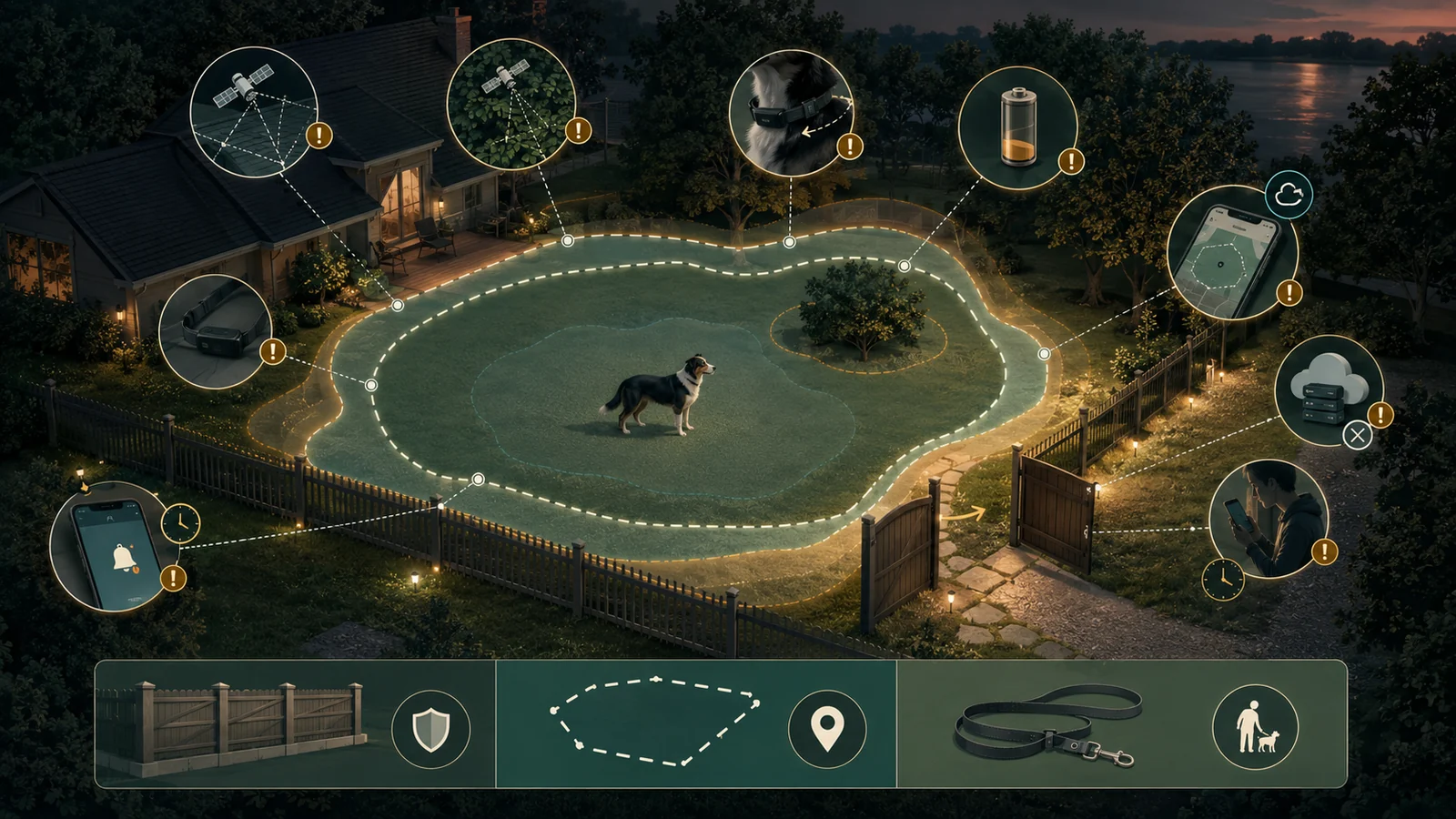
GPS virtual fences combine satellite positioning, boundary geometry, feedback, training, fit, power, software, service, and human supervision. The technology can add a boundary cue and remote visibility, but it does not create a physical wall or remove the need for recovery planning.
Quick answer
A GPS virtual fence is an electronic boundary-and-training system, not a physical barrier.
Depending on the product and current state, it may compare a collar’s estimated position with a stored boundary and deliver tones, vibration, optional static feedback, remote tracking, or phone alerts.
It does not physically stop a dog, prevent another animal or person from entering, or guarantee containment.
Before relying on it, separate fit, training, property geometry, GPS, configuration, battery, service, phone-alert, human-response, and recovery-layer risks.
Swipe horizontally to see all columns.
| Condition | Fail-closed disposition | Why |
|---|---|---|
| Road, deep water, cliff, livestock, wildlife, or other high-consequence boundary | Use an appropriate physical or supervised containment layer | Electronic position, power, training, service, and feedback can fail. |
| Property too small, narrow, complex, covered, or close to structures/hazards | Stop or use another architecture | Product-specific warning areas, buffers, sky view, and line spacing may not fit. |
| Dog has fear, aggression, guarding, pain, skin, neurologic, or other material concern | Obtain appropriate professional review before reliance | A generic training guide cannot determine suitability or welfare. |
| Phone alert is being treated as containment | Stop that assumption | Notification delivery and human response occur after the collar event and can fail. |
| Unexpected feedback, missing feedback, or a run-through occurs | Secure the dog, stop unsupervised reliance, preserve evidence, and follow the exact product workflow | Escalating feedback alone can hide fit, GPS, geometry, training, power, or configuration failures. |
| All documentation and controlled checks pass | Retain only a documented readiness record | It is not proof of safety, humane use, accuracy, reliability, or containment. |
Choose the physical and human safety plan first; then decide whether an electronic boundary adds a useful layer.
Key facts
| Field | What this guide uses |
|---|---|
| Evidence basis | Current government, manufacturer, professional-association, and peer-reviewed records organized through a reproducible risk screen. |
| Exact current sample | Halo Collar 5, SpotOn GPS Fence Nova Edition, and PetSafe Guardian GPS 2.0 Dog Fence + Tracking. |
| Access | Documentation only. No collar, app, account, dog, property, boundary, feedback, escape, or recovery case was tested. |
| Checked | July 28, 2026, for the United States. |
| Primary category limit | No system is a physical barrier or a guarantee that a dog cannot cross. |
| Support-page limit | A troubleshooting article identifies a recognized path; it does not show how often the problem occurs. |
| Research limit | Broad electronic-fence and remote e-collar studies are not exact current GPS-fence product tests. |
| Specialist gate | No qualified reviewer assessed the material containment, behavior, training, skin, pain, or welfare claims. |
Use this table as a boundary check: a documentation record can identify dependencies and limits, but it cannot establish safety, humane use, accuracy, reliability, or containment.
What a GPS virtual fence can – and cannot – do
The pet location technologies explainer separates positioning from data delivery. A GPS virtual fence adds a stored or synchronized boundary, a product algorithm, feedback hardware, dog training, property rules, and supervision. Some products add cellular tracking and alerts, but those remote features still depend on a separate delivery chain.
Swipe horizontally to see all columns.
| Job | GPS virtual fence may provide | What remains separate |
|---|---|---|
| Estimate collar position | GNSS/GPS-based position estimate | Exact accuracy, currentness, and dog attachment |
| Compare with a boundary | Product algorithm and stored fence coordinates | Property suitability, warning area, buffers, assignment, and sync |
| Deliver a cue or feedback | Tone, vibration, optional static depending on product/configuration | Dog learning, welfare, fit, contact hardware, wear, and suitability |
| Show location remotely | Available on some products with service/connectivity | Cellular/Wi-Fi/Bluetooth, vendor service, app, phone, permissions, and human response |
| Notify after crossing or feedback | Phone notification on supported systems | Prompt delivery, observation, and action |
| Physically stop movement | No | Fence, enclosure, leash, supervised area, indoor management, or another physical control |
| Recover after escape | Location or escape record may help | Visible ID, microchip, current records, local help, search, and human response |
The technology can add information or a learned boundary cue. It does not turn uncertainty into a wall.
The failure map
Failure can occur before the collar reaches the boundary, at the boundary, or after the dog crosses. The existence of many vendor support paths confirms that the systems have multiple operating states; it does not quantify category reliability.
Swipe horizontally to see all columns.
| Failure family | Examples | Immediate response |
|---|---|---|
| Physical-barrier gap | Dog, person, vehicle, wildlife, or hazard can cross the line | Use physical/supervised containment when consequence is material. |
| GPS variation | Blockage, multipath, canopy, structures, terrain, stale or unavailable state | Test the exact property and preserve timestamps/states. |
| Boundary geometry | Small/narrow area, sharp corners, excessive posts, overlapping/opposing lines, bad buffers | Rebuild from exact product rules. |
| Configuration/sync | Wrong fence, wrong dog, failed Bluetooth/update, stale collar boundary | Secure dog and verify collar-held state before reuse. |
| Unexpected or delayed feedback | Feedback indoors, in safe space, late, shifted, reduced, or absent | Remove/disable collar and preserve evidence. |
| Escape/run-through | Dog crosses despite configured system | Stop unsupervised reliance and investigate the full chain. |
| Training/behavior/welfare | Cue not learned, distraction overwhelms response, fear/pain/behavior concern | Use appropriate professional review. |
| Fit/contact/wear/skin | Wrong size, orientation, tips, tightness, wear time, leash path, irritation | Stop use for irritation, pain, damage, or fit failure. |
| Power/update/hardware | Low battery, charging fault, interrupted update, damaged collar | Verify power/hardware/update before relying. |
| Service/account | Inactive subscription, wrong assignment, payment/account/access issue | Verify exact live service and access state. |
| Network/app/notification | No cellular, phone internet, app permission, vendor service, or noticed alert | Do not count phone notification as containment. |
| Recovery gap | Dead/stale location, no ID, no search plan, delayed response | Maintain independent identification and recovery layers. |
The right question is not “Can GPS fail?” It is “Which failure can the scenario tolerate, and what independent layer remains when it happens?”
GPS drift, blockage, and signal-state changes
GPS.gov explains that user accuracy depends on the receiver, satellite geometry, blockage, reflections, atmosphere, installation, and local environment. Buildings, garages, large windows, metal, tree canopy, hills, valleys, and partial sky view can change the collar’s estimated position or its confidence.
Swipe horizontally to see all columns.
| Product | Current documented behavior | Evidence limit |
|---|---|---|
| Halo Collar 5 | Low GPS disarms fence feedback; Medium limits feedback; High enables full configured feedback. Indoor/near-boundary feedback troubleshooting exists. | No independent state-transition time, boundary accuracy, or false-feedback rate. |
| SpotOn Nova | Vendor documents GPS initialization and drift factors and markets Nova-specific hardware/algorithm mitigation. | Independent lab method, raw data, environment distribution, and reproduction were not retained here. |
| PetSafe Guardian GPS 2.0 | Support covers no GPS/LTE, unexpected activation, and escape; current escape article says the boundary is a general area and correction can delay or vary. | No independent distribution of variation, delay, or missed/false correction. |
| All three | Clear sky, fit/orientation, battery, firmware, property, and product state matter. | One successful walk or map point is not universal evidence. |
Do not translate a vendor’s stated “accuracy,” satellite count, dual-frequency hardware, AI, or drift-reduction claim into a safety or containment probability unless the exact method and results support that conclusion.
Property geometry and boundary design
Virtual fences need usable space inside their warning and feedback envelope. A line that fits on a map may not fit safely around buildings, gates, driveways, roads, water, neighboring property, narrow passages, or areas with poor sky view.
Swipe horizontally to see all columns.
| Product | Current retained property guidance | Material conflict or stop question |
|---|---|---|
| Halo Collar 5 | Roughly 30 × 30 ft minimum, 7–10 ft warning area, and current structure/hazard buffers | Official support conflicts at 15 versus 20 ft from structures; the risk method uses 20 ft conservatively until resolved. |
| SpotOn Nova | Roughly one-third acre and at least 80 ft at the narrowest mapped area in current property guidance | Broad “anywhere” marketing does not replace actual property evaluation, sky view, or hazard analysis. |
| PetSafe Guardian GPS 2.0 | At least one-half acre; 4–32 posts; 8 ft between posts; 25 ft per structure story; 35 ft opposing lines; 15 ft from roads/hazards; simple shape | Dense canopy, sharp corners, narrow areas, overlapping lines, wrong assignment, and complex boundaries remain stop questions. |
Treat exact product rules as screening criteria, not proof that a property is suitable or safe.
Swipe horizontally to see all columns.
| Question | Why it matters | Evidence to retain |
|---|---|---|
| What is the narrowest usable width? | A warning/feedback band can consume daily space. | Measured map plus field measurement. |
| How far is every structure? | Walls, garages, upper floors, and windows can affect GPS and transitions. | Structure height and shortest boundary distance. |
| How far are roads, water, cliffs, livestock, and other hazards? | Consequences determine whether electronic-only reliance is acceptable. | Shortest distance and physical/supervised backup. |
| Where are trees, metal roofs, vehicles, slopes, valleys, and covered areas? | They can block or reflect signals. | Annotated property map and test observations. |
| Are there gates, delivery routes, mower paths, neighbors, or frequent visitors? | Human routines can conflict with the boundary or dog behavior. | Daily-use scenarios and stop plan. |
| Does a physical fence already exist? | Digital lines may need product-specific offset and should not reduce safe space. | Exact product instruction and measured offset. |
A map alone is not enough: retain measured distances and a practical stop plan before relying on a boundary.
Fence creation, assignment, synchronization, and updates
A boundary can be correct in the account but wrong or absent on the collar. Current PetSafe instructions explicitly require assigning the correct dog to the fence, pairing through Bluetooth, and updating the collar. Halo and SpotOn also depend on the current collar/app fence state.
Swipe horizontally to see all columns.
| Checkpoint | Failure mode | Fail-closed check |
|---|---|---|
| Product/account identity | Wrong collar, dog, account, or service plan | Record exact model, collar identifier, dog assignment, and current service. |
| Fence version | Old or edited boundary remains on collar | Record version/time and confirm current sync. |
| Fence assignment | Dog/collar assigned to wrong fence or none | Verify assignment in app and collar behavior before wear. |
| Bluetooth/Wi-Fi/update | Sync or firmware update incomplete | Keep collar off dog until completion and current status confirmation. |
| Fence complexity | Too many posts, sharp corners, overlap, narrow corridors | Simplify using exact product rules. |
| Transition between locations | Old fence remains active during travel, vehicle, home, or another property | Turn off, switch, or use exact product transition procedure. |
| Beacon/keep-out/ignore zone | Range or overlap suppresses or creates feedback unexpectedly | Test the exact three-dimensional range and floor/structure context. |
A visible polygon on a phone is not proof that the intended collar has the current boundary, feedback settings, assignment, battery, GPS state, and service.
Unexpected, delayed, missing, or wrong-place feedback
Three product-specific support paths show why feedback should be treated as an observed state rather than an assumption: Halo documents indoor/near-boundary feedback, SpotOn lists drift and poor-GPS troubleshooting, and PetSafe documents unexpected activation and delayed/variable correction.
Swipe horizontally to see all columns.
| Observed pattern | Possible documented layers | Do not jump directly to |
|---|---|---|
| Feedback inside the house or intended safe area | GPS state/position, boundary near structure, assignment, beacon/zone, stale fence, configuration | “The dog did something wrong.” |
| Feedback activates later or in a slightly different place | GPS variation, direction/motion algorithm, update/state, geometry | A fixed universal boundary width. |
| No feedback at boundary | Low/no GPS, battery, power, disabled setting, wrong assignment, sync, fit/contact, service | Increasing correction before verifying system state. |
| Dog crosses through feedback | Training, distraction, fit, contact, feedback setting, GPS, power, geometry, dog behavior | A single-cause or prevalence conclusion. |
| Feedback does not stop on return | Direction algorithm, configuration, product state, support issue | Continued unsupervised use. |
| Phone says feedback occurred but owner did not see it | Notification, connectivity, app, timestamp, human observation | Proof that the dog received, understood, or responded to it. |
When feedback occurs unexpectedly, secure the dog and remove or disable the collar before changing settings. Preserve the time, GPS/battery/network state, fence version, assignment, location context, and any state-changing troubleshooting.
Escape and run-through failures
An escape can involve training, distraction, dog fit, feedback configuration, battery, GPS, property geometry, wrong assignment, service, or supervision. Manufacturer terms from Halo and SpotOn reject a universal containment guarantee, and PetSafe maintains a current escape troubleshooting workflow.
Swipe horizontally to see all columns.
| Record field | Useful evidence | Not established by the field |
|---|---|---|
| Exact time and last known collar state | Sequence and stale/current distinction | Why the dog crossed |
| Boundary and assignment version | Whether the intended fence should have been active | That the collar actually held or applied it |
| GPS, battery, network, service, and app state | Possible system dependencies | Causation without controlled evidence |
| Dog fit, contact hardware, wear, training, and distraction | Behavioral/physical context | A universal dog response |
| Property and hazard context | Consequence and search priorities | A product-level escape probability |
| Physical/supervised backup | Whether an independent layer existed | Proof that every physical arrangement is adequate |
| Support steps and outcome | What was changed and what happened next | Failure prevalence or repair success rate |
The 2017 cross-sectional survey found more owner-reported escapes among its broad electronic-fence group than physical-fence groups in that sample. It does not identify current GPS products, prove causation, or predict whether a particular dog will escape.
Training, behavior, and welfare limits
All three retained product families require training. Their protocols differ, but each expects the dog to learn product-specific cues and return behavior. A product training sequence is not an individualized welfare assessment.
Swipe horizontally to see all columns.
| Evidence layer | What it supports | What it cannot support |
|---|---|---|
| Halo training material | Current vendor sequence and feedback states | Independent welfare, containment, or dog-specific suitability |
| SpotOn training material | Tone-first sequence, optional feedback, distraction proofing, and run-through troubleshooting | Independent success rate or humane-use verdict |
| PetSafe Guardian GPS 2.0 training | Current minimum 15-day sequence, session pattern, wear limit, and leash/skin controls | A result for a real dog or every correction level |
| AVSAB position | Professional reward-based training recommendation and opposition to aversives | Halo/SpotOn/PetSafe product certification |
| Remote e-collar studies | Findings for their manually operated training protocols | GPS virtual-fence containment performance |
| Broad survey and legal cases | Reasons for caution and further study | Prevalence, causation, or a current-product ranking |
| Real qualified review | Could review exact dog, feedback, training, welfare, property, and stop criteria | Guarantee of containment or zero risk |
A dog with fear, aggression, guarding, pain, skin, neurologic, or other material behavior/health concerns should not be routed through a generic feedback-escalation plan. This package supplies no diagnosis, treatment, or individualized training advice.
Fit, contact hardware, wear, and skin
The collar must represent the dog’s location and deliver only the intended feedback. Poor fit, rotation, wrong contact points, excessive tightness, excessive wear, leash attachment, damaged hardware, or skin irritation can undermine both functions.
Swipe horizontally to see all columns.
| Product | Retained current controls | Evidence gap |
|---|---|---|
| Halo Collar 5 | Dog range, orientation, two-finger fit, blanks for no-static use, static-tip/leash restriction, daily off/repositioning, neck checks | No real fit, pressure, skin, pain, stress, or wear observation. |
| SpotOn Nova | Current weight/neck range, antenna orientation, contact points, training, and charge routine | No real fit, wear duration, contact pressure, skin, or dog response observation. |
| PetSafe Guardian GPS 2.0 | Neck minimum, separate regular collar/harness, never attach leash to GPS collar, no more than 12 hours/day, stop for irritation | No real max-fit, skin, pain, correction, or dog response observation. |
Stop use for redness, irritation, damage, pain, abnormal behavior, or inability to fit the collar according to the exact current instructions. Do not solve a signal, training, or property problem by tightening the collar beyond a normal safe fit.
Power, service, connectivity, app, and notification failures
The collar’s local boundary behavior and the owner’s remote visibility are different systems. GPS can estimate location without cellular service, but a phone cannot receive live data without an operating delivery chain. Battery, firmware, account, service, assignment, app, phone, and human attention remain material.
Swipe horizontally to see all columns.
| Product | Local boundary path | Remote/app path | Important failure boundary |
|---|---|---|---|
| Halo Collar 5 | Preloaded fence can deliver configured feedback under documented power/movement/High-GPS conditions | Membership, connectivity, app, phone, and current status affect visibility/notifications | Low/Medium GPS reduces feedback; app state is not local feedback proof. |
| SpotOn Nova | Core fence documented without cellular subscription | Optional plan/coverage required for tracking, alerts, remote feedback, and related features | No plan or coverage means no remote recovery/notification path. |
| PetSafe Guardian GPS 2.0 | Stored/assigned fence operates through current collar setup and service architecture | Subscription, LTE, app, phone internet, permissions, and assignment affect tracking/notifications | Official support says notifications may be delayed/absent and must not be relied on alone. |
Local feedback and remote visibility use different layers, so a phone alert cannot substitute for containment.
Swipe horizontally to see all columns.
| Stage | Potential failure | Evidence needed |
|---|---|---|
| Collar power and hardware | Dead battery, charge fault, damage, interrupted update | Physical status, charge, firmware, timestamp |
| GPS estimate | Blocked, shifted, unavailable, stale | Signal/GPS status, environment, last update |
| Cellular/Wi-Fi/Bluetooth | No coverage, handoff, router/pairing issue | Connection source and repeated exact-location test |
| Vendor service/account | Outage, inactive plan, billing, wrong assignment | Service/account/assignment record |
| App and phone | No internet, permission, background restriction, stale app | App/OS version, notification settings, receipt timestamp |
| Human response | Alert missed, stale point treated as current, no plan | Observer/action time and next verification |
A notification is evidence that one part of the chain reported an event. It is not containment, proof that feedback occurred correctly, proof that the dog understood it, or proof that a person responded.
What independent evidence does – and does not – show
Independent sources are useful only when their designs are kept intact. A broad electronic-fence survey, five legal cases, remote e-collar trials, and a professional training position do not form a current comparative product test.
Swipe horizontally to see all columns.
| Evidence | Narrow supported use | Prohibited use |
|---|---|---|
| GPS.gov accuracy guidance | Explain receiver/environment dependence | Exact Halo, SpotOn, or PetSafe accuracy |
| Starinsky et al. 2017 | Report the cross-sectional broad-containment association in that sample | GPS-specific escape rate, causation, or current-product prediction |
| Polsky 2000 | Identify a possible boundary/aggression concern from five legal cases | Prevalence or universal mechanism |
| Cooper et al. 2014 | Discuss welfare/efficacy within its remote e-collar training design | GPS virtual-fence outcome |
| China et al. 2020 | Discuss performance within its remote training comparison | Current containment product outcome |
| AVSAB position | State the professional reward-based training position | Individualized dog review or product approval |
| Vendor support records | Identify recognized operating/troubleshooting paths | Failure frequency, severity, or independent reliability |
No independent exact-model dataset in this package supports a comparative statement that Halo, SpotOn Nova, or Guardian GPS 2.0 is safest, most accurate, most reliable, most humane, or least likely to fail.
Current product-specific examples
The sample shows why one generic checklist is unsafe. Product rules differ materially.
Swipe horizontally to see all columns.
| Dimension | Halo Collar 5 | SpotOn Nova | PetSafe Guardian GPS 2.0 |
|---|---|---|---|
| Core fence service | Membership required | Documented without subscription | Subscription required for full functions |
| Remote tracking/alerts | Integrated through service/connectivity | Optional cellular plan | Integrated through subscription/LTE |
| Dog range retained | ≥5 months, ≥10 lb, neck 8–30.5 in | ≥15 lb, neck 10–26 in | Neck ≥8 in; individual fit still required |
| Property path retained | ~30×30 ft plus warning/buffer; 15/20-ft conflict | ~⅓ acre; 80-ft narrowest recommendation | ≥½ acre; 25 ft/story; 35-ft opposing lines; 15-ft hazard buffer |
| Feedback | Sound, vibration, optional static | Two tones, vibration, optional static | Tone, vibration, 10 static levels |
| Training | Vendor multi-stage sequence | Tone-first and distraction-proofing sequence | Retained minimum 15 days |
| Indoor/structure treatment | Low GPS intended indoors; indoor feedback troubleshooting exists | Property/drift guidance; exact real indoor behavior untested | Remove indoors; structure buffers scale per story |
| Phone notification | Remote visibility path separate from local feedback | Optional-plan remote path | Officially not sufficient as sole containment |
Do not copy a PetSafe structure rule into Halo, use a Halo GPS-state label for SpotOn, or treat SpotOn’s no-subscription core fence as the service model for the other products.
Build a layered plan around the consequence of failure
A serious safety plan should remain useful when the GPS collar is unavailable. The dog GPS tracker buyer guide can help evaluate a separate location layer, but tracking still does not replace containment.
Swipe horizontally to see all columns.
| Layer | Job | Common-dependency question |
|---|---|---|
| Physical or supervised containment | Prevent access when crossing has serious consequences | Does it still work without the GPS collar, app, service, phone, or electricity? |
| GPS virtual fence | Deliver a learned electronic boundary cue/feedback | Does the dog/property/training/GPS/power state remain appropriate? |
| Cellular GPS tracker | Report location and support recovery | Does it share the same collar, battery, account, network, or phone? |
| Visible ID tag | Give a finder an immediate contact route | Is the contact current and privacy-safe? |
| Microchip | Provide persistent identifier after scanning | Is registration current? It is not a locator. |
| Human supervision | Observe dog, property, gates, visitors, weather, and device state | Who is responsible and what are the stop conditions? |
| Recovery plan | Search, verify sightings, contact local help, preserve records | Can it start without a working device notification? |
Two electronic features are not independent layers when they share the same collar, battery, GPS state, account, vendor service, phone, or human responder.
How this analysis works – and what remains unknown
This page applies Pet Signal Guide’s research method to current authority, manufacturer, professional-association, and peer-reviewed records. A deterministic screen evaluates the exact product, dog range, property geometry, physical-containment need, service, assignment, sync, power, GPS environment, indoor/outdoor behavior, feedback configuration, training, wear, skin, behavior/health concerns, specialist review, notifications, controlled testing, recovery plan, and material unknowns.
The method returns only a fail-closed disposition or a completed documentation packet. It does not score products, estimate frequency or probability, calculate severity, certify humane use, diagnose a dog, approve a property, or recommend a purchase.
Pet Signal Guide did not buy, borrow, fit, charge, activate, update, map, sync, assign, train, test, submerge, damage, return, or replace any product. No dog received feedback, approached a real boundary, escaped, or was recovered. No account, subscription, alert, outage, support case, or specialist review was executed. Exact-model containment success, false-feedback distribution, drift distribution, battery runtime, skin/welfare outcome, service life, and failure prevalence remain unknown.
Sources
- GPS overviewGPS.gov / U.S. National Coordination Office for PNT · Checked 2026-07-28. GPS provides positioning signals to receivers; it does not itself transmit collar data, issue feedback, or provide a containment guarantee.
- GPS AccuracyGPS.gov / U.S. National Coordination Office for PNT · Checked 2026-07-28. User accuracy depends on receiver, geometry, blockage, reflections, atmosphere, installation, and environment; signal-in-space commitments are not consumer-collar accuracy.
- Humane Dog Training position statementsAmerican Veterinary Society of Animal Behavior · Checked 2026-07-28. Professional-association position recommends reward-based methods and opposes aversive methods; not an exact-product review.
- Escape rates and biting histories by containment methodStarinsky, Lord, and Herron / JAVMA / PubMed · Checked 2026-07-28. Cross-sectional owner survey of broad physical-fence, electronic-fence, and tether categories; not GPS-specific and not causal.
- Can Aggression in Dogs Be Elicited Through Electronic Pet Containment Systems?Polsky / Journal of Applied Animal Welfare Science · Checked 2026-07-28. Five legal-case reports; hypothesis-generating and unable to establish prevalence or current GPS-product effects.
- Welfare consequences and efficacy of remote electronic training collarsCooper et al. / PLOS ONE · Checked 2026-07-28. Manually operated remote e-collar training study; not a GPS containment system.
- Efficacy of dog training with and without remote electronic collarsChina, Mills, and Cooper / Frontiers in Veterinary Science · Checked 2026-07-28. Remote e-collar recall/obedience study; not an exact GPS virtual-fence test.
- Halo Collar 5 current product and storefrontHalo / Protect Animals with Satellites LLC · Checked 2026-07-28. Current exact product identity and vendor claims; no independent accuracy, containment, battery, waterproof, or welfare test.
- Unified Terms and ConditionsHalo / Protect Animals with Satellites LLC · Checked 2026-07-28. Current terms state no physical or virtual fence completely prevents escape and define owner training/supervision responsibility; not legal advice.
- Minimum and maximum Halo Fence sizeHalo Support · Checked 2026-07-28. Current minimum geometry, warning area, and 15-foot structure-buffer guidance; conflicts with a current 20-foot record.
- Fence count and location limitsHalo Support · Checked 2026-07-28. Current 20-foot structure/hazard guidance and offline-fence statement; conflicts with the 15-foot record.
- Low, Medium, and High GPS statesHalo Support · Checked 2026-07-28. Documents product feedback changes by GPS state; no independent state-transition, accuracy, or false-feedback measurement.
- When prevention feedback occursHalo Support · Checked 2026-07-28. Documents Warning, Boundary, Emergency, and GPS-state behavior; no dog response or welfare outcome observed.
- Interpret collar status on the Pet CardHalo Support · Checked 2026-07-28. Documents last-update, GPS, feedback, and network status fields; app display was not observed.
- Unexpected prevention feedback indoors or inside a boundaryHalo Support · Checked 2026-07-28. Official troubleshooting record for indoor/near-boundary feedback; support-page existence does not establish prevalence.
- How GPS and connectivity work with Halo CollarHalo Support · Checked 2026-07-28. Separates local GPS/fence behavior from app connectivity; no outage or reconnect test.
- Halo operation without cellular or Wi-FiHalo Support · Checked 2026-07-28. Documents preloaded-fence use and remote-app limits; no remote field execution.
- Optimize Halo GPS signal levelsHalo Support · Checked 2026-07-28. Vendor calibration and diagnostic workflow; no yard or dog observation.
- Use the Halo training systemHalo Support · Checked 2026-07-28. Vendor training sequence; no training, learning, stress, or containment outcome observed.
- Select and install Halo contact tipsHalo Support · Checked 2026-07-28. Documents contact blanks, static tips, leash restriction, wear, and neck checks.
- Halo Collar fitting and orientationHalo Support · Checked 2026-07-28. Vendor fit/orientation guidance; no physical fit or skin observation.
- Halo Beacon rangeHalo Support · Checked 2026-07-28. Documents spherical range and possible cross-floor feedback when set too high; no beacon test.
- Halo plans and subscriptionsHalo / Protect Animals with Satellites LLC · Checked 2026-07-28. Current plan and billing presentation; service state is a material dependency and values remain volatile.
- SpotOn GPS Fence Nova Edition product surfaceSpotOn Fence · Checked 2026-07-28. Current Nova identity, fit, battery, GNSS, fence, training, and optional-tracking claims; no independent product observation.
- SpotOn Terms of UseSpotOn Fence · Checked 2026-07-28. Terms state GPS accuracy may vary, the system is not a primary restraint, no containment system contains every dog 100%, and battery/app dependencies apply.
- How SpotOn GPS Fence worksSpotOn Fence · Checked 2026-07-28. Vendor feedback sequence and no-cellular local-fence architecture; no controlled boundary result.
- SpotOn boundary training planSpotOn Fence · Checked 2026-07-28. Vendor training sequence and marketing success claim; no independently reproduced dog outcome.
- Getting Started with SpotOn GPS FenceSpotOn Fence · Checked 2026-07-28. GPS initialization, fence setup, training, and support-topic hub; no account/collar execution.
- SpotOn contact and support hubSpotOn Fence · Checked 2026-07-28. Current support hub lists poor GPS, drift, notification, tracking, connection, charging, update, and property-fit topics; does not establish frequency.
- Ensure a property is suitable for SpotOnSpotOn Fence · Checked 2026-07-28. Current property guidance includes roughly one-third acre and 80-foot narrowest-area recommendations; no property evaluation was performed.
- What is GPS drift?SpotOn Fence · Checked 2026-07-28. Vendor explanation of drift and Nova performance claims; independent lab methodology was not retained in this package.
- SpotOn setup, service, and training overviewSpotOn Fence · Checked 2026-07-28. Documents that core fencing can work without cellular while tracking/alerts require service, and states training is necessary.
- SpotOn pre-purchase fit and battery guidanceSpotOn Fence · Checked 2026-07-28. Vendor fit and battery estimates; no runtime or fit measurement.
- SpotOn tracking subscription plansSpotOn Fence · Checked 2026-07-28. Current optional tracking-plan display and feature split; current price and terms must be rechecked.
- SpotOn Five Star GuaranteeSpotOn Fence · Checked 2026-07-28. Current return, warranty, training, and accident-forgiveness marketing; no claim or transaction observation.
- Guardian GPS 2.0 Dog Fence + Tracking product supportPetSafe / Radio Systems Corporation · Checked 2026-07-28. Exact PIF00-18096 identity, property, fit, service, battery, feedback, and vendor claims; no product access.
- Guardian GPS 2.0 store surfacePetSafe / Radio Systems Corporation · Checked 2026-07-28. Current price and product marketing; no checkout or independent performance evidence.
- Set up Guardian GPS 2.0PetSafe Support · Checked 2026-07-28. Documents app/account, 2.4 GHz Wi-Fi, Bluetooth, updates, base, subscription, and setup sequence; no execution.
- Create a Guardian GPS 2.0 fencePetSafe Support · Checked 2026-07-28. Documents property size, fence-post, structure, opposing-line, road/hazard, sky-view, assignment, and Bluetooth sync requirements.
- Edit a Guardian GPS 2.0 fencePetSafe Support · Checked 2026-07-28. Documents geometry and sync controls; no boundary execution.
- Guardian GPS 2.0 activates where it should notPetSafe Support · Checked 2026-07-28. Official unexpected-activation troubleshooting; does not establish prevalence.
- Dog escaping Guardian GPS 2.0 boundaryPetSafe Support · Checked 2026-07-28. Official escape troubleshooting states GPS boundaries are general areas and correction may delay or vary; no independent containment evidence.
- Guardian GPS 2.0 has no LTE or GPS signalPetSafe Support · Checked 2026-07-28. Official signal troubleshooting; no field test.
- Guardian GPS 2.0 phone notifications missingPetSafe Support · Checked 2026-07-28. Official warning that notifications depend on cellular/phone conditions and should not be relied on alone for containment.
- Guardian GPS 2.0 boundary training phase 2PetSafe Support · Checked 2026-07-28. Documents minimum training time, sessions, wear limit, skin checks, separate regular collar/harness, and leash restriction.
- Assign or remove a dog from a Guardian GPS 2.0 fencePetSafe Support · Checked 2026-07-28. Documents active-subscription, Bluetooth, assignment, and fence-switch dependencies; no execution.
- Set up Guardian GPS 2.0 subscriptionPetSafe Support · Checked 2026-07-28. Current subscription/free-trial process; no checkout, cancellation, or renewal observation.
- Track a dog with Guardian GPS 2.0PetSafe Support · Checked 2026-07-28. Vendor app update-frequency guidance and active-subscription dependency; not measured end-to-end latency.