
Documentation-led buyer guide
Choose a pet travel carrier by matching two independent envelopes: the dog’s natural movement space and the exact itinerary’s outside carrier rules. Marketing labels and generic airline dimensions do not replace either check.
Quick answer
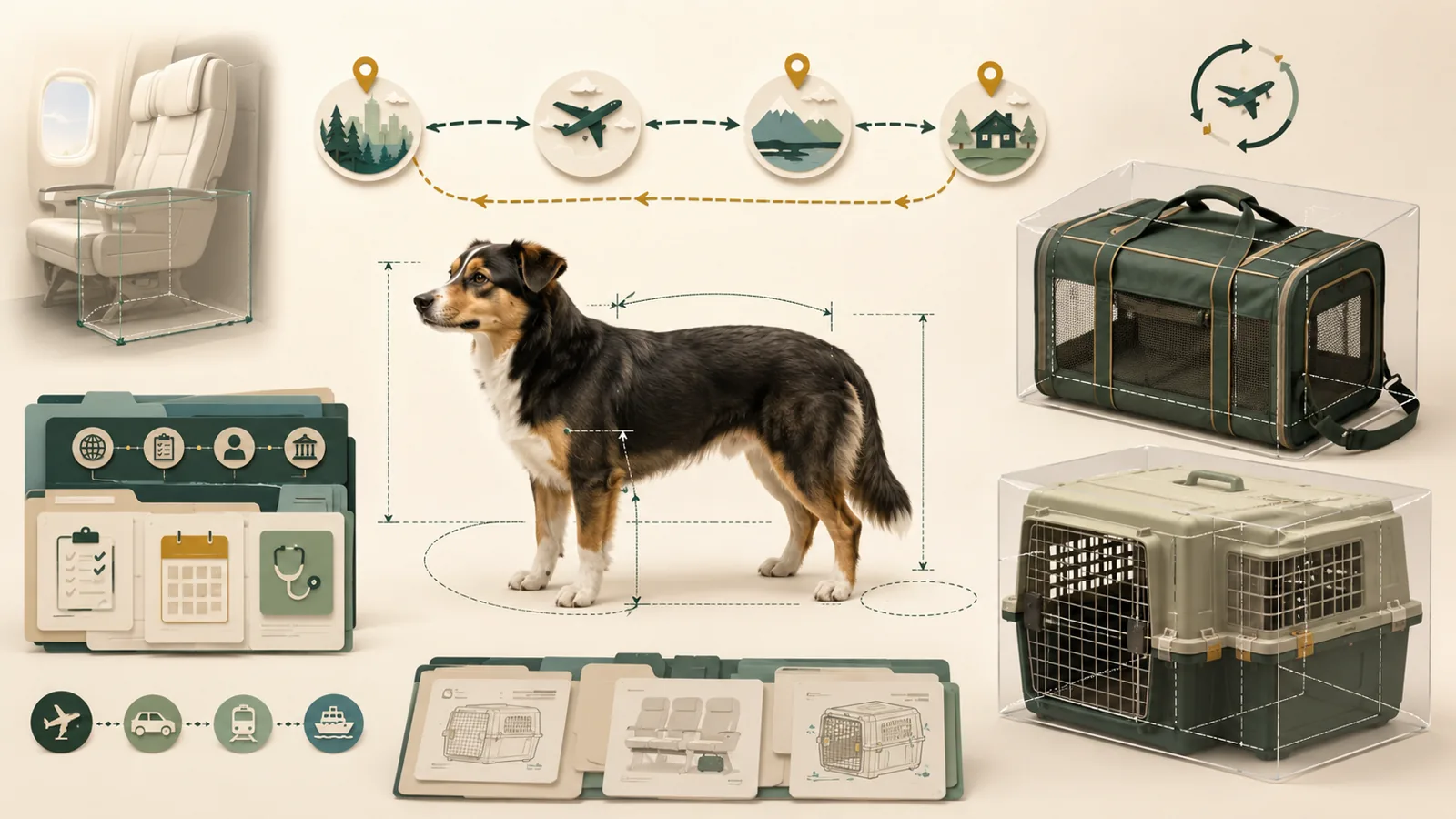
A carrier is suitable only when the dog fits inside it and the exact itinerary accepts its outside dimensions and construction. Start with measured standing, turning, sitting and lying space; then verify the operating airline, aircraft, seat or cargo path, route and date.
“Airline approved,” a manufacturer weight range, or a size that matches one generic airline page does not guarantee check-in acceptance. A route or aircraft change can invalidate an earlier match.
On smaller screens, scroll the table horizontally.
| Situation | Immediate route | Do not assume |
|---|---|---|
| Mode or operating carrier unknown | Stop and freeze the itinerary | A generic cabin carrier will be accepted |
| Dog cannot move naturally inside | Choose a larger carrier or different plan | Weight rating proves fit |
| Carrier exceeds exact flight limit | Change carrier, seat, flight or mode | Soft walls may be crushed around the dog |
| Cargo construction incomplete | Do not present it for cargo acceptance | An accessory kit repairs every rule |
| All documentation fields complete but unobserved | Run direct fit and final recheck | Documentation equals a safe trip |
The strongest result here is a conditional documentation match; no carrier was tested with a dog or accepted by an airline.
Key facts
On smaller screens, scroll the table horizontally.
| Field | Details |
|---|---|
| Evidence basis | Current government, standards, airline and manufacturer documentation plus a reproducible fit-routing method. |
| Access | Documentation only; no carrier, dog, booking, aircraft, cargo facility or checkpoint was observed. |
| Checked | August 22, 2026, for a United States dog-travel context. |
| Main limitation | No qualified specialist reviewed individual-dog fitness, stress, brachycephalic risk, temperature or welfare. |
The strongest result here is a conditional documentation match; no carrier was tested with a dog or accepted by an airline.
Who this guide may help – and who should stop
May help
- A dog owner comparing cabin and checked/cargo carrier architecture before booking.
- A traveler with exact dog measurements who will verify every operating segment.
- A buyer who treats unknown airline, route and fit fields as blockers.
Stop or use qualified help
- The dog has a respiratory, mobility, health, stress or temperature concern.
- A brachycephalic or airline-restricted dog lacks qualified route review.
- The operating carrier, aircraft, seat, cargo path or pet reservation is not fixed.
- The dog cannot stand, turn, sit erect and lie naturally in the exact carrier.
Start with the transport job
“Pet carrier” covers different jobs. A cabin carrier must fit under the exact seat while the dog remains fully contained. A checked or cargo kennel uses a rigid construction and handling workflow. A road carrier has different restraint and climate questions.
On smaller screens, scroll the table horizontally.
| Mode | External gate | Additional controls |
|---|---|---|
| In cabin | Exact under-seat or airline acceptance envelope | Combined weight, leak-proof floor, ventilation, secure checkpoint handling |
| Checked baggage | Exact airline, aircraft and destination acceptance | Rigid enclosure, hardware, bowls, labels, weather and handling |
| Manifest cargo | Cargo facility, aircraft and shipper acceptance | Cargo booking, construction, documents, collection and disruption plan |
| Ground only | Vehicle placement and restraint | Ventilation, climate and stop plan; vehicle-restraint evidence is separate |
Do not buy the carrier before the transport mode and operating carrier are known.
Measure the dog and preserve natural movement
IATA’s current traveler guidance uses A from nose to tail root, B from ground to elbow, C across the shoulders or widest point, and D from the floor to the head or ear tips in a natural stance. Its one-animal starting formula is A + half B for length, two times C for width, and D plus bedding for height. The retained guidance adds 10% for snub-nosed breeds.
The formula is a starting envelope, not a substitute for observation. The dog must still stand, turn, sit erect and lie naturally. A weight limit cannot prove those movements.
On smaller screens, scroll the table horizontally.
| Field | Record | Failure condition |
|---|---|---|
| A, B, C and D | Measure the current dog | Any missing or stale dimension |
| Bedding | Measure compressed travel thickness | Height calculated without bedding |
| Weight | Dog plus exact carrier | Combined rule unknown or exceeded |
| Natural movement | Observe stand, turn, sit and lie without force | Excessive contact or inability to reposition |
| High-risk review | Record qualified route when material | Health/welfare question unresolved |
Internal dimensions control the dog’s space; exterior dimensions control the itinerary. Both must pass.
Cabin carrier checks
Cabin rules are not universal. American retains an 18 × 11 × 11 inch soft-sided reference and different hard-sided limits for mainline and regional aircraft. Delta recommends 18 × 11 × 11 inches for most aircraft but says the exact aircraft determines the under-seat space. Southwest publishes 18.5 × 13.5 × 9.5 inches for another carrier. JetBlue’s retained pet record uses a different envelope.
On smaller screens, scroll the table horizontally.
| Airline path | Retained field | Qualification |
|---|---|---|
| American soft-sided | 18 × 11 × 11 in | Aircraft, cabin, regional and hard-sided limits differ |
| Delta recommendation | 18 × 11 × 11 in | Exact aircraft under-seat space controls |
| Southwest other carrier | 18.5 × 13.5 × 9.5 in | Dog must remain fully inside and able to move |
| JetBlue retained pet path | 17 × 12.5 × 8.5 in | Recheck exact current flight and policy |
A permitted soft carrier may compress within its design, but it should not be crushed around the dog or used to evade natural-movement requirements. Confirm the pet reservation separately from the passenger ticket.
Checked and cargo kennel checks
USDA’s current air-travel lessons and exact airline/cargo rules add construction and handling controls that a cabin bag does not answer. A rigid-looking shell is not automatically ready.
On smaller screens, scroll the table horizontally.
| Control | Documentation question | Stop condition |
|---|---|---|
| Rigid construction | Is the exact shell and fastener system accepted? | Soft, damaged or prohibited construction |
| Door and hardware | Does the carrier require metal door/hardware? | Current requirement not met |
| Ventilation | Are required sides and openings clear? | Coverage insufficient |
| Handles and protrusion | Can handlers lift without contact; is dog contained? | Weak handle or protrusion risk |
| Bowls/absorbent material | Can required setup be reached without opening? | Required setup missing |
| Labels/routing pouch | Are live-animal, upright, owner and route records current? | Missing or stale route data |
| Wheels | Removed or disabled when required | Kennel can roll during handling |
Construction must match the current operating carrier and route; “meets most requirements” is not acceptance.
Verify the exact operating airline, aircraft and reservation
Codeshare itineraries can display one marketing carrier while another airline operates the segment. The operator’s policy, aircraft, seat, cabin and destination restrictions control that leg. A flight-number, aircraft, seat or partner change can reopen the carrier decision.
Record the operating airline for every leg, transport mode, pet reservation, aircraft, seat or cargo facility, carrier envelope, combined-weight rule, breed/temperature restrictions, check-in point, fee and disruption instructions with an absolute checked date.
Plan the United States security checkpoint
TSA’s current process requires pets to be removed while the empty carrier is screened. The checkpoint plan is therefore part of carrier suitability, especially for an escape-prone or difficult-to-handle dog.
Use secure handling appropriate to the dog, follow officer instructions and ask about private screening when needed and available. The carrier should open and close reliably without exposing the dog longer than necessary. No checkpoint workflow was tested.
What the three exact examples can – and cannot – show
The examples demonstrate different evidence problems; they are not a shortlist or ranking.
On smaller screens, scroll the table horizontally.
| Carrier | Documented architecture | Material unknown |
|---|---|---|
| Sleepypod Air | Soft, compressible cabin carrier; 16–22 × 10.5 × 10.5 in exterior; 15–21 × 9.5 × 9.5 in interior | Exact dog movement and exact-flight compression/acceptance |
| Petmate See & Extend | Soft carrier; 18 × 11 × 11 in exterior; manufacturer says up to 15 lb | Internal dimensions and direct dog fit |
| Petmate Sky Kennel 28 | Rigid kennel; 28 × 20.5 × 21.5 in exterior; 24.25 × 18.25 × 19.5 in interior | Current airline, aircraft, hardware and route acceptance |
Sleepypod’s “airline approved” wording, Petmate’s “meets most” wording and a product weight range remain manufacturer statements. Each must be reconciled with the itinerary and dog.
Count ownership and disruption costs without false precision
Carrier price alone is not a fair travel-cost comparison. The exact transaction can add shipping, tax, replacement hardware, bedding, bowls, airline pet fees, cargo handlers, veterinary work, certificates, permits, quarantine, ground transport, delay and rebooking.
On smaller screens, scroll the table horizontally.
| Cost field | Status here | Buyer treatment |
|---|---|---|
| Carrier purchase | Not normalized | Verify seller, model, amount and date |
| Airline/cargo fee | Route-specific unknown | Confirm with pet reservation |
| Veterinary/documents | Route-specific unknown | Use exact route-research timeline |
| Hardware/accessories | Candidate-specific unknown | List only when required |
| Disruption/rebooking | Unknown | Keep contingency rather than zero |
| Tax/shipping | Transaction-specific unknown | Never insert zero |
An unknown required cost makes the complete required total unavailable.
A route change can invalidate the carrier
Reopen the record after any change to date, flight, operating carrier, aircraft, cabin, seat, transit, destination, mode, pet reservation, dog size/health or carrier configuration. A carrier that fits one segment may not fit its replacement.
A separate exact-route workflow must verify government, transit and return requirements. A carrier match never creates destination permission.
Stop gates before purchase or travel
On smaller screens, scroll the table horizontally.
| Stop gate | Why it blocks | Unblock record |
|---|---|---|
| Mode or route undefined | External and construction criteria are unknown | Frozen itinerary and mode |
| Dog internal fit failed | Natural movement space is insufficient | Different carrier or plan |
| Exact flight limit unknown | Generic dimensions may not apply | Operator/aircraft/seat confirmation |
| Cargo controls incomplete | Handling construction unresolved | Exact airline/cargo inspection record |
| High-risk review incomplete | Consequences exceed this guide | Qualified review and current airline rule |
| Pet reservation unconfirmed | Passenger ticket is insufficient | Current confirmation |
| Material unknown rejected | Method cannot turn unknown into pass | Resolve or change plan |
| Final recheck missing | Policy or itinerary may have changed | Dated final review |
A no-go result is useful: it prevents a documentation gap from being mislabeled as fit.
Final decision by scenario
On smaller screens, scroll the table horizontally.
| Buyer scenario | Documentation route | Current boundary |
|---|---|---|
| Small dog in cabin | Measure dog, exact airline/aircraft/seat, combined weight, checkpoint and reservation | Conditional until direct fit, final recheck and specialist boundary pass |
| Large dog in checked/cargo | Exact rigid kennel, aircraft/cargo path, hardware, route, weather and handling | Conditional; many airlines/routes may not accept this mode |
| Brachycephalic or high-risk dog | Current airline restriction plus qualified veterinary/welfare review | Stop until review and route rules pass |
| Codeshare itinerary | Resolve every operating carrier and segment | Stop while any operator/aircraft is unknown |
| Changing itinerary | Reopen affected rules and reservation | Prior carrier match is stale |
| No option fits both envelopes | Change flight, mode or travel plan | Do not force a product into a failed envelope |
No scenario creates a universal product winner; the route and dog determine which candidates remain possible.
How the carrier-fit method works
The versioned method applies the sitewide research and evaluation method. It computes an IATA-style minimum internal envelope, then checks movement, construction, cabin dimensions or cargo controls, combined weight, route, operating carrier, aircraft, checkpoint plan, breed/temperature review, unknowns, specialist review, direct observation and final recheck.
Sixteen regression cases, 20 invalid-input cases and 500 deterministic property cases verify routing and unknown-not-pass behavior. They are not carrier tests, airline confirmations or veterinary reviews. The method never outputs a score, ranking, legal clearance or acceptance guarantee.
Evidence limits
- No carrier was bought, measured, loaded, compressed, checked in or transported.
- No dog participated in fit, checkpoint, flight, cargo or welfare observation.
- No airline, airport, TSA officer, cargo handler, USDA official or destination authority reviewed the article.
- No veterinarian or animal-transport/welfare specialist reviewed an individual dog or the conclusions.
- Prices and fees were not normalized for public display.
- Airline, aircraft, seat, route and product rules can change after the checked date.
Sources
- USDA APHIS – Travel With a Pet. Checked 2026-07-28. United States federal starting point; not airline acceptance, individual-dog fitness, or route-specific clearance.
- USDA APHIS – Pets on Planes Lesson 1: Preparing and Receiving Pets for Air Travel. Checked 2026-07-28. Kennel, document, age, breed and readiness framework; exact airline, itinerary and dog still control.
- USDA APHIS – Pets on Planes Lesson 2: Care and Handling During Air Travel. Checked 2026-07-28. Handling and temperature framework within its scope; not a specific-flight guarantee.
- USDA APHIS – Transporting Animals in Commerce. Checked 2026-07-28. Explains AWA transport scope; owner-custody travel can fall outside parts of that scope.
- IATA – Traveler’s Pet Corner. Checked 2026-07-28. Container measurement and industry guidance; airline and government variations remain controlling.
- TSA – TSA Travel Tips. Checked 2026-07-28. United States security-screening workflow; not airline acceptance or international-entry guidance.
- CDC – Bringing a Dog into the United States. Checked 2026-07-28. Dog-entry and return context; not carrier fit or airline acceptance.
- USDA APHIS – USDA-Accredited Veterinarians: Certifying Animals for International Travel. Checked 2026-07-28. Certification workflow; no accredited veterinarian reviewed this package.
- eCFR – 9 CFR § 3.15 Primary Enclosures Used to Transport Live Dogs and Cats. Checked 2026-07-28. Federal rule within its legal scope; not a universal private-traveler or airline rule.
- eCFR – 9 CFR § 3.17 Food and Water Requirements. Checked 2026-07-28. Food and water rule within its scope; route-specific instructions can differ.
- American Airlines – Pets – Travel Information. Checked 2026-07-28. Rules can vary by aircraft, cabin, route, destination and operating partner.
- American Airlines – Optional Service Fees. Checked 2026-07-28. Current fee display only; eligibility, route and transaction can change.
- Delta Air Lines – Pet Travel Overview. Checked 2026-07-28. General recommendation; exact aircraft under-seat space and reservation control.
- Delta Air Lines – International and Connection Pet Travel. Checked 2026-07-28. Connection and route restrictions; government and operating-partner rules remain separate.
- Southwest Airlines – Pet Policy. Checked 2026-07-28. Current Southwest cabin policy; route and operational restrictions require final recheck.
- Southwest Airlines – What Type of Pet Carriers Can I Bring?. Checked 2026-07-28. Published dimensions and movement conditions; check-in acceptance remains transaction-specific.
- Southwest Airlines – Traveling With Pets – Airport Information. Checked 2026-07-28. Southwest airport process; TSA and jurisdiction rules remain separate.
- JetBlue – Traveling With Pets. Checked 2026-07-28. JetBlue-operated flight policy; aircraft, partner and route can change.
- JetBlue – Carry-On Bags. Checked 2026-07-28. Carry-on context; the dedicated pet policy remains controlling.
- Alaska Airlines – Travel With Pets. Checked 2026-07-28. Current Alaska-operated itinerary context; fleet, partner and destination restrictions can differ.
- Alaska Airlines – Travel Advisories. Checked 2026-07-28. Dated operational or temperature restrictions; not a stable year-round rule.
- Sleepypod – Sleepypod Air. Checked 2026-07-28. Manufacturer dimensions and marketing; not dog-fit observation or airline acceptance.
- Sleepypod – Sizing Guide. Checked 2026-07-28. Manufacturer sizing context; direct fit and exact-flight confirmation remain required.
- Petmate – Petmate See & Extend Carrier. Checked 2026-07-28. Manufacturer exterior dimensions and weight range; internal dog fit not observed.
- Petmate – Petmate Sky Kennel. Checked 2026-07-28. Manufacturer says most airline requirements; exact route, airline and hardware acceptance remain unobserved.
- Petmate – Petmate Airline Travel Kit. Checked 2026-07-28. Accessory contents do not establish that the kennel or itinerary is accepted.
- Sherpa – Sherpa Ultimate on Wheels Carrier. Checked 2026-07-28. Marketing and product data; “airline approved” is not blanket acceptance.
- Pet Signal Guide – How We Research and Evaluate Pet Technology. Checked 2026-07-28. Sitewide evidence method; not carrier, dog, airline or route evidence.
- Pet Signal Guide – How Pet Location Technologies Work. Checked 2026-07-28. Location-technology context; not a carrier or travel rule.
- Pet Signal Guide – Alternatives to a Pet GPS Tracker. Checked 2026-07-28. Recovery-layer context; not carrier fit or travel permission.